

Have you ever picked up a prescription and noticed the pill looks exactly like your brand-name medication-but the box says something completely different? Maybe it’s labeled "colchicine" instead of "Colcrys," or "methylphenidate ER" instead of "Concerta." If you’ve seen this and wondered what’s going on, you’re not alone. These are authorized generics-and they’re more common than you think.
What Exactly Is an Authorized Generic?
An authorized generic is the exact same drug as the brand-name version, down to the last ingredient. It’s made by the same company, in the same factory, using the same formula. The only differences? It doesn’t carry the brand name on the label, and sometimes the pill looks slightly different-maybe a different color or imprint. Otherwise, it’s identical in strength, dosage, how it works, and how your body reacts to it. The U.S. Food and Drug Administration (FDA) defines it clearly: an authorized generic is an approved brand-name drug sold without the brand name on the label. That’s it. No extra testing. No changes to the formula. No shortcuts. It’s the same product, just packaged differently. This isn’t a generic version created by another company trying to copy the drug. This is the original manufacturer selling their own product under a different label. Think of it like a car company making the exact same model but selling it under a cheaper dealership name.How Are Authorized Generics Different From Regular Generics?
This is where things get confusing. Most people think all generics are the same. They’re not. Regular generic drugs are made by other companies after the brand-name patent expires. To get approved, they have to prove they’re bioequivalent-meaning they work the same way in your body. But they can use different inactive ingredients. That means the filler, dye, or coating might be different. For most people, that doesn’t matter. But for some, those differences can cause reactions-like stomach upset or allergic responses to a dye or preservative. Authorized generics don’t have that issue. Because they’re made by the brand company using the same formula, they have the exact same inactive ingredients. If you’ve had no problems with your brand-name drug, you won’t have any with its authorized generic. There’s another big difference: paperwork. Regular generics go through a long approval process called an ANDA (Abbreviated New Drug Application). Authorized generics? They don’t need one. Since they’re already approved under the brand’s original NDA (New Drug Application), the manufacturer just needs to notify the FDA they’re launching it. That makes them faster to bring to market. And here’s something most people don’t know: authorized generics don’t show up in the FDA’s Orange Book-the official list of approved generic drugs. That’s because they’re not considered "generic" under the regulatory system. They’re still the brand product, just unlabeled.Why Do Drug Companies Make Authorized Generics?
It sounds strange: why would a company that just spent millions developing a drug turn around and sell a cheaper version of it? The answer is business strategy. When a brand-name drug’s patent is about to expire, other companies start preparing to launch their own generics. The first one to file often gets 180 days of exclusive rights to sell the generic-meaning no other generic can enter the market during that time. That’s a huge financial advantage. To protect their market share, brand companies sometimes launch their own authorized generic right before or during that 180-day window. Now, instead of losing all their customers to one competitor, they split the market. They keep some of the sales, and the other generic company still gets their exclusivity period. A 2022 study published in Health Affairs found that between 2010 and 2019, there were 854 authorized generic launches. In 75% of cases, the authorized generic came out after the first generic had already entered the market. That’s not an accident. It’s a tactic. It’s not always about undercutting competition. Sometimes, it’s about keeping pharmacy benefit managers (PBMs) and insurers happy. If a brand company offers a lower-priced version, insurers are more likely to keep covering the drug instead of switching to a different one entirely.What Do Authorized Generics Cost?
Prices vary. Authorized generics are almost always cheaper than the brand-name version-sometimes by 20% to 30%. But they’re usually more expensive than traditional generics that come later, especially when multiple companies start making the same drug. For example, if you’re paying $150 a month for the brand-name drug Celebrex, the authorized generic might cost $110. But once three or four other generic makers enter the market, the price could drop to $30 or less. So, timing matters. If you get your prescription filled right after the authorized generic launches, you might save money. But if you wait a few months, you might save even more.
Examples of Authorized Generics
You’ve probably taken one without realizing it. Here are a few common ones:- Colcrys (brand) → Colchicine (authorized generic by Prasco Laboratories)
- Concerta (brand) → Methylphenidate ER (authorized generic by Watson/Actavis)
- Celebrex (brand) → Celecoxib (authorized generic by Greenstone Pharmaceuticals)
- Unithroid (brand) → Levothyroxine (authorized generic by Jerome Stevens Pharmaceuticals)
What Should Patients Know?
Most patients never notice the difference. But sometimes, you’ll get a pill that looks unfamiliar. That’s normal. The authorized generic might be a different color or shape. But it’s not a different drug. Some people get nervous when their medication changes-even if it’s the same thing. If that happens, talk to your pharmacist. They can confirm it’s an authorized generic and explain why it looks different. Also, don’t assume your insurance will automatically switch you to the cheaper version. Some plans still default to the brand name unless you specifically ask for the generic. Always check your receipt. If you’re paying more than you expected, ask why.Are Authorized Generics Safe?
Absolutely. Since they’re made by the same company, using the same process and ingredients, they’re as safe as the brand-name drug. The FDA treats them as identical. No extra risk. In fact, for people who’ve had bad reactions to traditional generics-like allergies to dyes or fillers-authorized generics can be a lifesaver. Because they’re chemically identical, they eliminate that variable.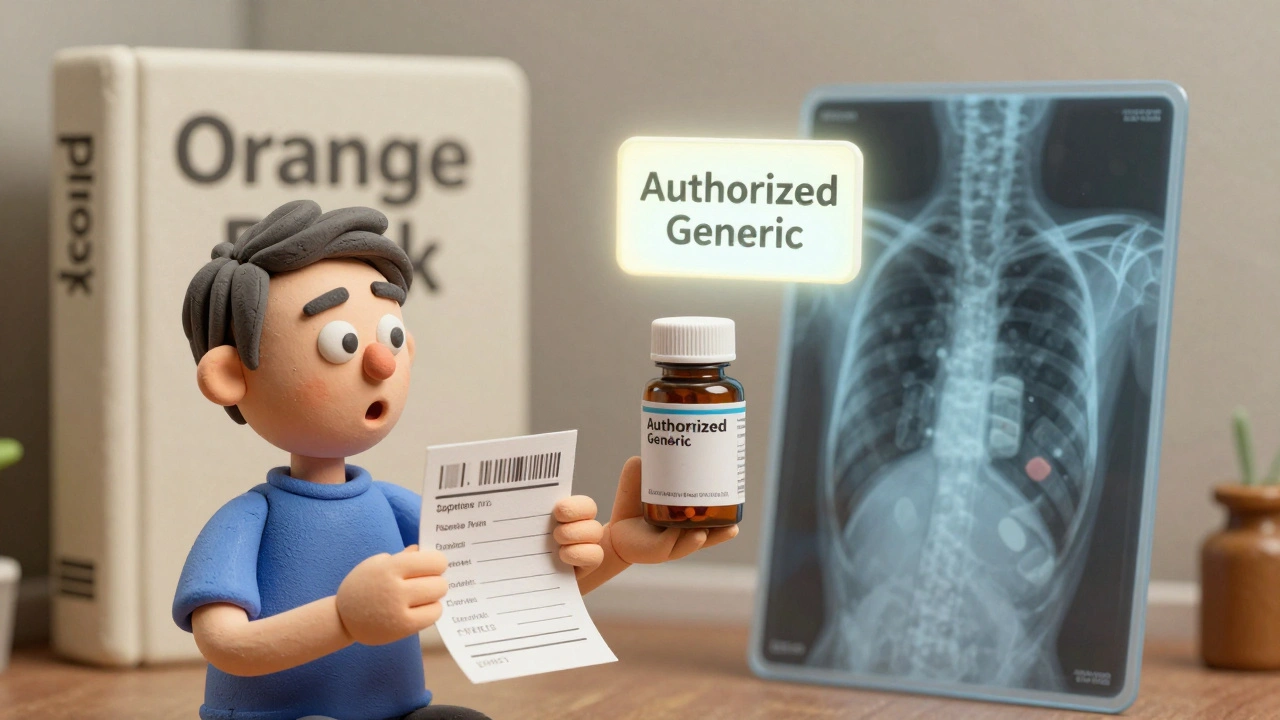
What’s the Catch?
The main downside? They’re not always the cheapest option. If you’re willing to wait a few months after a brand-name drug goes generic, you’ll likely find a traditional generic that costs far less. Also, because authorized generics aren’t listed in the Orange Book, they’re harder to track. Pharmacists and doctors have to rely on manufacturer notifications or direct communication to know when they’re available. That means you might not hear about them unless you ask. And yes, some critics argue they’re a way for big pharma to delay true competition. By launching their own generic, they keep control over pricing and market share. It’s not evil-it’s business. But it’s worth understanding so you can make informed choices.How to Find Out If Your Drug Has an Authorized Generic
Here’s how to check:- Look at your prescription. Write down the exact drug name and dosage.
- Ask your pharmacist: "Is there an authorized generic for this?" They have access to databases that track these.
- Visit the FDA’s website and search for their "List of Authorized Generic Drugs." It’s updated periodically.
- Use drug pricing apps like GoodRx-they often show authorized generics alongside traditional ones.
Bottom Line: Should You Switch?
If you’re paying full price for a brand-name drug and an authorized generic is available, it’s almost always worth switching. You’ll get the exact same medicine at a lower cost. But if you’re already on a traditional generic and it’s working fine, there’s no need to change. Unless you’re having side effects from the inactive ingredients, stick with what you’ve got. The key is awareness. Authorized generics aren’t a secret. They’re a tool-used by manufacturers, covered by insurers, and available to you. Knowing they exist gives you more control over your healthcare costs.Are authorized generics the same as brand-name drugs?
Yes. Authorized generics are made by the same manufacturer, in the same facility, using the exact same active and inactive ingredients as the brand-name drug. The only differences are the label and sometimes the pill’s color or shape. They are therapeutically identical.
Why are authorized generics cheaper than brand-name drugs?
They’re cheaper because they don’t carry the marketing, advertising, and research costs associated with the brand name. The manufacturer saves money by selling without the brand label, and those savings are passed on to consumers. However, they’re often more expensive than traditional generics that enter the market later.
Do authorized generics show up in the FDA’s Orange Book?
No. Authorized generics are not listed in the FDA’s Orange Book because they are not approved under the Abbreviated New Drug Application (ANDA) process. Instead, they’re marketed under the original brand’s New Drug Application (NDA), which means they’re considered the same product as the brand-name drug, just unlabeled.
Can I trust an authorized generic if it looks different from my brand-name pill?
Yes. Changes in color, shape, or imprint are common with authorized generics because the manufacturer must distinguish them from the branded version. But the active ingredient, dosage, strength, and formulation are identical. Always confirm with your pharmacist if you’re unsure.
Are authorized generics available for all brand-name drugs?
No. Only brand-name manufacturers choose to launch an authorized generic, usually when a patent is about to expire. It’s a business decision, not a requirement. Some drugs have them; others don’t. Always ask your pharmacist or check the FDA’s official list.
Benjamin Sedler
December 5, 2025 AT 12:55Okay but let’s be real-this whole ‘authorized generic’ thing is just Big Pharma’s way of saying ‘we’re not gonna let you win, even when we’re supposed to lose.’ They make the exact same pill, slap a new label on it, and act like they’re doing you a favor. Meanwhile, your co-pay drops from $150 to $110 and they’re still laughing all the way to the bank. 🤡
Gareth Storer
December 7, 2025 AT 11:52So let me get this straight-the FDA doesn’t even list these things? That’s like a restaurant serving the exact same steak as their $40 dish but calling it ‘House Cut’ and charging $25… then refusing to put it on the menu. Genius. Or just shady. Hard to tell anymore.
Pavan Kankala
December 7, 2025 AT 14:57Authorized generics? More like authorized monopolies. The system’s rigged. The same companies that charge you $200 for a pill then ‘generically’ sell it to you for $110 are the same ones lobbying Congress to block real generics. This isn’t healthcare-it’s a pyramid scheme with pills. And we’re all the suckers at the bottom.
They don’t want competition. They want you to think you’re saving money while they control the entire pipeline. Wake up. The ‘authorized’ part means ‘approved by the people who already own you.’
Jessica Baydowicz
December 8, 2025 AT 01:06OMG I had NO IDEA about this!! I just switched my Concerta to the methylphenidate ER and saved $90 a month-my cat is now living like a queen 🐱💸 THANK YOU for explaining this so clearly!! I told my whole book club and now we’re all checking our prescriptions. Knowledge is power!!
Yasmine Hajar
December 9, 2025 AT 06:11As someone who’s had allergic reactions to dye in regular generics, I can’t tell you how much this means. My doctor never mentioned authorized generics-my pharmacist did. I cried when I realized I could finally take my meds without my skin breaking out. This isn’t just about money. It’s about dignity. Thank you for writing this.
Karl Barrett
December 9, 2025 AT 11:30From a pharmacoeconomic standpoint, the authorized generic represents a strategic Pareto-optimal outcome for manufacturer-market dynamics: it internalizes the externality of patent expiry by preemptively cannibalizing the brand’s own market share while preserving margin integrity. The absence of ANDA submission reduces regulatory latency, allowing for rapid market penetration during the 180-day exclusivity window. However, the opacity of their listing in the Orange Book introduces information asymmetry, which disproportionately affects vulnerable patient populations lacking pharmacy literacy.
Jake Deeds
December 10, 2025 AT 14:20I mean… I just don’t understand how people can be okay with this. You’re literally trusting your body to a pill that’s been repackaged by a corporation that’s already proven it doesn’t care about you. If you’re not outraged, you’re not paying attention. This isn’t ‘smart shopping’-it’s surrender.
And don’t get me started on how they make the pills look different just to make you feel like you’re taking something ‘new.’ It’s psychological manipulation. They want you to doubt yourself. Don’t let them.
Elizabeth Crutchfield
December 11, 2025 AT 02:52i just got my celebrex generic and was like… wait this looks different?? i thought it was the same?? now i feel like a dummy lol
Ben Choy
December 12, 2025 AT 02:35Just asked my pharmacist about my levothyroxine-turns out the authorized generic is $12 vs $85 for the brand. I’m switching tomorrow. 😊 Seriously, if you’re on any of these meds, just ask. It’s so easy. And your wallet will thank you.
Chad Handy
December 12, 2025 AT 07:36Look, I’ve been on the same meds for 14 years. I’ve seen every generic, every brand, every ‘special formulation,’ every ‘new delivery system.’ I’ve paid $200, $75, $15, $3. I’ve had panic attacks because the pill looked different. I’ve called my doctor at midnight. I’ve cried in pharmacy parking lots. I’ve spent hours on the phone with insurance. I’ve been lied to. I’ve been ignored. I’ve been gaslit into thinking I was ‘overreacting.’ And now you tell me there’s a version that’s literally identical? And no one told me? And I had to figure it out myself? This system is broken. Not just flawed. Broken. And it’s not about money anymore. It’s about trust. And we’ve lost it all.
Jenny Rogers
December 12, 2025 AT 19:34It is imperative to note that the utilization of authorized generics constitutes a regulatory loophole that undermines the foundational principles of the Hatch-Waxman Act. By permitting the original manufacturer to circumvent the ANDA process, the FDA effectively sanctions a form of market manipulation under the guise of consumer benefit. This practice, while technically legal, is ethically indefensible and necessitates immediate congressional review.
Scott van Haastrecht
December 14, 2025 AT 01:19Authorized generics are a trap. They’re the pharma industry’s version of a Trojan horse. You think you’re getting a deal, but you’re just helping them delay real competition. The moment you switch, you’re giving them legitimacy. They’re not your ally. They’re your enemy wearing a white coat.
And don’t let anyone tell you it’s ‘safe.’ Safety is a marketing term they invented after the opioid crisis. If you want real safety, demand real generics-made by companies that didn’t invent the brand in the first place.
Chase Brittingham
December 15, 2025 AT 15:29I just want to say thank you for writing this. I’ve been scared to switch my meds for years because I didn’t know what was going on. This cleared everything up. I’m going to my pharmacist tomorrow and asking for the authorized generic. No more overpaying.
Bill Wolfe
December 17, 2025 AT 04:28Let’s be honest-most people don’t care. They just want the cheapest thing, and they don’t understand the difference between bioequivalence and chemical identity. The fact that you even bothered to explain this means you’re probably the 0.1% who actually reads the fine print. The rest? They’ll take whatever the insurance gives them, even if it’s made by a company that doesn’t even have a website. Sad, but true.
And don’t get me started on GoodRx. It’s a beautiful tool… until you realize they’re just middlemen profiting off your ignorance. The real power is in knowing what’s inside the pill. Not the price tag.