
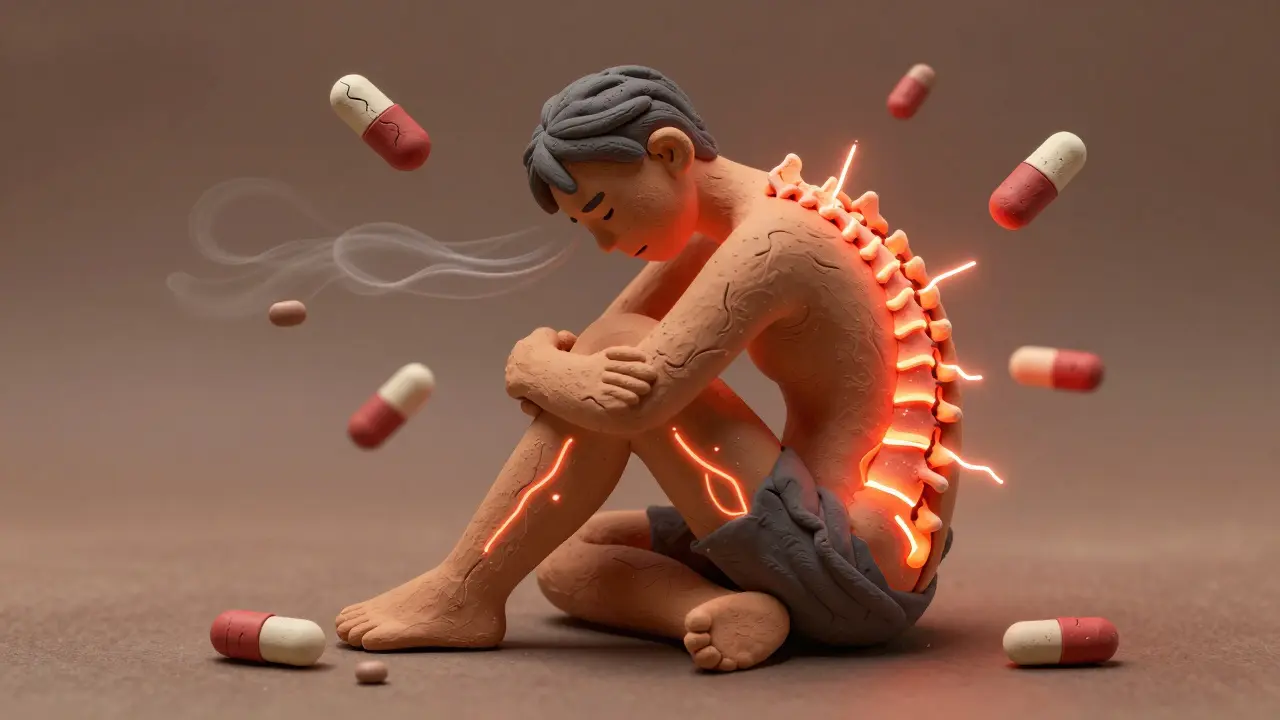
For years, doctors reached for opioids when pain wouldn’t quit. But for some patients, the more opioids they took, the worse their pain became. It didn’t make sense-until they learned about opioid-induced hyperalgesia, or OIH. This isn’t tolerance. It’s not addiction. It’s your nervous system turning against you, making even light touches feel like fire. And it’s more common than most clinicians realize.
What Exactly Is Opioid-Induced Hyperalgesia?
Opioid-induced hyperalgesia happens when long-term opioid use makes your body more sensitive to pain-not less. Instead of calming your nerves, the drugs start overstimulating them. You might notice your original pain spreading-like a backache now radiating into your legs or hips. Or maybe a gentle hug, a breeze, or even a light touch on your skin now hurts. That’s allodynia, a hallmark of OIH.
This isn’t rare. Studies show 2% to 15% of people on long-term opioids develop it. In some clinics, up to 30% of patients thought to have “tolerance” actually have OIH. The key difference? With tolerance, you need higher doses to get the same pain relief. With OIH, higher doses make the pain worse.
OIH can show up after just 2 to 8 weeks of steady opioid use. It’s more likely if you’re on high doses-especially over 300 mg of morphine per day-or if you have kidney problems. That’s because metabolites like morphine-3-glucuronide build up and directly irritate nerve cells in your spinal cord.
How Is OIH Different From Tolerance or Withdrawal?
People often confuse OIH with tolerance or withdrawal. But they’re not the same.
- Tolerance: Your body adapts. The same dose doesn’t work as well. You need more to get relief. Pain doesn’t get worse-you just need a higher dose to keep it under control.
- Withdrawal: You feel sick when you miss a dose. Sweating, nausea, anxiety, muscle aches. These symptoms go away when you take the opioid again.
- OIH: Your pain gets worse when you take more opioids. It spreads beyond the original area. You might feel pain in places you never had it before. And if you reduce the dose, the pain improves-not gets worse.
Here’s a real example: A 58-year-old woman with chronic lower back pain was on 120 mg of oxycodone daily. After six months, her pain doubled. Her doctor increased her dose to 200 mg. Her pain got worse. Then 250 mg. Now she couldn’t sit without screaming. Her skin hurt if her pants brushed against it. She wasn’t addicted. She wasn’t withdrawing. She had OIH.
Why Does This Happen? The Science Behind the Pain
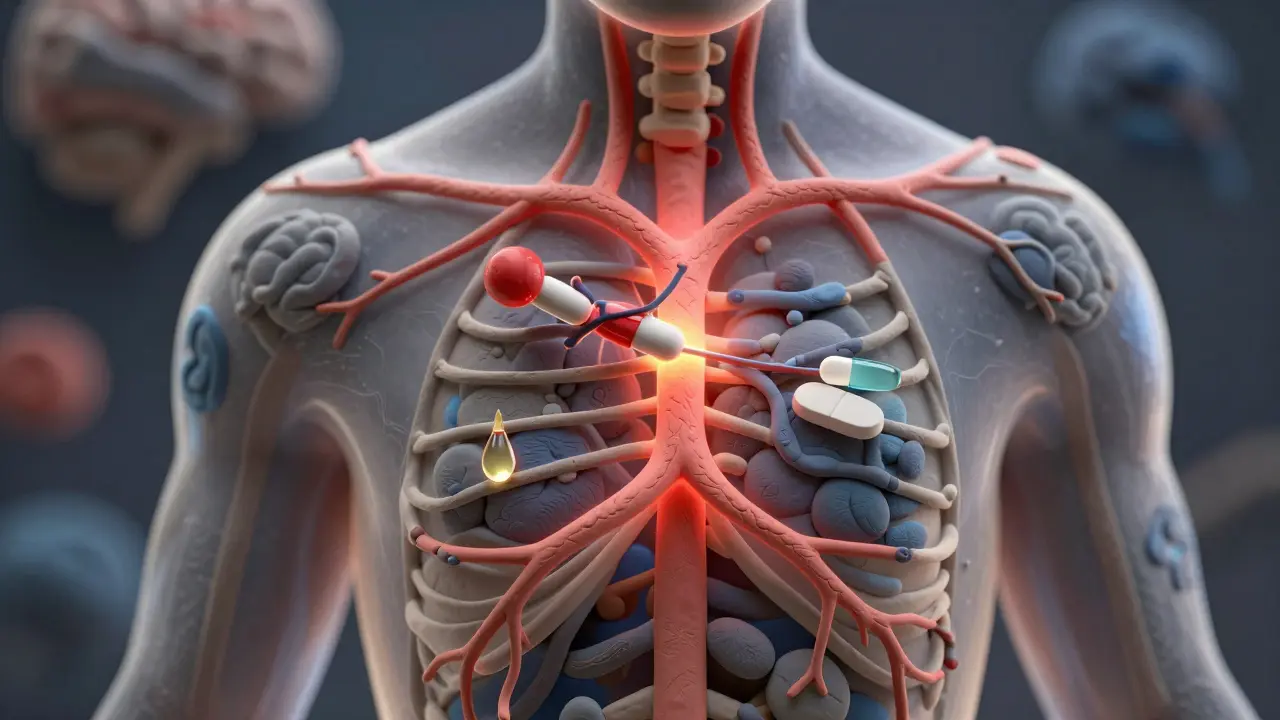
It’s not magic. It’s biology. Opioids bind to receptors in your brain and spinal cord to block pain signals. But over time, they also trigger other systems that do the opposite.
The biggest player is the NMDA receptor. When opioids activate it, your spinal cord neurons become hyper-excitable. Think of it like turning up the volume on your pain alarm system. Glutamate, a neurotransmitter, floods the area, making nerves fire more easily. That’s why drugs like ketamine-NMDA blockers-can reverse OIH.
Other mechanisms include:
- Increased dynorphin, a natural pain enhancer released in the spinal cord
- Activation of the rostral ventromedial medulla, a brain region that sends “pain boost” signals down the spine
- Genetic factors, especially variations in the COMT enzyme, which affects how your body processes pain signals
- Toxic opioid metabolites that directly irritate nerve cells
These changes aren’t just theoretical. Studies using quantitative sensory testing show that people with OIH have lower pain thresholds after taking opioids. Their skin becomes more sensitive to heat, pressure, and pinpricks. That’s measurable proof your nervous system has rewired itself.
How Do Doctors Diagnose OIH?
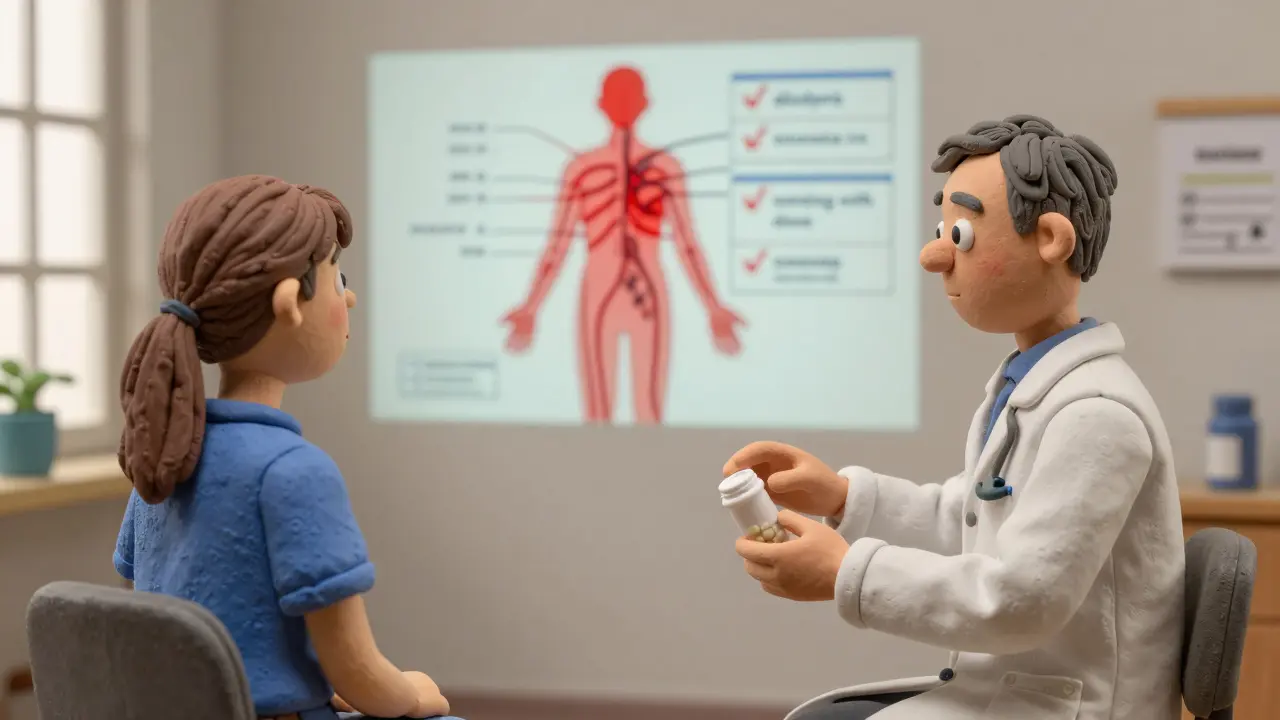
There’s no single blood test. No scan that shows it. Diagnosing OIH is like detective work.
Doctors look for these red flags:
- Pain worsening despite increasing opioid doses
- Pain spreading beyond the original site
- Allodynia-pain from non-painful stimuli
- No new injury or disease progression
- Improvement after reducing opioid dose
The Opioid-Induced Hyperalgesia Questionnaire (OIHQ), validated in 2017, helps. It’s an 8-item tool with 85% accuracy in spotting OIH. Questions include: “Has your pain become more widespread?” “Do you feel pain from things that never hurt before?” “Does increasing your opioid dose make your pain worse?”
But the real test? A careful dose reduction. If pain improves after lowering the opioid by 10-25%, OIH is likely. If pain spikes and you feel sick, it’s probably withdrawal.
How Is OIH Treated?
Stop increasing the dose. That’s the first rule. More opioids will only make it worse.
The most effective treatment? Reduce the opioid. Slowly. By 10-25% every 2-3 days. Most patients see improvement within 2-4 weeks. Full relief can take 4-8 weeks.
But reducing opioids isn’t easy. Many patients panic. They think they’ll be left in agony. That’s why support matters. Here’s what actually works:
- Switch opioids: Switching from morphine or hydromorphone to methadone helps. Methadone blocks NMDA receptors, which directly counters OIH. Buprenorphine is another good option-it has a ceiling effect and doesn’t trigger the same neurotoxic pathways.
- Add ketamine: Low-dose IV ketamine (0.1-0.5 mg/kg/hour) can reset the nervous system. Some clinics use nasal ketamine sprays for outpatient use. Results show pain scores dropping by 40-60% in weeks.
- Use clonidine: This blood pressure drug also calms overactive pain signals in the spinal cord. Dose: 0.1-0.3 mg twice daily.
- Try gabapentin or pregabalin: These drugs target nerve hypersensitivity. Doses range from 300-1,800 mg daily, split into three doses.
- Non-drug therapies: Physical therapy, cognitive behavioral therapy (CBT), and mindfulness reduce pain perception and help patients cope with the emotional toll of chronic pain.
One patient in Portland, on 200 mg of oxycodone daily, switched to methadone and added gabapentin. Within six weeks, her pain dropped from 9/10 to 3/10. She stopped needing emergency visits. She could sleep through the night.
Why Is OIH Often Missed?
Because it’s counterintuitive. Doctors are trained to fix pain with more painkillers. When pain gets worse, the reflex is to give more opioids. That’s the trap.
Also, there’s debate. Some experts, like Dr. Perry Fine, argue OIH is overdiagnosed. He points out that most human studies use experimental pain models-pinpricks and heat-on healthy volunteers. Real chronic pain is more complex.
But the evidence is mounting. The FDA now requires opioid labels to mention OIH as a possible side effect. The National Comprehensive Cancer Network includes OIH protocols in its 2024 pain guidelines. And 78% of pain fellowships now teach it.
Still, only 65% of pain specialists feel confident diagnosing it-up from 30% in 2010. The learning curve is real. It takes 6-12 months of experience with chronic pain patients to spot the patterns.
What’s Next for OIH?
Research is moving fast. The NIH is running a study (NCT05217891) looking for genetic markers that predict who’s at risk. Early results point to COMT gene variants. In 2025, two commercial genetic tests will launch to identify these risks before opioids are even prescribed.
Pharma companies are also racing to develop new drugs. Three NMDA-targeting compounds are in Phase II/III trials. One is a once-daily oral tablet designed to block OIH without sedation.
Even as opioid prescriptions drop 44% since 2016, over 10 million Americans still take them long-term. OIH won’t disappear. But with better awareness, it can be managed-without suffering.
What You Can Do
If you’re on opioids and your pain is getting worse:
- Don’t increase your dose on your own.
- Track your pain daily: intensity, location, triggers.
- Ask your doctor: “Could this be OIH?”
- Request the OIHQ questionnaire.
- Ask about alternatives: methadone, ketamine, gabapentin, CBT.
It’s not weakness to question opioids. It’s wisdom. OIH isn’t your fault. It’s a known biological response. And it’s treatable.
Is opioid-induced hyperalgesia the same as opioid tolerance?
No. Tolerance means you need higher doses to get the same pain relief. OIH means your pain gets worse when you take more opioids. With tolerance, pain stays in the same place. With OIH, pain spreads and becomes more sensitive to touch, heat, or pressure.
Can OIH happen with low-dose opioids?
Yes. While it’s more common with high doses-especially over 300 mg of morphine daily-it can occur at lower doses, especially in people with kidney issues or genetic risk factors. The key is duration: symptoms often appear after 2-8 weeks of continuous use.
Does stopping opioids cure OIH?
Not always-but tapering opioids usually helps. Many patients see improvement within 2-4 weeks of reducing their dose. Full recovery can take 4-8 weeks. Some need additional treatments like ketamine or gabapentin to calm the nervous system. Complete cessation isn’t always necessary; switching to a different opioid like methadone can be enough.
Can ketamine really reverse OIH?
Yes. Ketamine blocks NMDA receptors, which are overactive in OIH. Low-dose IV ketamine (0.1-0.5 mg/kg/hour) has been shown to reduce pain scores by 40-60% in clinical studies. Nasal ketamine sprays are now used in outpatient settings with similar results.
Why don’t more doctors know about OIH?
Because it’s counterintuitive. Doctors are trained to treat pain with opioids, not reduce them. Plus, OIH looks like tolerance or withdrawal. It takes experience to spot the subtle signs: spreading pain, allodynia, worsening with dose increases. Only 65% of pain specialists feel confident diagnosing it today-up from 30% in 2010.
Are there genetic tests for OIH risk?
Yes, but they’re not widely available yet. Research shows variations in the COMT gene affect how people process pain signals and respond to opioids. Two commercial genetic tests are expected to launch in early 2025 to identify high-risk patients before starting long-term opioid therapy.
Mindee Coulter
January 28, 2026 AT 23:04I’ve seen this firsthand with my mom. She was on oxycodone for years, then started screaming if her socks rubbed her feet. Doctor thought she was being dramatic. Turned out it was OIH. We tapered her down slow and now she’s on gabapentin and actually sleeps through the night. No more ER visits. Just goes to show - more meds ain’t always better.
Mark Alan
January 29, 2026 AT 11:08OMG YES 😭 I’ve been through this. My doc kept upping my fentanyl dose ‘cause I said I was in more pain. I was crying in the parking lot after every appointment. Then I found a pain specialist who actually listened. Switched to methadone. Pain dropped 70%. I didn’t need to be a zombie to feel human again. 🇺🇸
Anna Lou Chen
January 30, 2026 AT 10:38Let’s deconstruct this biosemiotic paradigm of nociceptive dysregulation. The opioid-NMDA feedback loop isn’t merely pharmacological - it’s an epistemological rupture in the phenomenology of suffering. We’re not treating pain, we’re negotiating the ontological collapse of the somatic self under neoliberal pharmaceutical hegemony. The real crisis isn’t OIH - it’s the medical industrial complex’s refusal to acknowledge that pain is not a signal, but a syntax of systemic failure.
fiona vaz
January 31, 2026 AT 07:23Great breakdown. I’m a nurse in a pain clinic and we use the OIHQ every time someone comes in with worsening pain on high doses. The ‘pain spreading’ question is the biggest red flag. Most patients don’t even realize their pain changed location until you ask. Simple tool, huge impact.
Lance Long
January 31, 2026 AT 09:20Hey - if you’re reading this and you’re scared to taper, I get it. I was there. But here’s the truth: your body isn’t broken. It’s just confused. OIH is your nervous system screaming ‘STOP!’ and we’ve been trained to ignore it. You don’t have to suffer to prove you’re strong. Slowing down isn’t quitting - it’s healing. One step at a time. You’ve got this.
Sue Latham
February 2, 2026 AT 01:15Wow. So you’re telling me the whole opioid epidemic was just… a giant misdiagnosis? Like, doctors didn’t know this? I mean, I’m not surprised - most of them still think ‘pain scale 1-10’ is a valid metric. But still. We’re paying billions for drugs that make people hurt more. And they wonder why people turn to street drugs. 🤦♀️
Linda O'neil
February 2, 2026 AT 02:05This is why I love working in integrative pain management. We don’t just reach for pills. We do acupuncture, yoga, breathwork, CBT - and yes, sometimes ketamine. One guy went from 300mg oxycodone to zero in 10 weeks. Now he’s hiking, playing guitar, sleeping. It’s not magic. It’s science. And it works. You don’t need opioids to live well.
Robert Cardoso
February 3, 2026 AT 04:37Let’s be real - 2% to 15%? That’s cherry-picked data. Most of these studies use experimental pain models on healthy college kids. Real chronic pain patients have comorbidities, depression, trauma, and yes - addiction. Calling every worsening pain case ‘OIH’ is just another way to avoid addressing the real issue: opioid misuse. Don’t pathologize the patient. Fix the system.
Kathy Scaman
February 4, 2026 AT 01:36My cousin went through this. She was on 150mg oxycodone, thought she was addicted. Her doctor said ‘just quit.’ She almost OD’d trying. Then she found a clinic that did slow taper + ketamine. Now she’s pain-free without opioids. It’s wild how little most docs know about this.
Howard Esakov
February 5, 2026 AT 19:23Of course OIH exists. But let’s not pretend this is some groundbreaking revelation. The NIH has known since the 90s. The problem? Pharma spent $2 billion lobbying to keep opioids on the shelf. Doctors were trained to prescribe. Now they’re too scared to taper. It’s not ignorance - it’s corruption. And yes, I’m calling it out.
Bryan Fracchia
February 7, 2026 AT 14:42I’ve been on opioids for 12 years after a car crash. I thought I was just getting used to the pain. Then I started feeling it in my hands, my neck, even my scalp. I didn’t know what was happening. I was terrified. I finally found a doctor who said, ‘Maybe it’s the medicine.’ We cut my dose by 20% and I cried for a week - not from pain, but from relief. I didn’t know I could feel normal again. Thank you for writing this.
Rose Palmer
February 8, 2026 AT 13:07As a certified pain management specialist, I want to emphasize that OIH is a clinically validated phenomenon with diagnostic criteria outlined in the 2024 NCCN guidelines. The cornerstone of management is opioid dose reduction, not cessation. Adjunctive agents such as methadone and clonidine are supported by Level 1 evidence. Patients must be monitored for withdrawal versus improvement. A multidisciplinary approach yields the best outcomes.
Chris Urdilas
February 8, 2026 AT 16:32So let me get this straight - we gave people opioids for pain… and now we’re surprised when their nervous systems turn into screaming toddlers? 🤦♂️ I mean, really? We didn’t think this might happen? Next we’ll be shocked that eating 10 donuts a day causes diabetes. The science’s been there for decades. The laziness? That’s new.
Jeffrey Carroll
February 8, 2026 AT 18:43Thank you for this comprehensive overview. The distinction between tolerance and OIH is critical and often misunderstood. I’ve reviewed multiple case studies where patients were mislabeled as non-compliant or psychologically dependent. The OIHQ is a valuable tool, and I encourage clinicians to integrate it into routine assessments. Early recognition prevents unnecessary escalation and patient suffering.
John Rose
February 9, 2026 AT 00:59What about the genetic component? If COMT variants predict OIH risk, why aren’t we testing before prescribing? We test for CYP450 enzymes before giving antidepressants. Why not opioids? This isn’t just about pain - it’s about precision medicine. We’re still treating chronic pain like it’s 1998.