
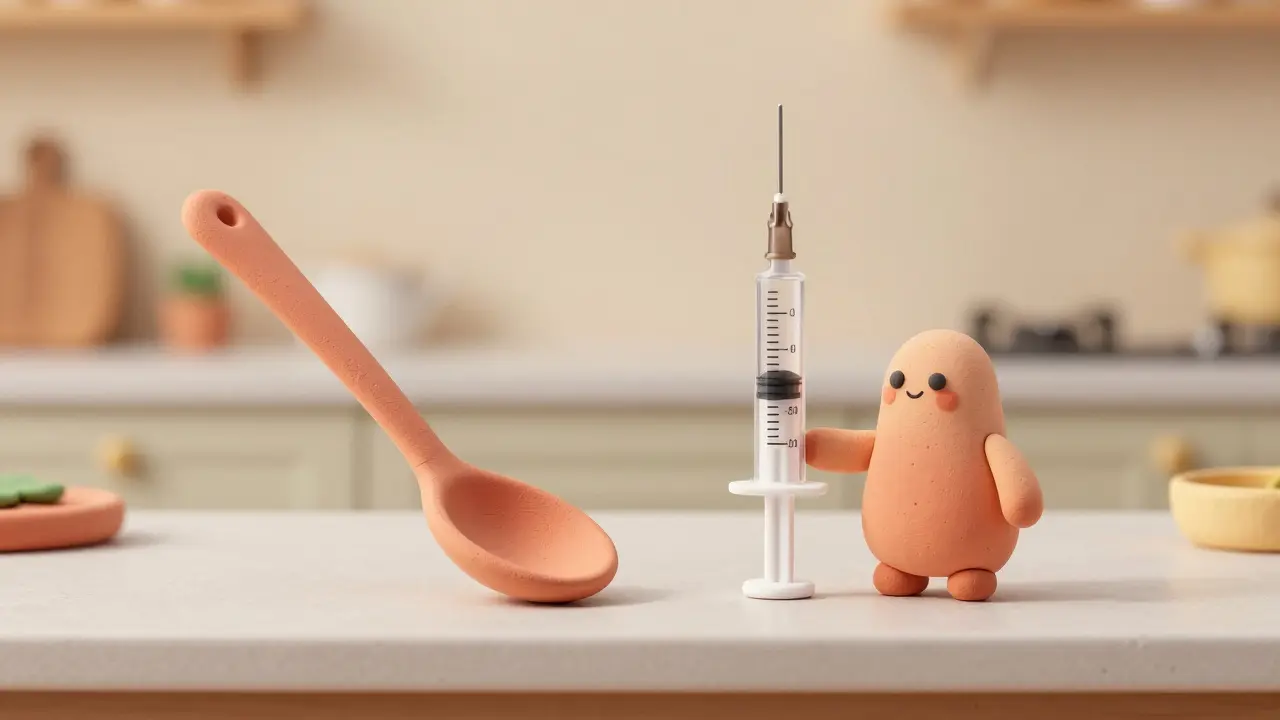
The good news is that these errors are almost entirely preventable. By switching from outdated tools to precise medical devices and following a a few strict verification steps, you can virtually eliminate the guesswork from your routine. Here is how to ensure every dose is exactly what it needs to be.
The Danger of the Kitchen Spoon
If you're still using a household spoon to measure medicine, you're taking a significant risk. Kitchen spoons are not measuring devices; they are eating utensils. Their volumes vary wildly from one drawer to the next. According to NIH testing protocols, household spoons only hit a 62% accuracy rate for a standard 2.5 mL dose. Compare that to Oral Syringes is a precision medical device used to administer a specific volume of liquid medication into the mouth, which boast a 94% accuracy rate.
The problem extends to dosing cups too. While better than spoons, cups often have confusing markings or allow liquid to spill, leading to an error rate of over 41% for doses under 5 mL. This is why the American Academy of Family Physicians has recommended using only syringes for pediatric liquid medications since 2020. If your pharmacy gave you a cup but the dose is small, ask for a syringe instead.
Choosing the Right Measuring Tool
Not all syringes are created equal. To prevent wrong-dose errors, you need a device that matches the precision of the dose required. If you are measuring a dose under 1 mL, you need a syringe with 0.1 mL graduations. For doses between 1 and 5 mL, 0.5 mL graduations are the standard. Using a tool that is too large for a small dose is a recipe for a mistake.
| Measuring Tool | Accuracy Rate | Reliability | Recommendation |
|---|---|---|---|
| Oral Syringe | 94% | Very High | Gold Standard |
| Dosing Cup | 76% | Moderate | Use only for large volumes |
| Household Spoon | 62% | Low | Do Not Use |
Stopping the 'Metric Muddle'
One of the biggest culprits in dosing errors is the use of non-metric units. Terms like "teaspoon" (tsp) or "tablespoon" (tbsp) are outdated and dangerous in a medical context. The World Health Organization notes that eliminating these non-metric units can prevent 33% of all wrong-dose errors. Why? Because people often confuse the two or use spoons that don't actually hold a standard teaspoon's volume.
Always look for Milliliters (mL), which is the universal metric unit for liquid volume. If a prescription comes back with "tsp" on the label, call your pharmacist and ask them to convert it to mL. Most modern pharmacies are now mandated by the American Society of Health-System Pharmacists (ASHP) to dispense liquid medications with a device that uses only metric markings.
Preventing Route and Labeling Mistakes
Errors don't just happen with the amount; they happen with the where and what. In hospital settings, a major breakthrough has been the ENFit system, which is a standardized enteral connection system with geometrically incompatible connectors to prevent tubing from being connected to the wrong site. By making it physically impossible to connect a feeding tube to an IV line, this system has reduced wrong-route errors by 98% in many facilities.
At home, you can prevent similar "look-alike" mistakes by organizing your medications. Ensure that oral medications are kept in distinct containers, ideally amber-colored, with bold labels. If you have multiple liquid medications that look similar, use a marker or a bright sticker to differentiate them. The Institute for Healthcare Improvement found that clear, standardized labeling can reduce these types of errors by 42%.
A Step-by-Step Checklist for Safe Dosing
To make sure you're doing everything right, follow this routine every single time you administer a liquid medication:
- Verify the Dose: Double-check the prescription label. If it's in teaspoons, convert it to mL.
- Pick the Precise Tool: Use an oral syringe. Ensure the syringe size matches the dose (e.g., don't use a 10 mL syringe for a 0.5 mL dose).
- Check at Eye Level: When drawing liquid into a syringe, hold it at eye level. The liquid should hit the line exactly.
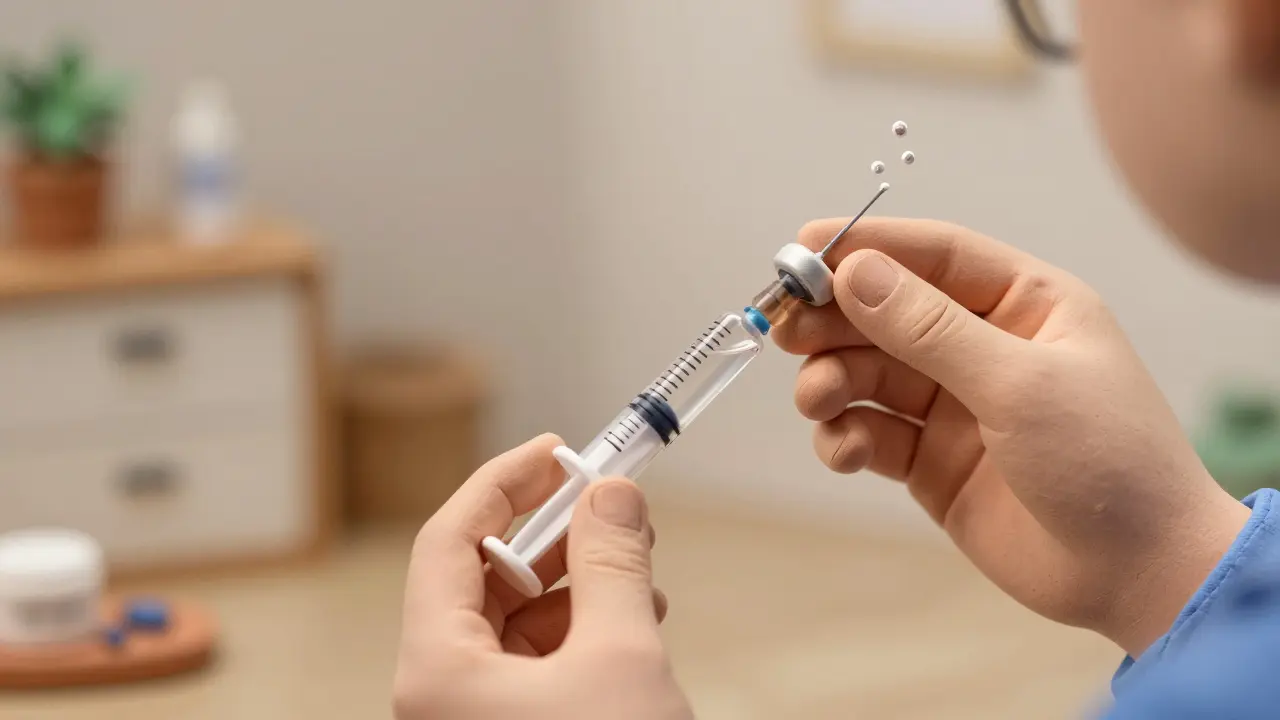
- Remove Air Bubbles: Tap the side of the syringe to move air bubbles to the top and gently push them out. An air bubble takes up space where medicine should be, resulting in an under-dose.
- Administer Directly: Place the syringe tip toward the inside of the cheek to avoid choking and ensure the full dose is swallowed.
The Role of Technology in Error Prevention
While the tools in your hand are vital, the systems behind the scenes are also evolving. Hospitals now use Barcode Medication Administration (BCMA), which is a system where clinicians scan a patient's wristband and the medication barcode to verify the right drug, dose, and patient. This technology reduces wrong-dose errors by 48% compared to manual checks.
For those at home, Electronic Health Records (EHR) are becoming more intuitive. Many now include clinical decision support that automatically flags a dose if it falls outside the standard weight-based parameters for a child. This automated "safety net" has been shown to reduce pediatric liquid errors by 58% in some clinical reviews. If your doctor uses a digital portal, don't be afraid to ask them to double-verify the weight-based calculation before they send the script to the pharmacy.
Can I use the cup that came with the medicine?
While better than a kitchen spoon, dosing cups are significantly less accurate than oral syringes, especially for small doses. They are prone to spilling and have less precise markings. If the dose is under 5 mL, an oral syringe is strongly recommended for safety and accuracy.
What should I do if the prescription is written in teaspoons?
Contact your pharmacist or doctor immediately and ask them to provide the dose in milliliters (mL). Using metric measurements eliminates the confusion associated with varying spoon sizes and is the global standard for preventing medication errors.
How do I handle air bubbles in the syringe?
Air bubbles displace the medication, meaning the patient gets less than the prescribed dose. After drawing the liquid, hold the syringe upright, tap the side firmly with your finger to force bubbles to the top, and gently push the plunger until the air is expelled and the liquid reaches the correct mark.
Are there different types of syringes I should know about?
Yes. For very small doses (under 1 mL), use a syringe with 0.1 mL markings. For doses between 1 mL and 5 mL, use a syringe with 0.5 mL markings. Using a syringe that is too large for the dose increases the likelihood of a measurement error.
What is the ENFit system I keep hearing about?
ENFit is a standardized connection system used in hospitals for enteral (tube) feeding. It uses unique connectors that cannot be accidentally attached to IV lines. This prevents the catastrophic error of injecting liquid medication or food directly into a patient's bloodstream.
Next Steps for Caregivers and Patients
If you are currently managing liquid medications at home, start by auditing your tool kit. If you find yourself using a kitchen spoon or an old, faded dosing cup, replace them immediately with a set of metric oral syringes. You can usually get these for free or a very low cost from your local pharmacy.
Next, review your current prescriptions. If any labels use "tsp" or "tbsp," call your provider for a conversion to mL. Finally, establish a "quiet zone" for dosing. Many errors happen when parents are rushed or distracted. By stepping away from the noise and using a checklist, you ensure that the medicine you're giving is safe, accurate, and effective.
David Snyder
April 14, 2026 AT 14:33This is such a helpful reminder for all the new parents out there. It's easy to get overwhelmed when the kids are sick, but having a simple checklist like this makes everything feel much more manageable. I'm glad the oral syringes are so accessible at pharmacies now.
mimi clouet
April 16, 2026 AT 03:28Actually, you should also mention that some generics come with those weird plastic droppers that are even worse than the cups! 🤦♀️ Always insist on the 1mL syringe for anything under that amount because the markings on droppers are basically just suggestions 😂 💉
john chiong
April 17, 2026 AT 12:02absolute madness that people still use soup spoons for medicine in this day and age it is practically criminal negligence to wing it with a childs health
Catherine Mailum
April 17, 2026 AT 14:54oh sure because we all have the luxury of a quiet zone in a house with a screaming toddler who refuses to take the medicine anyway...’great’ advice for people who live in a vacuum
melissa mac
April 18, 2026 AT 00:13I totally hear where you're coming from regarding the chaos of a sick household. Maybe we can suggest some tips on how to calm the environment first, or perhaps involving the child in the process so they feel more in control? It's all about finding a balance that works for each family.
Haley Moore
April 18, 2026 AT 22:20Honestly, I can't believe some of you actually struggle with basic metric conversions... like, it's just math? 🙄 But I guess for the masses, a little guide is cute 💅
Sam Dyer
April 20, 2026 AT 07:35The US healthcare system is a dumpster fire but at least we have the best medical tech in the world like the ENFit system 🇺🇸 Everyone else is just playing catch up with their prehistoric methods while we innovate the gold standard. Get your syringes and stop complaining about the labels! 🙄
Jasmin Stowers
April 21, 2026 AT 12:26totally agree on the syringes over cups
Anurag Moitra
April 23, 2026 AT 11:27It is imperative that caregivers adhere to these standards to ensure patient safety. The transition to metric units is a critical step in reducing avoidable clinical errors in home care settings.
Mark Dueben
April 23, 2026 AT 18:39I suppose it would be helpful if pharmacies just stopped giving out the cups entirely, though I'm sure they think they're being helpful by providing them. It's just a bit unfortunate that the wrong tool is often the default option provided to patients.