

SSRI Hyponatremia Risk Assessor
Check Your Risk Factors
Select the options that apply to you to calculate your relative risk profile.
Select your details on the left and click calculate to see your estimated risk level.
Recommendations:
You start taking a new antidepressant to feel better, but instead of clarity, you wake up feeling foggy, dizzy, or just "off." You might assume it’s the depression itself, or perhaps normal aging if you’re older. But there is a silent, dangerous culprit that often hides behind these symptoms: hyponatremia. This condition, where your blood sodium levels drop too low, is a known side effect of Selective Serotonin Reuptake Inhibitors (SSRIs). It doesn’t just make you tired; in severe cases, it can cause seizures, coma, or even death.
This isn't a rare glitch. According to a major 2024 meta-analysis published in European Psychiatry, between 1.9% and 4.4% of patients on SSRIs develop this condition. For adults over 65, that risk skyrockets to nearly 14-18%. The confusion caused by low sodium is frequently misdiagnosed as dementia or a worsening mental health crisis, delaying life-saving treatment. Understanding how SSRIs affect your electrolytes is crucial for staying safe while managing your mood.
How SSRIs Cause Low Sodium Levels
To understand why an antidepressant affects your salt balance, we need to look at what SSRIs actually do. Selective Serotonin Reuptake Inhibitors are a class of drugs that increase serotonin levels in the brain to improve mood and reduce anxiety. While boosting serotonin helps with depression, it also interacts with other parts of your body, specifically the hypothalamus in your brain.
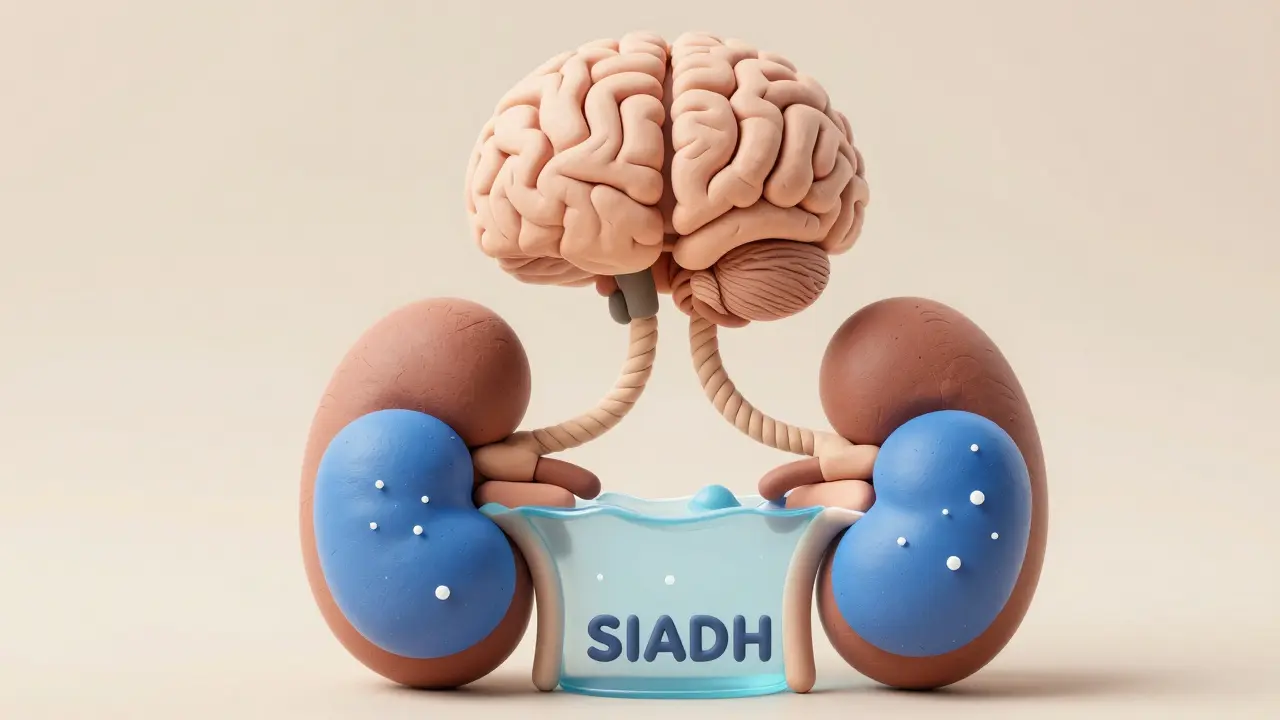
The hypothalamus controls the release of antidiuretic hormone (ADH), also known as vasopressin. ADH tells your kidneys to hold onto water. When serotonin levels rise due to SSRI use, it can accidentally trigger the hypothalamus to release too much ADH. This leads to a condition called Syndrome of Inappropriate Antidiuretic Hormone Secretion (SIADH).
When your body holds onto too much water, it dilutes the sodium in your bloodstream. Think of it like adding too much water to a cup of soup-the flavor (sodium) becomes weak, even though the amount of salt hasn't changed. This diluted state is hyponatremia. Research by Nagashima et al. (2021) confirmed that the stronger an antidepressant binds to serotonin transporters, the higher the risk of this sodium drop. This explains why pure SSRIs carry a higher risk than some other types of antidepressants.
Who Is Most at Risk?
Not everyone who takes an SSRI will develop low sodium. However, certain groups face a significantly higher danger zone. If you fall into any of these categories, you need to be extra vigilant:
- Age Over 65: Older adults have reduced kidney function and natural changes in fluid regulation. Their relative risk is 3.7 times higher than younger adults.
- Female Sex: Women account for about 65% of reported cases, possibly due to hormonal interactions or lower average body weight.
- Low Body Weight: People weighing less than 60 kg (approx. 132 lbs) are more susceptible to fluid shifts.
- Concurrent Medications: Taking diuretics (water pills), especially thiazides, increases the risk by 4.2-fold. These drugs already flush out sodium, and adding an SSRI creates a perfect storm.
- Pre-existing Kidney Issues: An estimated glomerular filtration rate (eGFR) below 60 mL/min/1.73m² indicates impaired kidney function, making it harder to regulate fluids.
If you are a young, healthy male with no other medications, your absolute risk is low. But if you are an elderly woman taking a blood pressure medication, the combination requires careful monitoring.
Recognizing the Symptoms: More Than Just Fatigue
The tricky part about SSRI-induced hyponatremia is that its early symptoms mimic common issues like fatigue, mild depression, or general malaise. Because of this, many patients-and even doctors-miss the warning signs until the situation becomes critical.
Watch for these specific red flags, especially within the first two to four weeks of starting or increasing your dose:
- Mental Fog and Confusion: This is the hallmark symptom. You might forget simple words, feel disoriented in familiar places, or struggle to concentrate. In the elderly, this is often mistaken for sudden-onset dementia.
- Nausea and Headache: These are early physiological responses to cellular swelling caused by low sodium.
- Weakness and Muscle Cramps: As sodium drops, nerve signals become erratic, leading to muscle twitching or weakness.
- Gait Instability: Unexplained falls or clumsiness in older adults are frequently linked to undiagnosed hyponatremia.
In severe cases, where sodium levels drop below 125 mmol/L, the risk escalates to seizures, coma, and respiratory arrest. A case report from 2022 described a 78-year-old woman whose sodium dropped to 118 mmol/L after just 10 days on sertraline, requiring intensive care. Early recognition is the difference between a simple medication adjustment and a hospital emergency.
Which Antidepressants Are Safest?
If you are at high risk for hyponatremia, you still have options. Not all antidepressants carry the same level of danger. The 2024 meta-analysis provided clear data on which drugs pose the least threat to your sodium levels.
| Antidepressant Class/Drug | Risk Profile (Odds Ratio) | Safety Note |
|---|---|---|
| Citalopram (SSRI) | 2.37 (High) | Highest risk among common SSRIs |
| Sertraline (SSRI) | 2.15 (High) | Frequently prescribed, high vigilance needed |
| Fluoxetine (SSRI) | 1.98 (Moderate-High) | Long half-life complicates rapid correction |
| Venlafaxine (SNRI) | 1.72 (Moderate) | Lower risk than SSRIs, but not zero |
| Bupropion (Atypical) | 0.85 (Low-Moderate) | Does not affect serotonin directly |
| Mirtazapine (Atypical) | 0.47 (Lowest) | Safest option for elderly/high-risk patients |
Mirtazapine is an atypical antidepressant that works on different receptors than SSRIs, resulting in a significantly lower risk of hyponatremia. With an odds ratio of only 0.47 compared to SSRIs, it is widely considered the safest choice for patients prone to electrolyte imbalances. Dr. Elena Martinez, lead author of the 2024 study, explicitly recommends considering Mirtazapine as a first-line treatment for elderly patients. Bupropion is another solid alternative, as it does not target serotonin reuptake in the same way, thereby avoiding the ADH trigger.
Monitoring and Prevention Strategies
You don't have to guess if your sodium is dropping. Simple blood tests can catch this issue before it causes confusion or seizures. The American Psychiatric Association’s 2023 guidelines recommend a proactive approach:
- Baseline Test: Get a serum sodium test within 7 days before starting your SSRI.
- Follow-Up Test: Repeat the test at 2 weeks after starting the medication or increasing the dose. This is the critical window when SIADH typically manifests.
- Ongoing Monitoring: If you are over 65 or take diuretics, monthly checks for the first three months are wise.
If your sodium levels dip slightly (125-134 mmol/L), doctors often recommend restricting fluid intake to 800-1000 mL per day and stopping the SSRI. Levels usually normalize within 72-96 hours. Severe cases require hospitalization and careful IV saline administration to avoid a dangerous condition called osmotic demyelination syndrome, which occurs if sodium is corrected too quickly.
It is also vital to educate your healthcare team. A 2023 survey revealed that 63% of primary care physicians were unaware of the specific 2-4 week onset window for this side effect. Don't hesitate to ask, "Should I check my sodium levels?" before leaving your appointment.
What To Do If You Suspect Low Sodium
If you are taking an SSRI and suddenly feel confused, nauseous, or unusually weak, do not ignore it. Do not assume it is just a bad day or a side effect you need to "push through."
- Contact Your Doctor Immediately: Explain your symptoms and mention your concern about hyponatremia.
- Avoid Excessive Water Intake: Until you see a doctor, stick to normal hydration. Drinking gallons of water can worsen the dilution if SIADH is present.
- Review Other Meds: Check if you are taking diuretics, NSAIDs, or other drugs that affect fluid balance.
- Seek Emergency Care for Severe Symptoms: If you experience seizures, loss of consciousness, or severe disorientation, call emergency services immediately.
Remember, treating the underlying cause-usually by adjusting or switching the antidepressant-is highly effective. Most people recover fully once the offending drug is removed and fluid balance is restored. By staying informed and proactive, you can protect your physical health while pursuing mental wellness.
How long does it take for SSRI-induced hyponatremia to develop?
Symptoms typically appear within the first two to four weeks of starting an SSRI or increasing the dosage. This window is critical for monitoring, as most cases are detected during this initial phase.
Can drinking salty water fix low sodium from SSRIs?
No, self-treating with salty water is not recommended and can be dangerous. The issue is often water retention (SIADH), not just lack of salt. Improper correction can lead to severe neurological damage. Always follow medical advice, which may include fluid restriction rather than salt supplementation.
Is Mirtazapine safer than SSRIs for seniors?
Yes, significantly. Studies show Mirtazapine has an odds ratio of 0.47 for causing hyponatremia compared to SSRIs, making it the preferred choice for elderly patients or those with kidney issues according to recent clinical guidelines.
What are the symptoms of severe hyponatremia?
Severe hyponatremia (sodium below 125 mmol/L) can cause seizures, coma, respiratory arrest, and death. Early signs include confusion, nausea, headache, and muscle weakness.
Do all antidepressants cause low sodium?
No, but SSRIs have the highest risk. SNRIs have a moderate risk, while atypical antidepressants like Bupropion and Mirtazapine have much lower risks. Tricyclic antidepressants vary, with some carrying higher risks similar to SSRIs.
Menu