
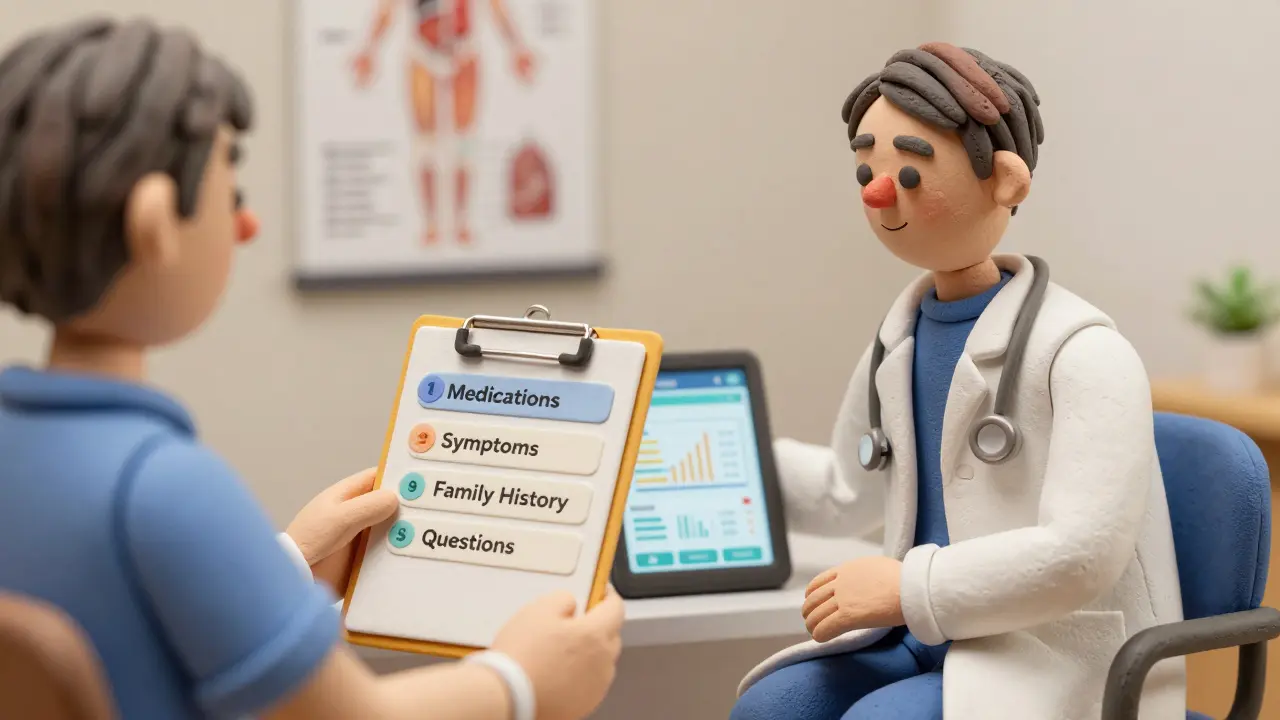
Doctor Appointment Prep Checklist
What to Bring
What to Discuss
What to Bring to Your Doctor Appointment
Showing up to your doctor’s office without the right information is like showing up to a car repair with no engine light on and no idea what’s wrong. You’ll waste time, miss chances to catch problems early, and leave frustrated. The good news? A little prep can turn a rushed 10-minute visit into a productive conversation that actually helps you.
Start with your medication list. Not just the names-write down the exact dose, how often you take it, and why. For example: Metformin 500mg, one tablet twice daily, for type 2 diabetes, prescribed by Dr. Patel, since 2022. This isn’t just helpful-it’s critical. Mayo Clinic’s data shows patients who bring accurate lists cut medication errors by 37%. Many people forget supplements or over-the-counter pills, but those matter too. A daily fish oil or sleep aid can interact with prescriptions you didn’t even think to mention.
Bring your health insurance card and a government-issued photo ID. Even if you’ve been seeing the same doctor for years, offices need to verify this each visit. Some clinics, like Cleveland Clinic, now require digital check-in via MyChart. If you’ve been sent a link to complete forms online, do it. Skipping this adds 15-20 minutes to your wait time.
Don’t forget family health history. Write down any major conditions in your parents, siblings, or grandparents-especially heart disease, diabetes, cancer, or mental health disorders. Mayo Clinic specifically asks for three generations of history because genetics play a bigger role than most people realize. If you don’t know exact details, write what you do know: “Mom had breast cancer at 52,” or “Dad had a stroke in his 60s.”
If you’ve had recent tests done elsewhere-blood work, X-rays, EKGs-bring the results. Don’t assume your doctor has access. Even if it was done at a different hospital, a printed copy or PDF on your phone saves time and avoids duplicate tests.
What to Talk About During Your Visit
Your time with the doctor isn’t just for reporting symptoms-it’s for asking questions that lead to better decisions. Most patients only mention one or two complaints, but the best visits cover four key areas: symptoms, lifestyle, goals, and next steps.
Start with your symptoms. Don’t say, “I’ve been tired.” Say: “I’ve had low energy for three months. It’s worse after lunch. I sleep 7 hours but wake up still exhausted. It’s a 7 out of 10 on the fatigue scale.” Add what makes it better or worse: “Coffee helps a little, but I crash by 3 p.m.” AdventHealth’s research found that patients who describe symptoms this way are 68% more likely to get the right diagnosis on the first try.
Be honest about your lifestyle. Doctors need to know how much you drink, if you smoke, how much you move, and whether you use any recreational drugs-even if you think it’s not “that bad.” They’re not judging. They’re trying to connect dots. If you drink two glasses of wine every night, say it. If you walk 10 minutes a day because you’re exhausted, say it. If you skip meals because you’re busy, say it. This isn’t about blame-it’s about finding the root cause of your symptoms.
Ask the big questions. Don’t wait for your doctor to lead. Say: “Why are you recommending this test?” “What are the side effects?” “What would you do if this were your mom or brother?” Mayo Clinic found that patients who ask these three questions understand their treatment plan 52% better and are more likely to follow through.
End with goals and next steps. Say: “I want to reduce my blood pressure without adding more pills,” or “I need to get back to walking my dog every day.” Then ask: “What’s the next thing I should do? When should I come back? Who do I call if things get worse?” Patients who set clear goals and confirm follow-up plans resolve 89% of their main concerns, according to St. Joseph Hospital Bangor’s study.

Common Mistakes People Make
Even with good intentions, most people mess up in predictable ways.
Mistake 1: Relying on memory. You think you remember your meds, but you don’t. A Mayo Clinic audit found 45% of medication lists brought in were incomplete or wrong. Write it down. Use your phone’s notes app. Or print a template from your clinic’s website.
Mistake 2: Only talking about the obvious. You mention your knee pain but not the anxiety that’s kept you up for weeks. Or you talk about your cough but not the weight loss you’ve ignored. Doctors can’t read your mind. Write down every odd feeling-even if it seems unrelated.
Mistake 3: Not preparing questions. Most people leave with more questions than answers. Write three questions before you go. Prioritize them. If you only get to ask one, make it the most important one.
Mistake 4: Skipping pre-visit forms. If your clinic asks you to fill out forms online, do it. Cleveland Clinic reports patients who complete digital check-ins save 22 minutes and have 19% more complete records. It’s not busywork-it’s efficiency.
Tools and Tech That Help
You don’t have to do this all by hand. Many tools make preparation easier.
Mayo Clinic’s app lets you import your pharmacy records from Walgreens, CVS, and other major chains. It syncs with Apple Health and Google Fit, so your activity and sleep data auto-populates. If you use one of these, turn on the sync before your appointment.
Cleveland Clinic’s AppointmentPass® system sends you a reminder to complete a symptom checker 48 hours before your visit. It asks you to rate pain, fatigue, mood, and sleep on a scale. That data goes straight to your doctor’s chart.
Ambetter Health now auto-updates your medication list when you refill a prescription through their mail-order pharmacy. If you’re on a long-term med, this cuts out manual entry entirely.
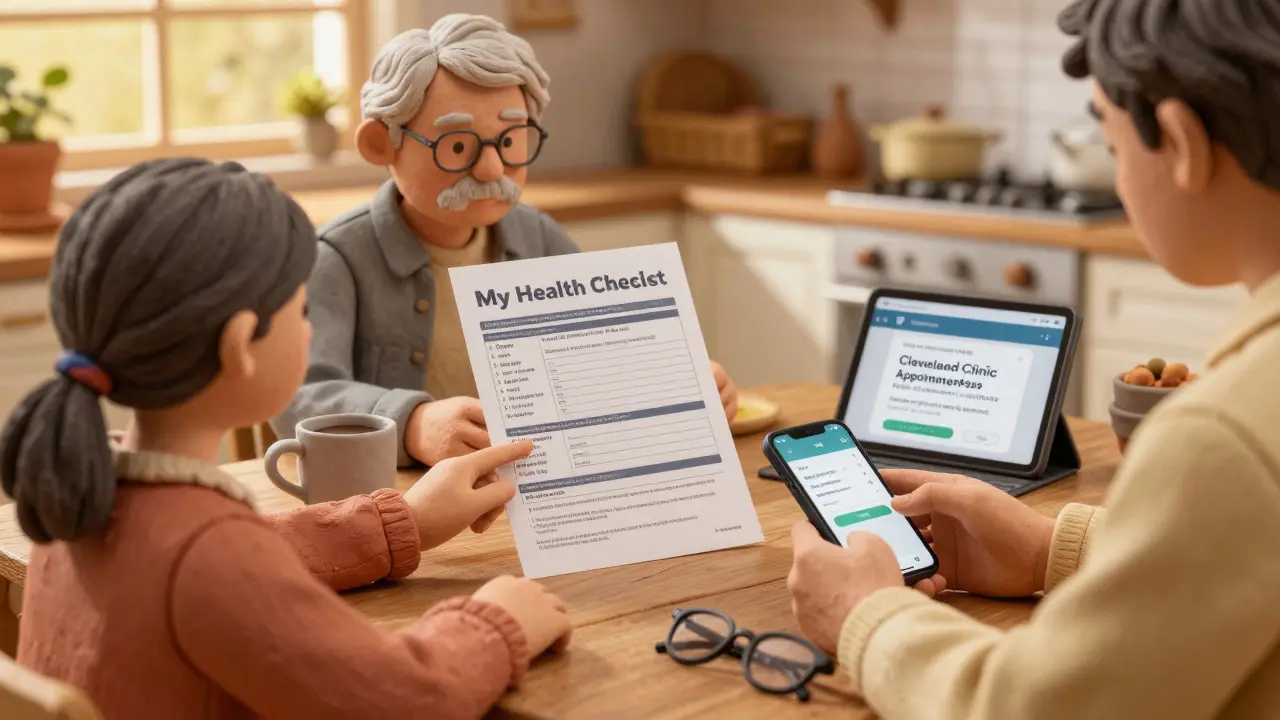
The Institute for Healthcare Improvement’s My Health Checklist is free to use online. It’s available in 12 languages and designed for different reading levels. You answer simple questions, and it generates a printable summary to bring with you.
What If You’re Nervous or Overwhelmed?
It’s normal to feel anxious. Doctors see hundreds of patients. You might feel like your concerns don’t matter.
Bring someone with you. A partner, friend, or adult child can help remember what was said, ask questions you forgot, and take notes. Many clinics encourage this.
Write your concerns on a sticky note. Keep it simple: 1. Chest tightness when walking, 2. Can’t sleep, 3. Worried about weight loss. Hand it to the doctor when you sit down. It removes the pressure of speaking perfectly.
Remember: your doctor works for you. If you feel rushed or dismissed, say so. “I’m worried this might be serious. Can we spend five more minutes?” Most doctors will adjust. You’re not being difficult-you’re being smart.
Final Checklist Before You Leave
- ✅ Medication list with names, doses, frequency, purpose, and prescribing doctor
- ✅ Insurance card and photo ID
- ✅ Recent test results (if done outside this clinic)
- ✅ Family health history (parents, siblings, grandparents)
- ✅ List of symptoms with timing, intensity, triggers
- ✅ List of 3 questions you want answered
- ✅ Confirmation of next steps: follow-up date, new tests, referrals
Preparation isn’t about being perfect. It’s about being clear. The more you bring, the less guesswork your doctor has to do. And the less guesswork there is, the better your care will be.
Shae Chapman
December 29, 2025 AT 15:28Colin L
December 30, 2025 AT 07:48Henry Ward
December 30, 2025 AT 17:50Joseph Corry
January 1, 2026 AT 07:35Cheyenne Sims
January 1, 2026 AT 13:51Nadia Spira
January 2, 2026 AT 18:09henry mateo
January 3, 2026 AT 14:14Kunal Karakoti
January 5, 2026 AT 04:03Kelly Gerrard
January 6, 2026 AT 08:10Glendon Cone
January 7, 2026 AT 13:25Aayush Khandelwal
January 8, 2026 AT 18:09Sandeep Mishra
January 10, 2026 AT 12:37Hayley Ash
January 11, 2026 AT 13:52kelly tracy
January 11, 2026 AT 19:31