
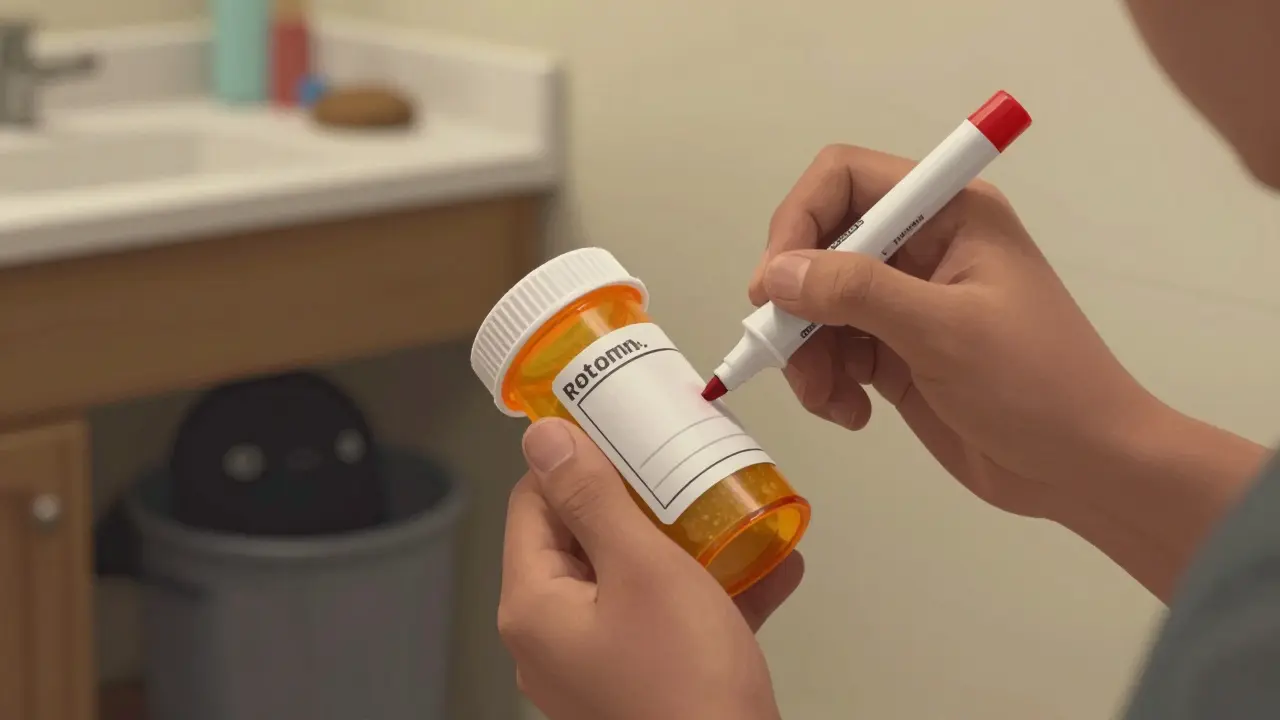
Throwing away old pills might seem like a simple chore, but if you don’t handle the packaging right, you’re risking more than just clutter-you’re risking your identity. Prescription bottles aren’t just empty plastic. They carry your name, address, doctor’s name, the exact medication you take, and sometimes even your insurance number. All of that is enough for someone to steal your identity, fake prescriptions, or even sell your drugs on the black market. And it’s happening more than you think.
Why Your Prescription Bottle Is a Goldmine for Thieves
Most people don’t realize that a single empty pill bottle contains enough personal information to open credit accounts, file fake insurance claims, or get access to controlled substances. The FDA says prescription labels include your full name, birth date, address, prescribing doctor, pharmacy details, and the drug’s name and dosage. That’s a full identity profile in one small container.
In 2021, a study in the Journal of the American Pharmacists Association found that 42% of prescription bottles tossed in home trash still had readable labels. That means nearly half of all discarded bottles were easy targets. One woman in Ohio lost $1,200 to fraud after someone found her oxycodone bottle, used her name to get more pills, and then ran up charges on her insurance. She didn’t even know it happened until her bill arrived.
The Department of Health and Human Services calls this one of the top 10 privacy risks in healthcare today. It’s not just about theft-it’s about control. Your health data is private for a reason. When you toss a bottle without removing your info, you’re giving strangers access to your medical history.
The Only Safe Way to Dispose of Medications: Take-Back Programs
If you want zero risk to your privacy, the best option is a drug take-back program. These are run by law enforcement, pharmacies, or local governments and are completely secure. The DEA’s National Prescription Drug Take Back Day collected over 821,000 pounds of medication in 2024 alone. You drop off your pills-bottle and all-and they’re destroyed in a way that leaves no trace of who owned them.
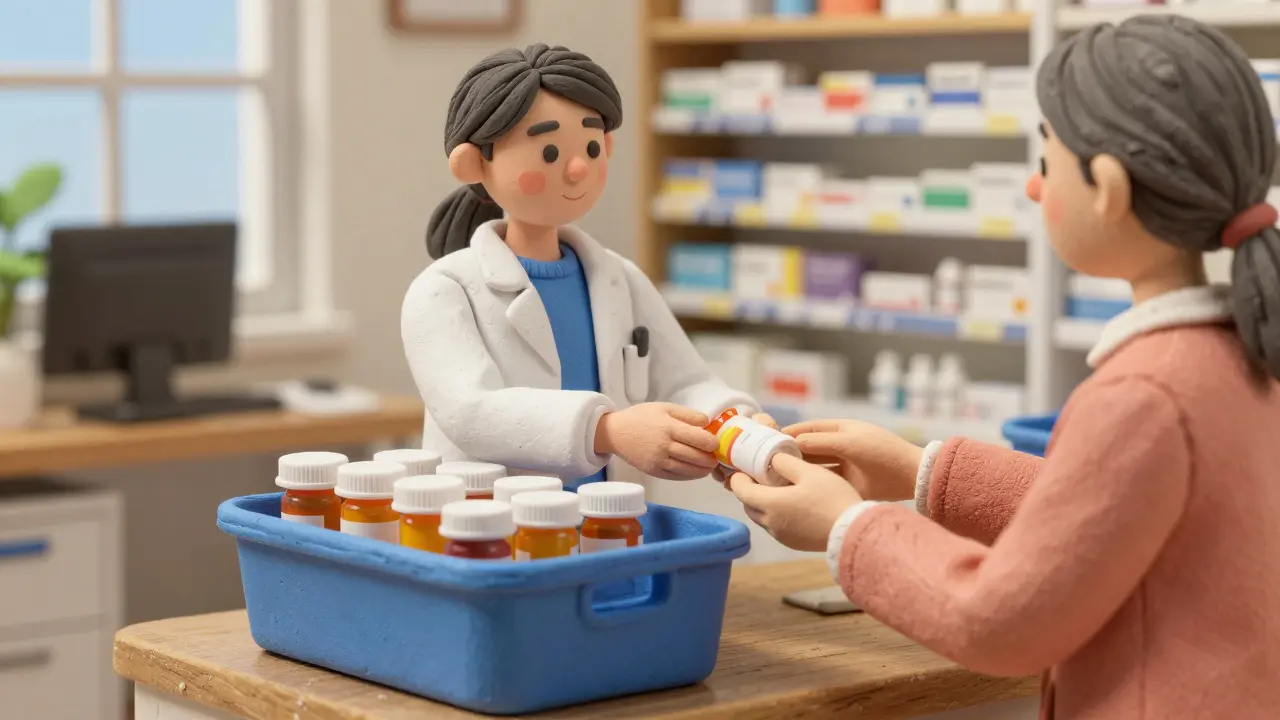
You don’t have to wait for a special event. Over 87% of chain pharmacies like CVS, Walgreens, and Rite Aid now offer year-round drop-off bins. Just walk in, hand over your unused meds, and leave. No questions asked. No labels to scratch. No mixing with coffee grounds. Your privacy is handled automatically.
And it’s not just convenient-it’s effective. A 2024 Pharmacy Times poll showed that 89% of people who used take-back programs felt “very confident” their info was safe. That’s compared to just 32% of those who threw pills in the trash.
What to Do If There’s No Take-Back Option Nearby
Not everyone lives near a pharmacy with a drop-off bin. If you’re stuck disposing at home, the FDA has a five-step method that works if you follow it exactly:
- Take the pills out of the original bottle.
- Mix them with something unappetizing-used coffee grounds, cat litter, or dirt. This makes them unappealing to kids, pets, or scavengers.
- Pour the mixture into a sealable container like a jar or plastic bag with a lid.
- Scratch out or cover every bit of personal info on the empty bottle with a permanent marker or duct tape. Don’t just smudge it-make sure the name, Rx number, and address are completely unreadable.
- Throw both the sealed container and the ruined bottle into the trash.
This process takes about five minutes per bottle. It’s not hard, but most people skip the last step. A 2022 Mayo Clinic report found that 68% of patients didn’t remove personal info properly. That’s the step that keeps your data out of the wrong hands.
What You Should Never Do
Some habits are dangerous-and surprisingly common.
Don’t flush pills unless they’re on the FDA’s Flush List. Only 15 medications, mostly powerful opioids and controlled substances, should go down the toilet. Flushing others harms water systems and isn’t necessary for privacy. The FDA updated the list in May 2024-check their website or use the DisposeRx app to confirm if your drug is on it.
Don’t just throw the bottle in the recycling. Recycling centers don’t check for personal info. Even if the label looks faded, someone can still read it with a flashlight or phone camera. Always destroy the label first.
Don’t assume “it’s just an old antibiotic.” Even expired painkillers, blood pressure meds, or antidepressants can be used for identity theft. Your name and doctor’s info on the label is enough to open doors.
Privacy-Focused Tools That Actually Work
There are products designed to make this easier.
DisposeRx deactivation pouches cost about $2 to $3 each and are sold at pharmacies. You pour your pills in, add water, shake, and the powder inside neutralizes the drugs. The pouch becomes a solid gel-no pills left to identify. And because the bottle isn’t used, you don’t have to worry about the label at all. One user on Yelp called it “finally a simple privacy solution.”
Sharpie Industrial markers (around $5 for a pack) are better than regular ones for covering labels. They’re designed to stick to plastic and won’t smudge. A 2023 University of Michigan study found that people who used these markers were 50% more likely to complete the privacy step correctly.
Some pharmacies now offer mail-back envelopes for $3 to $7. You put your meds in, seal it, and drop it in the mail. The company destroys everything and handles the privacy side. No in-person trip needed.
What About the Environment?
Privacy isn’t the only concern. The EPA estimates 3.2 million pounds of pharmaceuticals end up in U.S. waterways every year from improper disposal. Flushing pills contributes to this. So does dumping them in landfills without proper containment.
Take-back programs and deactivation pouches are the only methods that protect both your privacy and the environment. They ensure drugs don’t leach into soil or water. Even the DEA pushes these methods-not just for safety, but for ecological reasons.
Why Most People Get It Wrong (And How to Fix It)
A Reddit thread from November 2023 asked, “How many of you actually scratch off your name from pill bottles?” Out of 287 responses, 63% said they “sometimes forget” or “don’t bother.” Why? Because it’s annoying. It’s confusing. And no one told them it mattered.
Older adults are especially at risk. A Kaiser Family Foundation survey found that 37% of people over 65 were confused about the right steps. The process feels overwhelming. But here’s the fix: make it a habit.
When you pick up a new prescription, ask the pharmacist: “Can you help me destroy the old bottle’s label?” Most will do it for you. Or keep a permanent marker in your medicine cabinet. Every time you finish a bottle, take two seconds to black it out.
It’s not about perfection-it’s about consistency. You don’t need to be a security expert. You just need to treat your prescription labels like you treat your credit card statements: destroy them before tossing.
The Bigger Picture: Why This Matters Beyond Your Home
This isn’t just personal. The global market for pharmaceutical waste management is expected to hit $3.1 billion by 2030. Why? Because privacy and safety are now non-negotiable. Hospitals, pharmacies, and insurers are being fined for improper disposal. In 2023, HHS collected $4.2 million in penalties from healthcare providers who left PHI exposed in trash.
By doing this right, you’re not just protecting yourself-you’re helping reduce the burden on the system. Fewer stolen identities mean fewer insurance fraud claims. Fewer pills in the water mean cleaner ecosystems. Fewer diverted drugs mean fewer overdoses.
It’s a small action. But it ripples.
What’s Coming Next
By 2027, 40% of major pharmacies plan to install smart disposal kiosks that automatically destroy labels and neutralize drugs with the touch of a button. The government is also pushing new laws like the Safe Drug Disposal Act of 2024, which would fund free take-back programs nationwide.
But you don’t need to wait. Right now, you have everything you need to protect yourself. A marker. A trash can. A nearby pharmacy. Or a pouch. Pick one. Do it today.
Tony Du bled
December 21, 2025 AT 20:02Just threw out a bottle last week without thinking. Now I’m gonna grab a Sharpie before bed.
Cara Hritz
December 22, 2025 AT 10:07i so friggin forgot to scratch off my label on my blood pressure pills and now i’m paranoid someone’s gonna use my name to get oxy 😭 i’m not even on them anymore but the bottle still had my doc’s info and everything. why is this not on the back of the bottle???
Art Van Gelder
December 23, 2025 AT 17:11Let’s be real-this isn’t just about privacy. It’s about dignity. Every pill bottle is a silent testament to pain, to vulnerability, to the quiet battles fought in bedrooms and waiting rooms. When we toss those bottles with our names still legible, we’re not just carelessly discarding plastic-we’re exposing the most intimate chapters of our lives to strangers who might flip through them like a cheap novel. And the worst part? Most people don’t even realize they’re doing it. We’ve normalized neglect. We treat our medical history like trash because we’ve been conditioned to believe it’s disposable. But it’s not. It’s sacred. And if we don’t start treating it that way, we’re not just risking identity theft-we’re surrendering our humanity to convenience.
Johnnie R. Bailey
December 24, 2025 AT 02:29For folks without access to take-back bins, I’ve started keeping a small ziplock bag in my medicine cabinet labeled ‘DEACTIVATE.’ Every time I finish a script, I pour the pills in, add a spoonful of used coffee grounds, seal it, and toss it. Then I take a Sharpie to the bottle-full coverage, no shortcuts. Took me two weeks to make it a habit, but now it’s automatic. Also, if you’re on Medicare, ask your pharmacy-they’ll give you free mail-back envelopes if you ask. No one tells you this stuff, but it’s there.
Sam Black
December 25, 2025 AT 23:09I used to think this was overkill-until my neighbor’s daughter got hooked on stolen painkillers from a neighbor’s trash. The bottle had her full name, SSN, and doctor’s contact info. It wasn’t even a controlled substance-just Zoloft. But that’s all they needed. Now I use DisposeRx pouches. $2.50 a pop, but I sleep better. And honestly? If you’re too lazy to do this, you’re part of the problem.
Jim Brown
December 26, 2025 AT 09:17The act of destroying a prescription label is, in a metaphysical sense, an assertion of autonomy. It is the final ritual of reclaiming one’s narrative from the bureaucratic apparatus that once held dominion over one’s body. The label is not merely data-it is a relic of institutional intrusion, a remnant of a system that commodifies suffering. To obliterate it is to say: ‘I am not my diagnosis. I am not my medication. I am not your data point.’ In an age where our every movement is tracked, where our health is mined for profit, this small, silent act becomes an act of resistance. One might ask: does it truly matter? And yet, resistance is not always loud. Sometimes, it is the steady hand of a marker, the deliberate stroke that renders invisible what was once meant to be seen.
Sai Keerthan Reddy Proddatoori
December 26, 2025 AT 12:12US government letting pharmacies give out free disposal bags? No way. This is a plot to make us dependent on big pharma. They want you to think you need their pouches. Real Americans scratch labels with a knife and burn the bottles. That’s what we did in my village in India. No fancy pouches. No recycling. Just fire and respect. This whole thing is a scam to sell more products.
Jamison Kissh
December 28, 2025 AT 07:32What’s interesting is how this mirrors broader patterns of digital privacy. We’re told to delete cookies, use VPNs, encrypt messages-but we still leave physical traces of our most sensitive information in plain sight. The prescription bottle is the analog equivalent of leaving your password written on your monitor. And yet, we don’t even blink. Why? Because we’ve internalized the idea that physical spaces are ‘safe.’ But they’re not. The trash is the new internet. And if you’re not securing your data there, you’re already compromised.