

When you’re sick, your body fights infection by releasing stress hormones like cortisol and adrenaline. For someone with diabetes, this isn’t just a cold or flu-it’s a metabolic emergency waiting to happen. Blood sugar can spike even if you’re not eating. Insulin resistance surges. Ketones build up. And if you don’t act fast, you could end up in the hospital with diabetic ketoacidosis (DKA). That’s why sick day rules for diabetes aren’t optional. They’re life-saving.
Why Illness Changes Everything for People with Diabetes
When you have a cold, flu, or even a stomach bug, your body goes into survival mode. It doesn’t care about your meal plan or your insulin schedule. It’s pumping out hormones that tell your liver to dump glucose into your bloodstream. That’s fine for someone without diabetes. But if you have Type 1 or insulin-requiring Type 2 diabetes, your body can’t handle that extra sugar. Without enough insulin, your body starts breaking down fat for energy-and that creates ketones. Too many ketones? That’s DKA. It’s dangerous. It can kill.According to the CDC, about 27% of all diabetes-related hospitalizations are due to DKA triggered by illness. And in severe cases, the death rate is between 2% and 5%. The worst part? Most of these cases happen because people stop their insulin when they’re sick. They think, “I’m not eating, so I don’t need insulin.” That’s wrong. Always wrong.
Never Skip Your Long-Acting Insulin
This is the single most important rule. Never stop your long-acting insulin-not even for a day. Whether you take Lantus, Levemir, Basaglar, or another basal insulin, it’s still working in your body even when you’re not eating. It’s keeping your liver from dumping too much glucose and preventing ketone production. If you skip it, you’re essentially turning off your body’s only safety net.People with Type 1 diabetes must keep at least 80% of their usual basal dose, even during vomiting or fasting. For Type 2 patients on insulin, the same rule applies. You might need more, not less. Studies show insulin resistance can increase by 30-50% during illness. That means your usual dose might not be enough. Don’t guess. Test. Adjust. Call your provider if you’re unsure.
Check Your Blood Sugar Every 2-4 Hours
You can’t manage what you don’t measure. During illness, check your blood sugar at least every 3-4 hours if you’re an adult. If you’re a child or teenager, check every 2-3 hours. Some guidelines say to start checking as soon as you feel unwell-even before your sugar rises.Here’s what to do based on your numbers:
- Below 100 mg/dL: You’re at risk for low blood sugar. Take 15 grams of fast-acting carbs (like juice or glucose tablets). Recheck in 15 minutes.
- 100-180 mg/dL: This is your target range during illness. Keep hydrating. Keep insulin going.
- 180-240 mg/dL: You need extra insulin. Use your correction dose as usual. Don’t hold back.
- Over 240 mg/dL: Test for ketones immediately. If you’re using a CGM, look for a steady upward trend over several hours.
Many people wait until their sugar hits 300 mg/dL to act. That’s too late. By then, ketones may already be building. Start checking at 240 mg/dL. That’s the red flag.
Ketone Checks: When, How, and What to Do
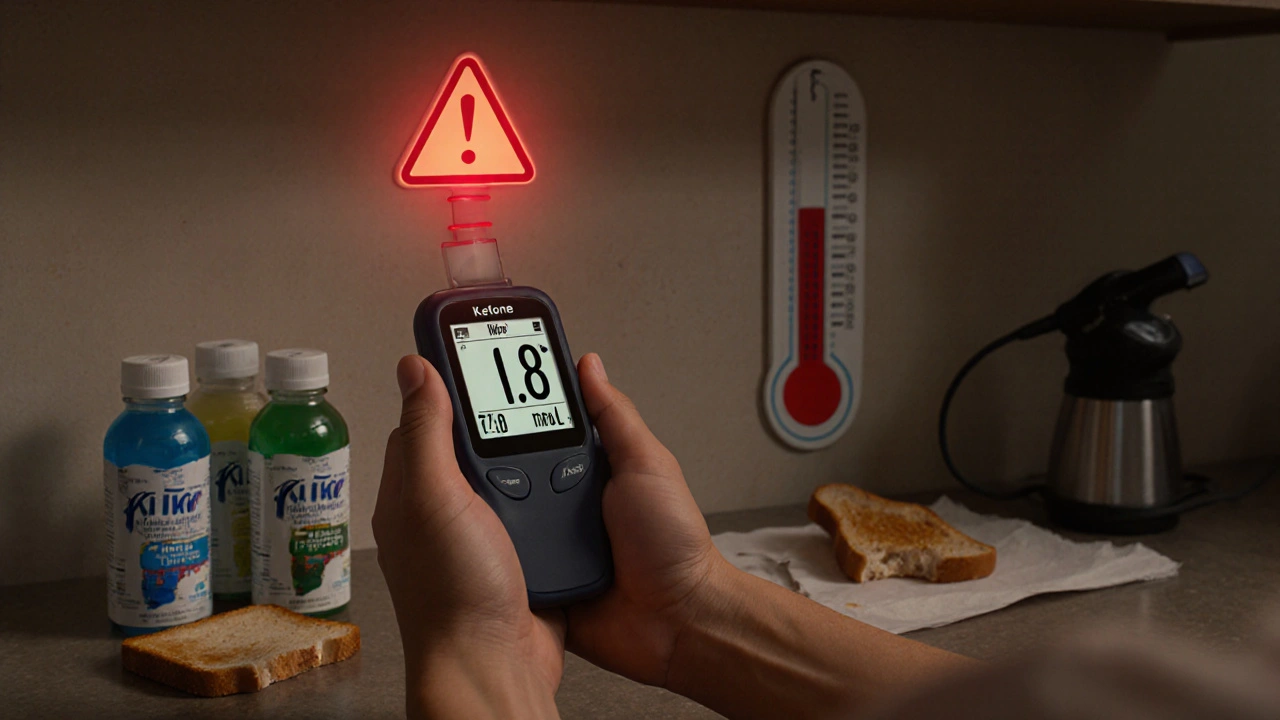
Ketone testing isn’t optional when you’re sick and your blood sugar is high. You need to know if your body is burning fat for fuel. There are two ways to test: blood ketone meters and urine strips. Blood ketone meters are more accurate and faster. Urine strips can be misleading-they show ketones from hours ago, not right now.Test for ketones when:
- Your blood sugar is over 240 mg/dL
- You have nausea, vomiting, or stomach pain
- You’re feeling unusually tired or confused
Here’s what the numbers mean:
- Below 0.6 mmol/L: Normal. Keep monitoring.
- 0.6-1.5 mmol/L: Moderate ketones. Increase insulin. Drink more fluids. Recheck in 2 hours.
- Over 1.5 mmol/L: High ketones. Call your doctor immediately. If you use an insulin pump, change your infusion site. This is a medical alert.
Urine ketone results? “Small” or “trace” means monitor closely. “Moderate” or “large” means treat like blood ketones over 1.5 mmol/L. Don’t wait. Don’t ignore it.
Hydration: The Silent Lifesaver
When your blood sugar is high, your body tries to flush out the extra glucose through urine. That means you’re losing water fast. Dehydration makes everything worse-it thickens your blood, makes insulin less effective, and speeds up ketone buildup.Drink fluids constantly. Not just water. You need the right balance of sugar and electrolytes.
Here’s the hydration plan:
- If your blood sugar is below 100 mg/dL: Drink fluids with sugar. 4-8 oz of regular soda, juice, or sports drink every hour.
- If your blood sugar is 100-180 mg/dL: Alternate between sugar-free fluids (water, diet soda) and fluids with 15g carbs (like half juice/half water). Aim for 6-8 oz every hour.
- If your blood sugar is over 180 mg/dL: Stick to sugar-free fluids. Water, unsweetened tea, broth, or sugar-free electrolyte drinks.
For kids, some guidelines suggest drinking “age in ounces” per hour (a 10-year-old drinks 10 oz/hour). That’s a good starting point, but adjust based on vomiting or diarrhea. If you can’t keep fluids down for more than 4 hours, go to the ER. IV fluids can save your life.
Special Considerations: Pump Users, Type 2, and Kids
If you use an insulin pump, your sick day rules are a bit different. You can’t just skip your basal rate. If ketones are moderate or high, increase your basal rate by 20% for 12 hours. Keep giving correction doses. Change your infusion set if your ketones stay high-it might be a blocked tube, not your body needing more insulin.People with Type 2 diabetes who don’t usually take insulin may need to start it during illness. Your doctor might give you a short-term insulin plan. Don’t refuse it. Your body is under stress. Oral meds won’t cut it.
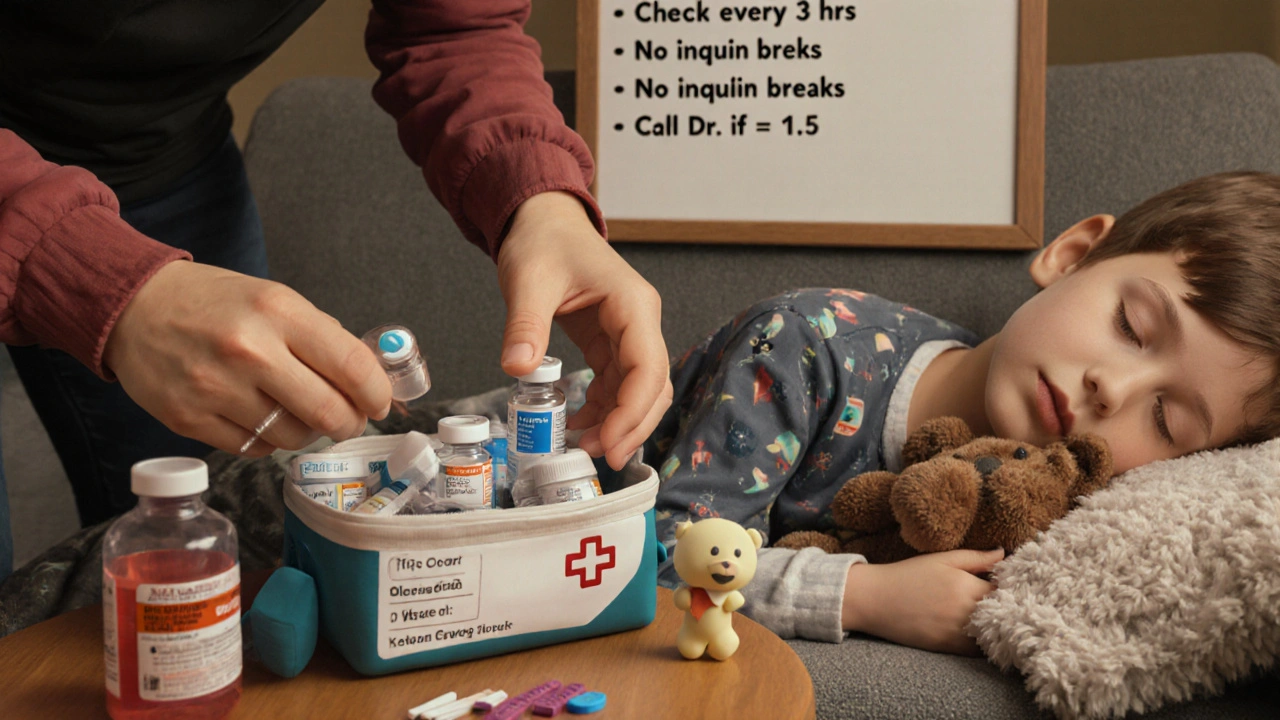
For children, dehydration and DKA happen faster. Watch for dry lips, no tears, less urination, or lethargy. Check blood sugar and ketones more often. Keep a sick-day kit ready: glucose tabs, ketone strips, insulin, fluids, and a list of emergency contacts.
What to Keep in Your Sick-Day Kit
Don’t wait until you’re sick to prepare. Build a kit now. Here’s what you need:- Extra insulin (both rapid-acting and long-acting)
- Unopened ketone test strips (they expire 6 months after opening)
- Blood ketone meter with extra batteries
- Glucose tablets or juice boxes
- Sugar-free electrolyte drinks
- Measuring cup (for accurate fluid intake)
- Thermometer, pain relievers (acetaminophen only-avoid NSAIDs like ibuprofen if you have kidney issues)
- List of emergency contacts and your doctor’s number
Check your kit every 3 months. Replace expired strips. Make sure your insulin hasn’t been exposed to heat.
What Not to Do
There are a lot of myths out there. Don’t fall for them:- Don’t skip insulin-even if you’re not eating.
- Don’t rely on urine strips if you have a blood ketone meter.
- Don’t drink alcohol-based cough syrups-they spike sugar.
- Don’t wait for vomiting to start before taking action.
- Don’t assume you’re fine just because you feel “not that sick.”
One Reddit user, u/SickDayStruggles, shared: “Different doctors told me to skip insulin when vomiting versus never skip it. I ended up in DKA with ketones at 22 mmol/L.” That’s not a scare story. That’s a real person who almost died because of conflicting advice. Don’t let that be you.
When to Call Your Doctor or Go to the ER
You don’t have to figure this out alone. Call your doctor if:- Your ketones are over 1.5 mmol/L and not coming down after 2 correction doses
- You’ve been vomiting for more than 4 hours
- Your blood sugar stays over 300 mg/dL for more than 6 hours
- You’re confused, having trouble breathing, or smell fruity on your breath
- You’ve lost 5 pounds or more in a few days
These are emergency signs. Don’t wait. Go to the ER. DKA is treatable-but only if caught early.
Final Thoughts: Be Ready Before You Get Sick
Sick day rules for diabetes aren’t complicated. But they require discipline. You have to check your numbers more often. You have to drink when you don’t feel like it. You have to give insulin when you think you shouldn’t. It’s hard. But it’s worth it.Every year, thousands of people with diabetes end up in the hospital because they didn’t follow these rules. You don’t have to be one of them. Prepare your kit. Know your numbers. Trust your meter. And never, ever stop your insulin.
Can I stop my insulin if I’m not eating when I’m sick?
No. You must continue your long-acting insulin even if you’re not eating. Illness causes your body to release stress hormones that raise blood sugar and increase insulin resistance. Stopping insulin can lead to dangerous ketone buildup and diabetic ketoacidosis (DKA). Always keep at least 80% of your usual basal dose, regardless of food intake.
How often should I check my blood sugar when I’m sick?
Check every 2-3 hours if you’re a child or teenager, and every 3-4 hours if you’re an adult. Start checking as soon as you feel unwell, even before your sugar rises. Don’t wait until it hits 300 mg/dL. Early action prevents complications.
Should I use urine or blood ketone strips?
Use blood ketone strips if you have a meter. They’re more accurate and show real-time ketone levels. Urine strips can be misleading-they reflect ketones from hours ago, not your current state. If you only have urine strips, treat moderate or large results as seriously as blood ketones over 1.5 mmol/L.
What fluids should I drink when my blood sugar is high?
If your blood sugar is over 180 mg/dL, drink sugar-free fluids like water, unsweetened tea, or sugar-free electrolyte drinks. If it’s between 100-180 mg/dL, alternate between sugar-free fluids and those with 15g of carbs (like half juice/half water). Avoid alcohol-based cough syrups and sugary drinks unless your sugar is low.
When should I go to the ER for diabetes-related illness?
Go to the ER if you’ve been vomiting for more than 4 hours, your ketones are over 1.5 mmol/L and not improving, your blood sugar stays above 300 mg/dL for 6+ hours, you’re confused or having trouble breathing, you’ve lost 5+ pounds quickly, or you smell fruity on your breath. These are signs of DKA-emergency treatment is needed.
Travis Freeman
November 29, 2025 AT 09:41Man, this is the kind of post that saves lives. I’ve been Type 1 for 18 years and I still get nervous when I’m sick-this is my new go-to reference. Thanks for laying it out so clearly.
Just added my sick kit to my pantry last week-insulin, ketone strips, juice boxes, electrolyte packets. No more winging it.
Also, never thought about how dehydration makes insulin less effective. That clicked for me.
Stay safe out there, everyone.
Sean Slevin
November 29, 2025 AT 23:20Okay, so-let me get this straight-when you’re sick, your body turns into a sugar-spewing, insulin-resistant, ketone-factory machine?? And you’re supposed to just keep injecting insulin like it’s your job??
WHY ISN’T THIS TAUGHT IN HIGH SCHOOL??
I mean, we learn quadratic equations but not how to not die from a cold??
Also, why do people think not eating = no insulin?? That’s like turning off your car’s engine because you’re not driving… and then wondering why the battery died.
Also, also, urine strips are like reading yesterday’s newspaper to know if it’s raining today. Ugh.
Chris Taylor
December 1, 2025 AT 08:32Been there. Vomiting for 12 hours, thought I’d skip my Lantus ‘cause I wasn’t eating. Ended up in the ER with ketones at 3.2.
They gave me IV fluids and a lecture. I cried. Then I cried harder when I realized I could’ve avoided it.
Don’t be like me. Keep the insulin on. Even if you’re just sipping water. Even if you feel like garbage.
It’s not weakness. It’s survival.
Melissa Michaels
December 1, 2025 AT 23:55This is an excellent and comprehensive guide. The emphasis on continuous basal insulin administration during illness is clinically sound and supported by current guidelines from the American Diabetes Association.
Additionally, the distinction between blood and urine ketone testing is critical. Blood ketone measurement provides real-time data essential for timely intervention.
Hydration protocols are appropriately stratified by glucose levels. This level of detail can prevent unnecessary hospitalizations.
Well done.
Consider adding a note about glucagon availability for caregivers of children with T1D during illness.
Thank you for sharing this resource.
Nathan Brown
December 3, 2025 AT 00:48It’s wild how the body turns on itself when sick.
Stress hormones → glucose flood → insulin deficiency → fat breakdown → ketones → acidosis → coma.
It’s not just diabetes. It’s a war inside your cells.
And yet… most people think, ‘I’m just a little sick.’
They don’t realize their pancreas is on fire.
That’s why I keep my kit next to my toothbrush.
Every morning. Every night.
Because you don’t get a warning before your body breaks.
🩸💧🩺
Matthew Stanford
December 3, 2025 AT 04:46Don’t skip insulin. Period.
Check sugars often.
Hydrate even if you’re not thirsty.
Use blood ketones if you can.
Call your doc before it’s an emergency.
Build your kit now.
You’ve got this.
And if you’re reading this while sick? You’re already doing better than you think.
Olivia Currie
December 3, 2025 AT 16:59OH MY GOD. I JUST REALIZED I’VE BEEN USING URINE STRIPS FOR 7 YEARS.
MY KETONES HAVE BEEN LITERALLY OUT OF DATE.
I’M GOING TO BUY A BLOOD KETONE METER RIGHT NOW.
WHY DID NO ONE TELL ME THIS WAS LIKE CHECKING THE WEATHER WITH A 3-DAY-OLD FORECAST??
I’M CRYING. AND I’M NOT EVEN SICK.
THANK YOU. I’M SO GRATEFUL.
Curtis Ryan
December 4, 2025 AT 09:58so i was sick last week and i skipped my insulin cause i thought ‘no food = no sugar’
then i felt like i was gonna die
so i checked my sugar
it was 420
and my ketones were 2.1
i called my doc and he said ‘dude you almost died’
so now i keep my kit in my purse
and i dont skip insulin
even if i throw up
even if i cry
even if i just wanna sleep
you dont get a do over with this stuff
Rajiv Vyas
December 6, 2025 AT 04:16Wait… so you’re telling me the government and Big Pharma want you to inject insulin when you’re sick?
What if this is all a scam?
What if your body just needs a cleanse?
What if ketones are natural and the doctors are just scared of people healing themselves?
I’ve been drinking lemon water and fasting for 3 days with a cold.
My sugar’s at 310.
But I feel ‘aligned’.
Maybe this post is propaganda?
Astro Service
December 6, 2025 AT 12:56Why do we need all this? Why not just take more insulin when you’re sick? Why the charts? Why the rules?
Just take insulin. Eat. Drink. Sleep. Done.
Why are we making this so complicated?
Maybe you’re overthinking it.
Just be normal.
Stop reading blogs.
Just live.
Stop being so scared of your own body.
DENIS GOLD
December 7, 2025 AT 19:26Oh wow, so if you’re American and you have diabetes, you need a whole damn manual just to survive a cold?
Meanwhile, in my country, people just take a pill and go to work.
Guess we’re just too soft here.
Maybe if you stopped being so fragile, you wouldn’t need a 10-page guide to not die from a cough.
Just toughen up.
Or move to a real country.
Ifeoma Ezeokoli
December 8, 2025 AT 20:25I’m from Nigeria, and I’ve seen people with diabetes here get sick and just… disappear.
No kits. No meters. No insulin.
They rely on herbs and prayers.
Some survive.
Most don’t.
This post? It’s a lifeline.
Even if you have nothing else-just keep the insulin on.
Even if you have to walk 5 miles to get it.
Even if you’re scared.
You’re still worth the fight.
❤️
Daniel Rod
December 9, 2025 AT 04:58My 12-year-old had a fever last week. Checked her sugar at 3:00 AM-412. Ketones at 1.8.
I gave her half her correction, turned up her pump basal by 25%, and sat with her while she drank sugar-free Gatorade.
By 7 AM, sugar was 160. Ketones gone.
This guide saved her.
Thank you.
Also, I bought a second ketone meter. One for her, one for me.
And I’m never letting her go to school sick without her kit.
🫂
Travis Freeman
December 10, 2025 AT 21:17Just read your comment about the pump basal increase-this is gold. I’ve been doing it wrong for years. I thought ‘just give more bolus’.
Turned up basal by 20% last night after a fever spike. Ketones dropped in 3 hours.
You’re right. It’s not just about insulin-it’s about timing, flow, and the body’s rhythm.
Thank you for sharing that.
Still can’t believe I almost missed this.