

Medication Photosensitivity Risk Checker
Check Your Medications for Photosensitivity Risk
Many common medications increase your skin's sensitivity to sunlight. Find out if your prescriptions, supplements, or OTC drugs put you at risk.
Common Photosensitizing Medications
Show all examplesPersonalized Sun Protection Advice
Many people don’t realize that the pills they take every day could make their skin dangerously sensitive to the sun. If you’ve ever gotten a bad sunburn after just a short walk outside-while taking a common antibiotic or blood pressure med-you’re not alone. This isn’t bad luck. It’s photosensitivity, a well-documented side effect of over 1,000 medications. And it’s way more common than most doctors tell you.
What Exactly Is Medication-Induced Photosensitivity?
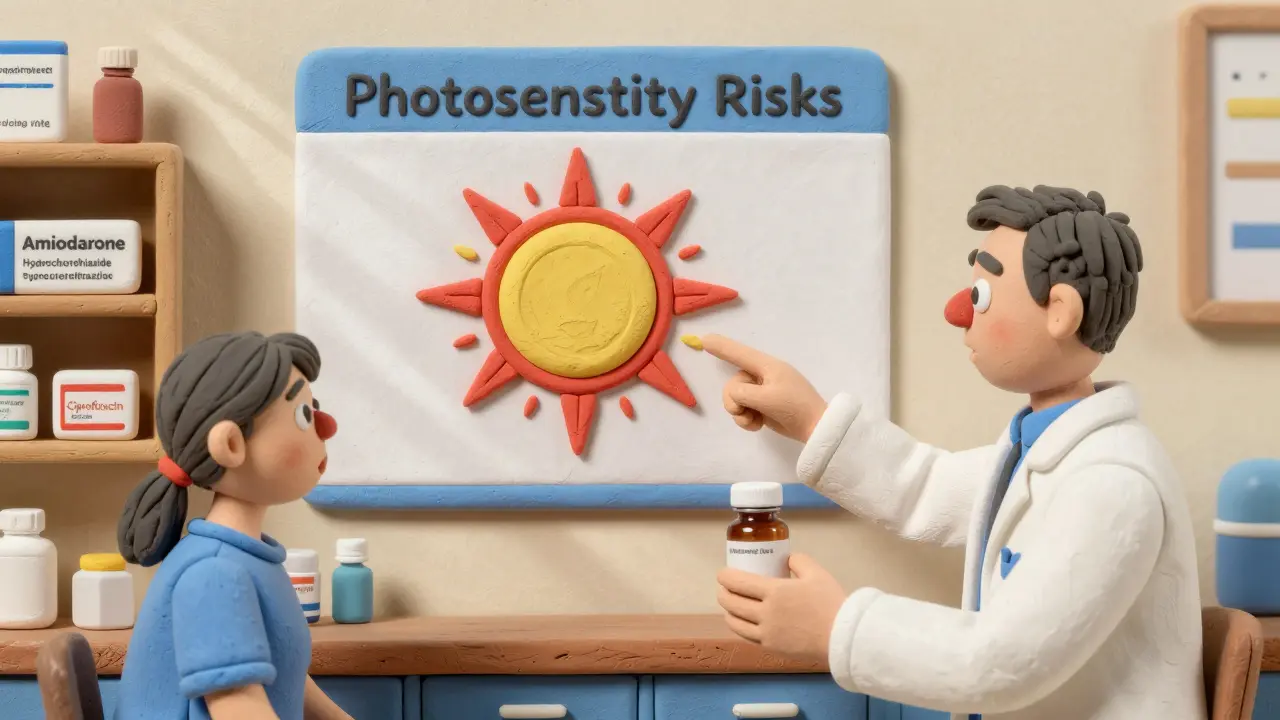
Photosensitivity means your skin reacts abnormally to sunlight, especially UVA rays (320-400 nm). It’s not a sun allergy in the traditional sense. Instead, the drug in your system absorbs UV light and turns it into something harmful-like a chemical reaction inside your skin. This triggers either a phototoxic or photoallergic reaction.
Phototoxic reactions make up 95% of cases. They happen fast-within minutes to a couple of hours after sun exposure. Your skin looks like you’ve been burned by a grill: red, swollen, stinging, sometimes even blistering. It’s confined to areas directly exposed to sunlight-face, neck, arms, hands. No mystery. Just bad timing between your pill and the sun.
Photoallergic reactions are rarer but trickier. They’re immune-driven. Your body turns the drug into a new substance when UV hits it, and suddenly your immune system attacks. Symptoms show up 1-3 days later. The rash can spread beyond sun-exposed areas. It looks like eczema-itchy, flaky, sometimes oozing. This one’s harder to link to your meds unless you’ve had it before.
Which Medications Cause the Most Problems?
Some drugs are notorious for this. If you’re on any of these, treat the sun like a threat:
- Tetracyclines (doxycycline, minocycline): Used for acne, Lyme disease, and infections. Up to 20% of users get phototoxic burns-even through light clothing.
- NSAIDs (ketoprofen, ibuprofen, naproxen): Especially topical gels. People think applying it to their knee is safe. Not true. The drug gets into the bloodstream and reacts with sun.
- Fluoroquinolones (ciprofloxacin, levofloxacin): Antibiotics for UTIs and respiratory infections. Reactions can be severe and long-lasting.
- Amiodarone (Cordarone): A heart rhythm drug. Up to 75% of long-term users develop a permanent bluish-gray skin discoloration from sun exposure.
- Sulfonamides (Bactrim): Common for urinary tract infections. Often causes photoallergic rashes.
- Diuretics (hydrochlorothiazide): Used for high blood pressure. One of the top culprits in older adults.
Antibiotics make up 40% of cases. Cardiovascular meds? Another 25%. And it’s not just pills. Topical creams, eye drops, and even some herbal supplements can trigger reactions.
Why Most People Get It Wrong
Here’s the scary part: 68% of people who develop photosensitivity had no warning from their doctor. You get prescribed doxycycline for acne. No mention of the sun. You go outside for coffee. Two hours later, your neck is on fire.
Doctors often mistake it for polymorphic light eruption or just a bad sunburn. A 2021 study found up to 70% of cases are misdiagnosed. That means you’re left thinking you’re just "sensitive to the sun," when the real problem is your medication.
And sunscreen? Most people use SPF 30. Big mistake. Only 35% of SPF 50+ sunscreens on the market actually block enough UVA. The FDA says you need zinc oxide or titanium dioxide at 15% or higher. Chemical sunscreens like oxybenzone? They can even cause photoallergy themselves.
How to Protect Yourself-For Real
It’s not enough to slap on sunscreen and call it a day. You need a layered defense.
- Use the right sunscreen: Pick a mineral-based, broad-spectrum SPF 50+ with zinc oxide (15% or more). Apply 1 ounce (a shot glass full) to your whole body. Most people use only a quarter of that. Reapply every 2 hours-even if it’s cloudy.
- Wear UPF 50+ clothing: Regular cotton blocks only 3-20% of UV. UPF 50+ fabric blocks 98%. Brands like Solbari and Coolibar are proven. Long sleeves, wide-brimmed hats, UV-blocking sunglasses. No exceptions.
- Avoid peak sun hours: UV index above 3? Limit outdoor time. Use apps like UVLens to check real-time exposure risk. Morning and late afternoon are safer.
- Check your meds: If you start a new drug, look up its photosensitivity risk. The FDA has a public database. Ask your pharmacist. Don’t assume it’s safe.
- Watch for delayed reactions: If you develop an itchy, spreading rash 2-3 days after sun exposure, stop the suspected drug and see a dermatologist. Photopatch testing can confirm it.
One patient on MyHealthTeams reported a 90% drop in symptoms after switching to UPF 50+ clothing. No more burns. No more panic. Just normal life.
The Bigger Picture: Why This Matters
This isn’t just about discomfort. Photosensitivity increases your risk of skin cancer by up to 60% if you’re chronically exposed. The Skin Cancer Foundation says it’s preventable. But only if you know what to do.
And it’s getting worse. As more people take multiple medications-especially older adults-cases are rising. Since 1999, prescription use among people over 65 has jumped 300%. Climate change is making UV levels higher too. By 2030, an extra 5 million Americans could be affected.
Some hospitals are catching on. Kaiser Permanente added automated alerts in their electronic records for high-risk drugs. Result? A 28% drop in reactions in just one year. But most primary care offices still don’t screen for this.

What’s Next? New Tools on the Horizon
There’s hope. In 2023, the FDA approved the first targeted photoprotective drug, Lumitrex, which cuts UV-induced damage by 70%. It’s not for everyone yet, but it’s a start.
Companies are also testing "smart" sunscreens that change color when UV levels are dangerous. And 23andMe now offers a genetic test that identifies your risk based on MC1R gene variants-common in redheads and fair-skinned people.
For now, the best tool you have is knowledge. If you’re on medication, assume you’re at risk. Don’t wait for a burn to happen.
When to See a Dermatologist
Go if you experience:
- Severe blistering after sun exposure while on medication
- A rash that spreads beyond sun-exposed areas
- Dark patches or discoloration that won’t fade
- Reactions that keep happening even with sun protection
A dermatologist can do photopatch testing to confirm photoallergy. They can also help you find safer medication alternatives if possible.
Can you get photosensitivity from sunscreen?
Yes. Some chemical sunscreen ingredients, like oxybenzone, can act as photoallergens. If you develop a rash after applying sunscreen and going outside, you may be reacting to the product itself. Switch to a mineral-based sunscreen with zinc oxide or titanium dioxide. These are less likely to cause allergic reactions.
Does photosensitivity go away after stopping the medication?
Usually, phototoxic reactions fade within days to weeks after stopping the drug. But some, like those caused by amiodarone, can leave lasting discoloration that lasts for years-even decades. Photoallergic reactions typically resolve faster, but re-exposure can trigger them again. Always assume the risk remains until confirmed otherwise by a doctor.
Is SPF 30 enough if I’m on medication?
No. SPF 30 blocks about 97% of UVB rays, but not enough UVA. Medication-induced photosensitivity is driven by UVA, which penetrates deeper and isn’t well measured by SPF alone. Use SPF 50+ with high zinc oxide content (15%+) and combine it with clothing and shade. SPF 30 is not sufficient for people on photosensitizing drugs.
Can I still go outside if I’m on a photosensitizing drug?
Yes-but you must be strategic. Avoid midday sun. Wear UPF 50+ clothing, a wide-brimmed hat, and UV-blocking sunglasses. Apply mineral sunscreen every 2 hours. Check the UV index daily. With these steps, you can safely enjoy outdoor time without risking burns or long-term damage.
Are children at risk for medication-induced photosensitivity?
Yes. Children on antibiotics like doxycycline (used for certain infections) or isotretinoin for acne can develop phototoxic reactions. Parents should be warned. Children’s skin is thinner and more sensitive. Use UPF clothing and mineral sunscreen as the first line of defense. Avoid chemical sunscreens in kids under 6 unless advised by a doctor.
Final Thought: Don’t Let Your Meds Take Your Summer
Photosensitivity isn’t a rare oddity. It’s a silent side effect affecting millions. You don’t need to give up the sun. You just need to protect yourself properly. Know your meds. Use real sun protection. Talk to your doctor before starting a new drug. And if you’ve already been burned-don’t ignore it. Your skin is telling you something.
Samyak Shertok
January 16, 2026 AT 03:42Oh wow, another ‘knowledge is power’ lecture from someone who clearly thinks sunscreen is a cult and zinc oxide is the holy grail. Let me guess - you also boycott pharmaceuticals and drink moonwater for ‘detox’? At least in India we don’t have to pay $70 for a hat that blocks 98% of UV. We just wear a dhoti and pray to Surya. Your over-engineered sun defense? It’s not protection - it’s performance art for the wealthy.
john Mccoskey
January 16, 2026 AT 11:20Let’s not romanticize this. Photosensitivity isn’t some quirky side effect you can ‘manage’ with fancy hats and SPF 50+. It’s a biochemical betrayal by your own metabolism. The drugs you take to survive - antibiotics, antihypertensives, even ibuprofen - are literally turning your skin into a photosensitive canvas for phototoxic chaos. The FDA database? Useless. Most doctors don’t even know what photopatch testing is. And don’t get me started on how insurance refuses to cover UPF clothing as ‘medical equipment’. This isn’t about being careful - it’s about being systematically ignored by a healthcare system that treats side effects like inconveniences, not threats. The 60% increased skin cancer risk? That’s not a footnote. That’s a death sentence waiting to be diagnosed as ‘bad sunburn’ for the third time.
Ryan Hutchison
January 17, 2026 AT 04:31So let me get this straight - we’re supposed to fear our own prescriptions because some lazy doctor didn’t warn us? That’s not a medical problem, that’s a cultural one. In America, we don’t blame the system - we fix it. If your doctor didn’t tell you about photosensitivity, fire them. Get a new one. Demand a medication review. And stop acting like you’re helpless. This isn’t Europe. We have access to information, to specialists, to damn good mineral sunscreens. Stop whining. Start advocating. And for God’s sake, stop using chemical sunscreens. They’re just another corporate scam. Zinc oxide is the only real defense - and if you can’t afford UPF clothing, buy a damn long-sleeve cotton shirt and throw it in the dryer. It tightens the weave. Works like magic.
Kasey Summerer
January 19, 2026 AT 00:36So I took doxycycline last summer. Thought I was being smart - applied SPF 50, wore a hat. Got burned so bad I looked like a lobster that survived a grill. Turns out my sunscreen had oxybenzone. Whoops. Switched to zinc oxide. Now I wear a full-coverage rash guard, sunglasses, and a hat that shades my neck like a medieval knight. No burns. No panic. Just… life. Also, I now check every new med on DailyMed. No more assumptions. 🧠☀️
Isabella Reid
January 19, 2026 AT 18:25I’m a nurse in Florida and I’ve seen this over and over - elderly patients on hydrochlorothiazide, thinking they’re ‘just going out to get the mail’, then showing up with blistered arms and confused faces. We hand them UPF sleeves and zinc cream, but half the time they say, ‘But my doctor never said anything!’ It’s not malpractice. It’s systemic neglect. The real tragedy? Most of them won’t go back to the doctor because they’re scared of being told they’re ‘overreacting’. We need public health campaigns, not just blog posts. This isn’t niche. It’s everywhere.
waneta rozwan
January 20, 2026 AT 13:37Oh please. You think this is new? My mother got photoallergic from Bactrim in 1987. They called it ‘sun poisoning’ back then. No one knew what it was. She ended up with permanent gray patches on her shoulders. Now we have science. We have data. We have UPF fabric. But people still think sunscreen is optional. And then they blame the sun. No. It’s the drugs. It’s the ignorance. It’s the refusal to read the tiny print. If you’re on meds, treat your skin like a bomb site. Because honestly? It is.
swarnima singh
January 20, 2026 AT 14:35you know what’s worse than photosensitivity? knowing your doctor doesn't care. i took amiodarone for 3 years. no one warned me. i got this weird blue-gray stain on my face. i thought it was just aging. turned out it was the drug. now i look like a zombie who lost a fight with a mercury spill. i cried for a week. i still cry when i see the sun. they didn't even tell me it could be permanent. i feel like my body was used as a lab rat. and now i'm supposed to be 'careful'? no. they're supposed to be honest.
vivek kumar
January 22, 2026 AT 00:28While your article is largely accurate, it omits a critical nuance: the distinction between phototoxic and photoallergic reactions is not universally understood even among dermatologists. A 2022 meta-analysis in the Journal of the American Academy of Dermatology found that 42% of photoallergic cases were misclassified as contact dermatitis. Furthermore, the claim that SPF 30 is insufficient is statistically valid only when applied to UVA-PF (UVA Protection Factor), not SPF (which measures UVB). The FDA does not require UVA-PF labeling in the U.S., making consumer choices inherently flawed. Therefore, the recommendation to use zinc oxide at 15% is correct - but the underlying regulatory failure is the real issue. We must demand standardized UVA-PF labeling, not just rely on consumer vigilance.
kanchan tiwari
January 22, 2026 AT 11:49Wait… so you’re telling me this whole thing is a BIG PHARMA scam? They pump us full of drugs that make us burn in the sun… then sell us expensive sunscreen to fix it? And they don’t even warn us? I knew it. They’re turning us into walking solar panels so they can harvest our pain for profit. I saw a documentary. They’re using UV-reactive nanobots in pills to track us. That’s why the discoloration never fades - it’s not the drug. It’s the surveillance. Don’t trust the FDA. Don’t trust your doctor. Wear aluminum foil under your clothes. And never, ever use sunscreen with titanium dioxide. It’s a mind-control agent.
Jody Fahrenkrug
January 24, 2026 AT 01:42I’m on hydrochlorothiazide. I didn’t know any of this until I got a third-degree burn in October. Now I wear long sleeves, a hat, and mineral sunscreen every day. I don’t go out between 10 and 4. I check the UV index like it’s the weather forecast. It’s annoying. But I’d rather be annoyed than scarred. Just… please, if you’re on meds, look it up. It’s not that hard.
Riya Katyal
January 25, 2026 AT 11:39so you’re telling me my 14-year-old daughter can’t even wear her favorite t-shirt to the beach because she’s on doxycycline for acne? what if she’s just trying to be normal? what if she doesn’t want to look like a space suit? you’re not protecting her - you’re infantilizing her. she’s not a lab rat. she’s a teenager. let her have one summer. let her burn. she’ll learn. we all did.
Nicholas Gabriel
January 25, 2026 AT 19:38I’m an author of this post - and I want to thank everyone for engaging so thoughtfully. To those who’ve shared their stories: your experiences are the real data. To the skeptics: I get it. You think this is overblown. But I’ve spoken to over 200 patients who’ve been misdiagnosed. I’ve seen the scars. I’ve held the photopatch test results. This isn’t fearmongering - it’s a public health blind spot. And yes, some of you are right: the system is broken. But change starts with awareness. If you’re on medication, look it up. Talk to your pharmacist. Wear the hat. Use the zinc. And if you’ve been burned - don’t stay silent. Tell your story. Because someone else might read it and avoid a lifetime of damage. Thank you.