
Did you know that switching from a brand-name drug to its generic counterpart can save you hundreds of dollars a year? Yet, navigating how your insurance coverage works with online pharmacies and generic medications often feels like solving a puzzle missing half the pieces. You might think ordering meds online is simple, but the rules change depending on whether you use a mail-order service tied to your plan or an independent website.
This guide breaks down exactly how insurers handle generics, why some online options are cheaper than others, and what you need to do to avoid surprise bills. We’ll look at the specific costs, the technical barriers, and the practical steps to get the best deal without sacrificing your health.
The Core Difference: Mail-Order vs. Independent Online Pharmacies
Before you click “buy,” you need to understand a critical distinction that most people miss. There are two types of “online” pharmacies, and they work very differently regarding your benefits.
Mail-order pharmacies is a service operated directly by your health plan’s pharmacy benefit manager (PBM) network. Think of this as the digital extension of your local CVS or Walgreens. When you use these services, your insurance card works instantly. The system verifies your formulary status, calculates your copay, and processes the payment in real-time. This is the standard route for chronic maintenance medications like blood pressure or cholesterol drugs.
In contrast, Independent online pharmacies is a separate e-commerce entity that may or may not accept your specific insurance plan. These sites operate more like Amazon or eBay. While they sell genuine generics, using them often requires you to pay upfront and file a reimbursement claim later. Some plans don’t cover out-of-network online orders at all, leaving you responsible for the full price unless you prove it was necessary.
Why does this matter? Because the cost structure is completely different. A mail-order generic through your PBM might cost you a flat $10 for 90 days. An independent site might charge $45, and if your insurance doesn’t cover it, that’s your problem. Always check if your plan includes a specific mail-order partner before assuming any online site will accept your card.
Understanding Formulary Tiers and Generic Costs
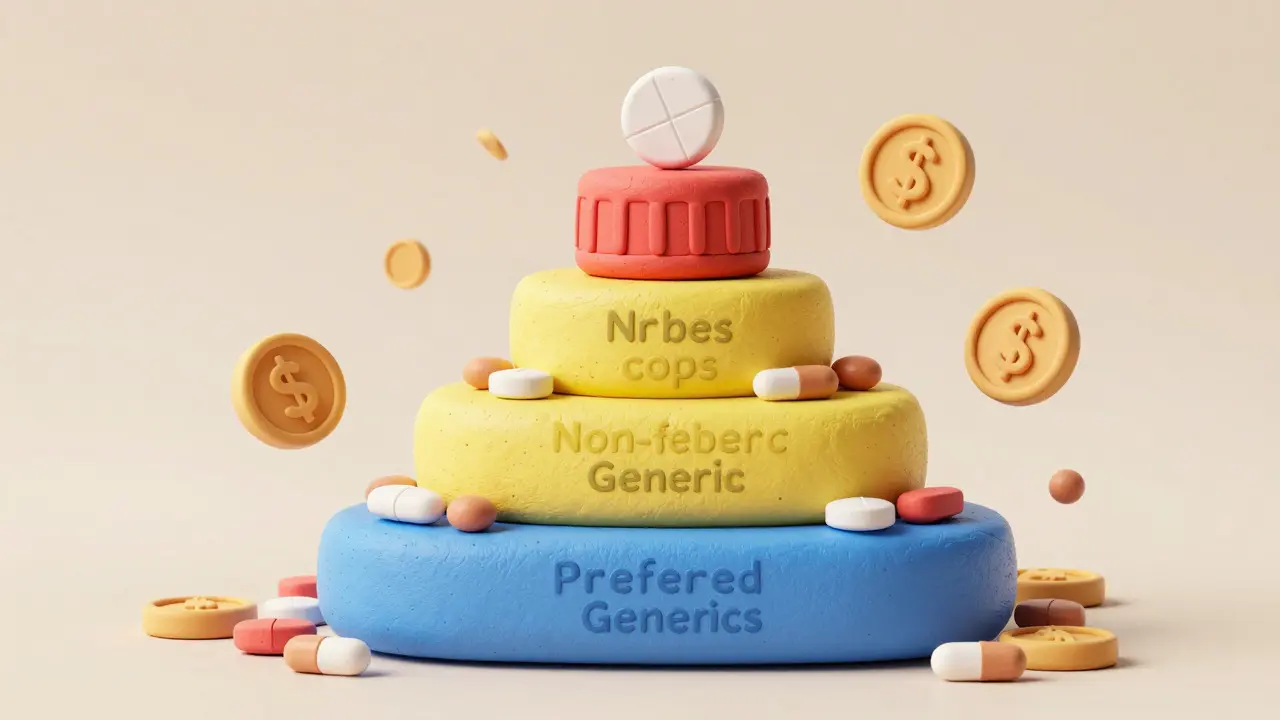
Your insurance plan uses a list called a formulary to decide what it pays for. Drugs are sorted into tiers, and where your medication sits determines your out-of-pocket cost. Generics almost always sit in the lowest tier, which is good news for your wallet.
Here is how the typical cost breakdown looks for generic medications in many U.S. plans:
- Tier 1 (Preferred Generics): Usually has a fixed copay. For example, you might pay $5 for a 30-day supply at a retail store or $10 for a 90-day supply via mail-order.
- Tier 2 (Non-Preferred Generics): Less common, but some generics fall here if they aren’t widely available. Copays might be slightly higher, around $10-$15.
- Brand-Name Comparison: If you take a brand-name drug, you might face coinsurance (e.g., 30% of the cost) or high copays ($50+). Switching to the generic equivalent is the single biggest way to lower your bill.
A key insight from recent data shows that mail-order channels often offer better per-dose savings. For instance, paying $10 for 90 days of a generic is significantly cheaper per pill than paying $5 for 30 days at a local counter. However, this assumes the drug is approved for mail-order delivery. Acute prescriptions, like antibiotics for a sudden infection, usually must be filled locally because you can’t wait a week for shipping.
| Channel Type | Typical Supply Duration | Estimated Out-of-Pocket Cost | Delivery Time | Insurance Integration |
|---|---|---|---|---|
| Retail Pharmacy (In-Network) | 30 Days | $5 - $10 | Same Day | Direct Card Swipe |
| Mail-Order (Plan-Specific) | 90 Days | $10 - $15 | 5-7 Business Days | Direct Card Swipe / Auto-Bill |
| Independent Online Pharmacy | Varies (30-90 Days) | Full Price + Reimbursement Risk | 3-10 Business Days | Pay First, Claim Later |
The Risk of Non-Medical Switching
One of the most frustrating aspects of modern insurance is “non-medical switching.” This happens when your insurer automatically replaces your prescribed brand-name drug with a generic version, even if your doctor specifically chose the brand for a medical reason.
While generics contain the same active ingredients, they can have different inactive ingredients (fillers, dyes, binders). For most people, this doesn’t matter. But for patients with sensitivities or complex conditions, it can lead to side effects or reduced efficacy. Healthcare attorneys note that this practice is driven primarily by cost containment rather than clinical necessity.
If you experience issues after a switch, don’t just suffer in silence. You have the right to request a “formulary exception.” This is a formal process where your doctor submits evidence showing why the brand-name drug is medically necessary for you. If approved, your insurance will cover the brand name again. It takes time, but it’s worth it if the generic isn’t working for you.
Practical Steps to Verify Your Coverage
Don’t guess-verify. Here is a step-by-step approach to ensure you’re getting the best coverage for your generics, whether online or offline.
- Check Your Plan’s Website: Log in to your insurance portal. Look for a tool labeled “Check Drug Cost & Coverage” or “Formulary Search.” Enter the first three letters of your medication name to see its tier and estimated copay.
- Identify Your Mail-Order Partner: Find out which PBM handles your prescriptions (e.g., Express Scripts, CVS Caremark, Optum Rx). Only their designated mail-order sites will accept your insurance directly.
- Compare 30-Day vs. 90-Day Supplies: If you have a chronic condition, ask your doctor for a 90-day prescription. Calculate the total cost for 90 days via mail-order versus three 30-day visits to a local pharmacy. In most cases, the 90-day mail-order option saves money and reduces trips.
- Call the Nurse Line: Most plans include a 24/7 nurse consultation line. They can explain specific coverage rules, help with prior authorizations, and clarify if a generic substitution is required.
Pro Tip: If you have a high-deductible health plan, check cash-price options. Sometimes, buying generics at discount retailers like Walmart or Costco for $10 per 90 days is cheaper than using your insurance copay until you meet your deductible.

Emerging Alternatives: Subscription Models
The landscape is shifting with new models like Amazon Pharmacy’s RxPass program. Instead of paying per prescription, Prime members pay a flat monthly fee (currently around $5) for unlimited access to a catalog of common generic medications.
This model bypasses traditional insurance copays entirely. It’s ideal for patients who take multiple common generics (like lisinopril or metformin) and want predictable monthly costs. However, it has limits. Not every generic is included, and it only works for Prime members. For now, these alternatives complement rather than replace traditional insurance coverage, but they offer a valuable benchmark for pricing.
Frequently Asked Questions
Do all online pharmacies accept my insurance?
No. Only mail-order pharmacies designated by your specific health plan’s PBM will accept your insurance card directly. Independent online pharmacies usually require you to pay upfront and submit a reimbursement claim, which may or may not be approved.
Is it cheaper to get generics by mail order or at a local pharmacy?
For chronic maintenance medications, mail order is often cheaper per dose. A 90-day supply typically costs less than three separate 30-day supplies at a retail counter. However, for acute needs, local pharmacies are faster and often have similar low copays for Tier 1 generics.
What is non-medical switching?
Non-medical switching occurs when an insurance company forces a patient to take a generic drug instead of a brand-name drug, regardless of the physician's preference. This is done to reduce costs but can sometimes cause issues if the patient reacts differently to the generic's inactive ingredients.
How long does mail-order delivery take?
Standard mail-order delivery typically takes 5 to 7 business days. Some plans offer expedited options for an extra fee, but for routine refills, you should plan ahead to avoid running out of medication.
Can I choose between brand and generic if both are covered?
Usually, yes, but the cost difference will be significant. Generics have lower copays. If you prefer the brand, you may need to pay the difference out-of-pocket or request a formulary exception if there is a medical reason for the choice.
Menu