
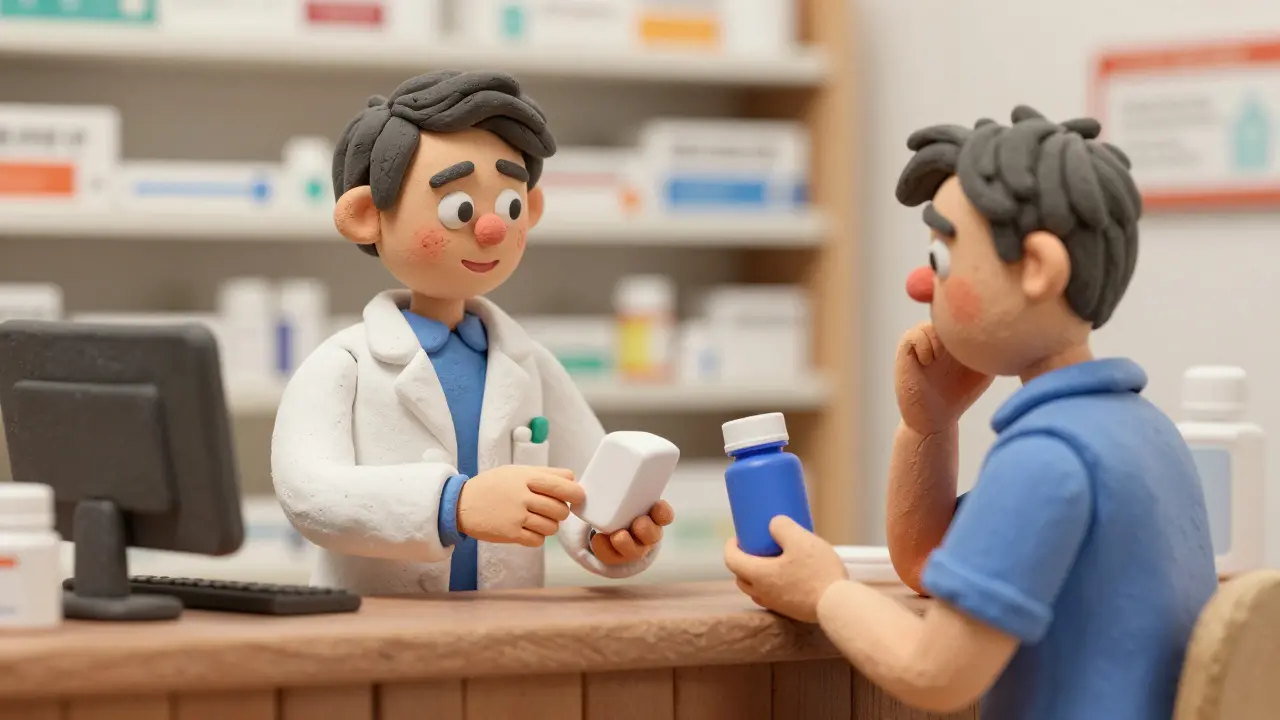
Picture this: You hand a patient their prescription, but instead of the familiar blue oval they’ve taken for years, it’s a white rectangle. Their face drops. They ask, “Is this really the same medicine?” If you’ve ever felt that moment of tension in your pharmacy, you know exactly why managing patient hesitation about generics is one of the toughest parts of our job.
It’s not just stubbornness. Research shows that 27% of patients actively worry about generic substitutions. When we get these conversations wrong, people skip doses or demand brand names, costing the healthcare system billions and putting health outcomes at risk. But when we handle them right, we build trust and keep patients safe. Here is how you can turn those awkward moments into opportunities for connection.
Why Patients Doubt Generics (And It’s Not Just About Price)
We often assume patients reject generics because they think they’re cheaper quality. While cost is a factor, the real issue is usually trust. According to FDA surveys, 43% of patients believe generics contain only 80% of the active ingredients found in brand-name drugs. That is a massive misconception.
Then there is the visual shock. A 2019 study from the University of Michigan found that 78% of patients cite pill appearance as their primary concern. When a pill changes color, shape, or size, patients literally see it as a different drug. They aren’t being difficult; they are reacting to a change in what looks like a critical part of their treatment. Understanding that this hesitation stems from fear of the unknown, rather than arrogance, is the first step to fixing it.
Do generic drugs have the same active ingredients as brand names?
Yes. By law, generic medications must contain the exact same active ingredient, dose, strength, and route of administration as the brand-name product. The Food and Drug Administration (FDA) requires generics to demonstrate bioequivalence, meaning they perform in the body within an acceptable range (80-125%) compared to the brand name.
The Science Behind the Swap: Explaining Bioequivalence Simply
You don’t need to be a chemist to explain bioequivalence, but you do need to be clear. The Hatch-Waxman Act of 1984 established strict rules: generics must prove they deliver the same amount of active ingredient into the bloodstream over the same time period as the brand name. This is called bioequivalence.
However, only 32% of patients actually understand these rigorous standards, according to 2022 data from the National Community Pharmacists Association. Your job is to bridge that gap. Instead of throwing around terms like "pharmacokinetics," try saying, "This generic has been tested to ensure it works in your body at the exact same speed and strength as the brand name you were used to."
Think of it like buying store-brand batteries. They might look different and cost less, but if they meet the same safety and performance standards, they will run your remote just as long as the name brand. Using analogies like this helps demystify the science without oversimplifying the safety.
Timing Is Everything: Catch Them Before the Counter
Where and when you have this conversation matters more than you might think. The FDA’s 2022 report on Generic Drug User Fee Amendments (GDUFA III) highlights a striking difference: 89% of patients accepted generics when educated at the point of prescribing, compared to just 63% when the education happened only at the pharmacy counter.
If possible, coordinate with prescribers. A team-based approach involving both doctors and pharmacists boosts generic acceptance to 85%, significantly higher than pharmacist-only interventions (67%). If you are the first line of defense, try to catch concerns early. Don’t wait for the patient to complain about the pill’s look. Proactively explaining the substitution before they express concern achieves an 82% acceptance rate, versus 47% when you react defensively after they voice doubt.

Communication Frameworks That Actually Work
Telling a patient "it’s the same thing" rarely works. In fact, dismissive approaches can reduce acceptance to 31%. You need a structured way to talk through their fears. Two frameworks stand out in recent research.
The Ask-Tell-Ask Method
This simple three-step process was tracked in a 2020 study across 1,247 patients. Providers who used Ask-Tell-Ask achieved a 68% generic acceptance rate, compared to 42% with standard communication. Here is how it breaks down:
- Ask: "What have you heard about switching to this generic version?" or "How are you feeling about the change in your medication?"
- Tell: Provide clear, concise information. "I understand the pill looks different. I want to assure you that this generic contains the exact same active ingredient and has passed strict FDA testing to work just like your previous prescription."
- Ask: "Does that make sense?" or "What questions do you still have?"
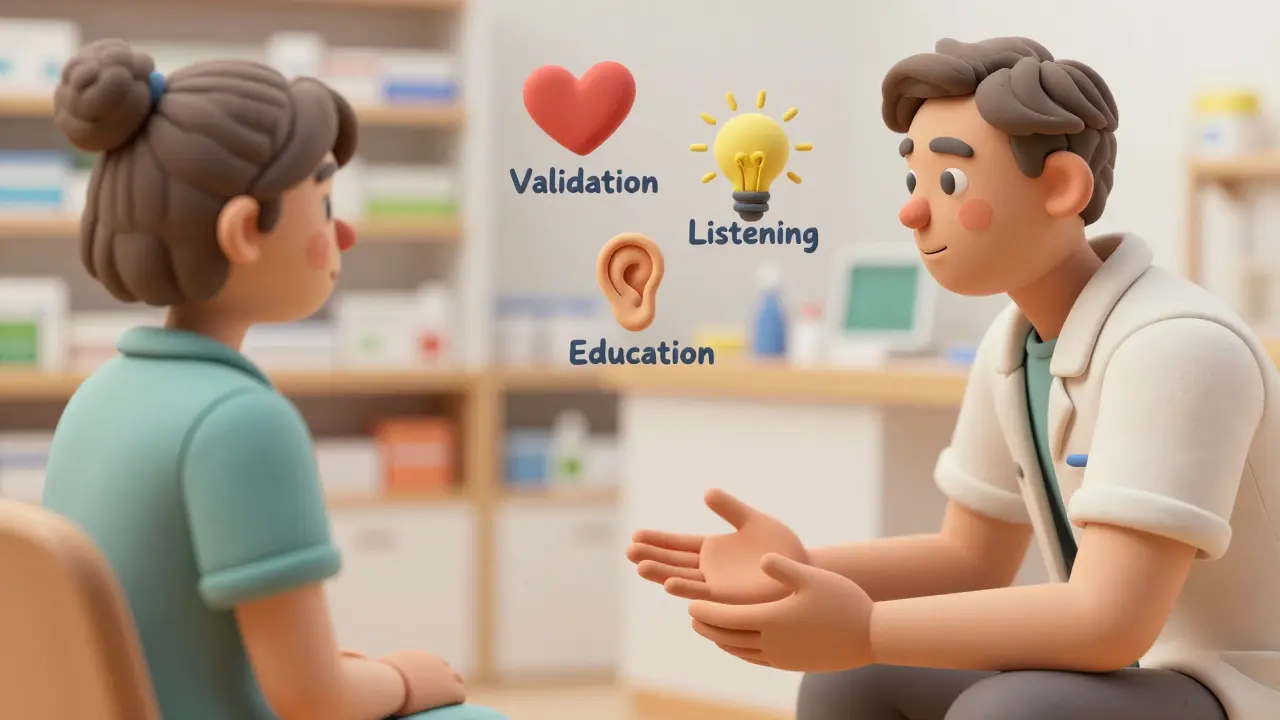
The VALUE Technique
A 2023 review in The U.S. Pharmacist found that the VALUE technique outperformed others with a 76% success rate. It stands for:
- Validate their concerns ("It’s completely normal to feel unsure when your pill changes.")
- Acknowledge their feelings ("I can see this is worrying you.")
- Listen actively (Let them finish their thought without interrupting.)
- Understand their perspective ("So, you’re worried it won’t control your blood pressure as well?")
- Educate with empathy (Share the facts gently, focusing on their specific health goals.)
Words Matter: What to Say vs. What to Avoid
Your phrasing can make or break the conversation. A publication by the Royal Australian College of General Practitioners (RACGP) in October 2021 documented significant differences in outcomes based on wording.
When providers explained, "This medication contains exactly the same active ingredient but without the brand name marketing costs," acceptance increased by 29%. In contrast, simply stating, "This is cheaper," only improved acceptance by 7%. Worse, overemphasizing cost alone can backfire. A 2021 analysis in JAMA Internal Medicine showed a 22% decrease in trust when cost was the sole justification for switching.
Patients want to know they are getting effective care, not just cheap care. Frame the switch as a smart, evidence-based choice for their health, not a budget cut. Use personalized endorsements, too. Data from the American Journal of Managed Care shows that saying, "I prescribe this generic for my own family," increases acceptance rates by 37 percentage points. It humanizes the decision and leverages your expertise as a trusted advisor.
| Phrase Used | Acceptance Impact | Key Insight |
|---|---|---|
| "Same active ingredient, no marketing costs" | +29% | Facts + Value proposition | "I use this for my family" | +37% | Personal endorsement builds trust |
| "It's cheaper" | +7% | Low impact; may signal lower quality |
| "It's the same, just cheaper" | -31% | Dismissive tone reduces trust |
Handling Specific Objections: Pill Appearance and "It Didn't Work For Me"
Some objections are harder than others. Let’s tackle the two most common ones.
The Appearance Issue: As mentioned, 78% of patients worry about how the pill looks. Visual aids help. A Healthcare Hotline survey found that 68% of patients would accept generics if shown visual comparison tools. If your pharmacy has access to digital tools like the FDA’s "Generics Smart" toolkit (which includes 3D pill comparisons), use them. Showing a side-by-side image of the old and new pills with a label confirming "Same Active Ingredient" can instantly calm nerves.
The "It Didn't Work" Claim: Sometimes patients swear the generic doesn’t work as well. Before dismissing this, listen. Dr. Michael Cohen’s research in the American Journal of Health-System Pharmacy found that providers who incorporate patient goals into discussions achieve 41% higher adherence. Ask, "What specifically did you notice was different?" Was it a side effect? A timing issue? Often, the problem isn’t the drug’s efficacy but the inactive ingredients causing mild stomach upset, or the patient taking it at a different time of day. Addressing the root cause, rather than debating the science, resolves the issue faster.
Practical Tools for Busy Pharmacies
We all know time is tight. Primary care physicians average just 18 seconds before interrupting patients discussing medication concerns. In a busy pharmacy, you might have even less. So, how do you implement these strategies efficiently?
- Use Pre-Printed Materials: The FDA offers 17 evidence-based tools, including counter mats and brochures. Handing a patient a small card that explains bioequivalence in plain language takes 10 seconds and reinforces your verbal message.
- Leverage Technology: If your EHR allows, set automated prompts for generic substitution counseling. The American Medical Association recommends integrating generic education into electronic health records to remind providers to address concerns proactively.
- Practice Role-Playing: The ACCP suggests 4-6 hours of role-playing training to overcome reflexive dismissiveness. Practice handling common objections like "Generics don't work for me" with a colleague until the response feels natural.
- Document the Conversation: Under GDUFA III regulations, documenting generic substitution discussions using standardized terminology is now mandatory for many settings. This protects you and ensures continuity of care.
Building Long-Term Trust Beyond the Transaction
Dr. Janet Woodcock, Director of the FDA’s Center for Drug Evaluation and Research, noted in 2023 that "Generic hesitancy stems from trust gaps, not knowledge gaps." You cannot fix a trust gap with a fact sheet alone. You fix it by showing you care about the patient’s experience.
Function as a "trusted advisor," not just an information librarian. When a patient expresses doubt, validate it. Say, "I hear you, and I’m here to make sure you feel confident in this medication." This small shift in tone transforms the interaction from a transactional exchange to a therapeutic relationship. Over time, patients who feel heard are far more likely to follow your advice, leading to better adherence and healthier outcomes.
How much time should I spend discussing generics with a patient?
The American College of Clinical Pharmacy (ACCP) recommends allocating 3-5 minutes per patient for generic substitution discussions. This brief window is sufficient to address concerns adequately if you use structured communication techniques like Ask-Tell-Ask.
What should I do if a patient insists the generic causes side effects?
First, document the complaint. Then, investigate whether the side effects could be related to inactive ingredients or timing. If the issue persists, consult with the prescriber about alternative generic manufacturers or, if medically necessary, reverting to the brand name. Never dismiss the patient's experience.
Are there legal requirements for documenting generic substitution talks?
Yes. Effective January 2024, FDA mandates under GDUFA III require that generic substitution discussions be documented in patient records using standardized terminology. This ensures transparency and continuity of care.
Which demographic groups are most hesitant about generics?
According to the 2023 AHRQ National Healthcare Quality and Disparities Report, 38% of patients over 65 express concerns about generics, compared to 22% of younger patients. Additionally, 47% of rural patients show hesitation versus 29% of urban patients.
Can AI help with generic medication communication?
Emerging research suggests yes. The NIH is funding a study testing AI-driven communication strategies that adapt to individual patient belief profiles. Currently, digital toolkits like the FDA's "Generics Smart" offer virtual reality demonstrations and 3D comparisons to aid understanding.
Menu