

The factory floor feels different today. Walk through any major plant in 2026 and you might spot the same tightness in the air, a quiet tension that wasn't there five years ago. It isn't just about hitting production quotas anymore. The conversation has shifted dramatically toward survival and trust. Manufacturers are no longer asking, "Can we build enough?" Instead, they are terrified by a new question: "If we miss one detail, does the whole thing collapse?"
This anxiety isn't unfounded. Recent data paints a picture of high stakes. According to the U.S. Manufacturing Insights Report, released in July 2025 by ZEISS Industrial Quality Solutions, 93% of manufacturers now rank quality as very or extremely important to their operations. Among executives, that number jumps to 95%. When nearly everyone admits that quality is mission-critical, the room becomes small and claustrophobic. There is nowhere to hide.
The Real Fears Driving Production Anxiety
Why is the mood so tense? It stems from a clash between expectations and resources. In 2025, 44% of manufacturers identified rising material costs as their top concern. But hidden behind that headline is the fear of waste. You buy expensive raw materials-lithium for batteries, rare earth metals for electronics-and if your inspection process misses a defect until after assembly, that money vanishes.
Think of it like cooking a gourmet meal. You have the finest ingredients, but if you burn them or plate them wrong, the value disappears instantly. In manufacturing, the cost of rework accounts for a massive chunk of lost revenue. About 38% of respondents cite rework and iterations as a leading challenge. This creates a vicious cycle. You spend money to fix a mistake, which delays the timeline, which causes pressure to rush the next batch, leading to more mistakes.
It's not just internal inefficiency. We are seeing this bleed into the supply chain. A single missed shipment can trigger domino effects, idling machines across the country. Manufacturers are operating in just-in-time environments where buffers are non-existent. The margin for error has become razor-thin. This fragility fuels the psychological impact of quality failure. It stops being a checkbox exercise and starts feeling like walking a tightrope without a net.
The People Problem: Training vs. Tech
Technology alone won't solve the crisis, even though companies are rushing to buy it. The biggest headache right now is human capital. The Manufacturing Institute projects a shortage of 2.1 million manufacturing workers by 2030. Right now, 47% of manufacturers struggle with a lack of skilled personnel. They have machines, but who knows how to calibrate them?
This creates a unique kind of stress known as skill fatigue. Production managers are expected to deliver aerospace-grade precision while moving at consumer electronics speed. One manager noted in a recent forum discussion, "It's impossible without proper technology investment," but another admitted that investing doesn't always help. Traditional leaders warn against throwing money at shiny tools without fixing workforce training needs first.
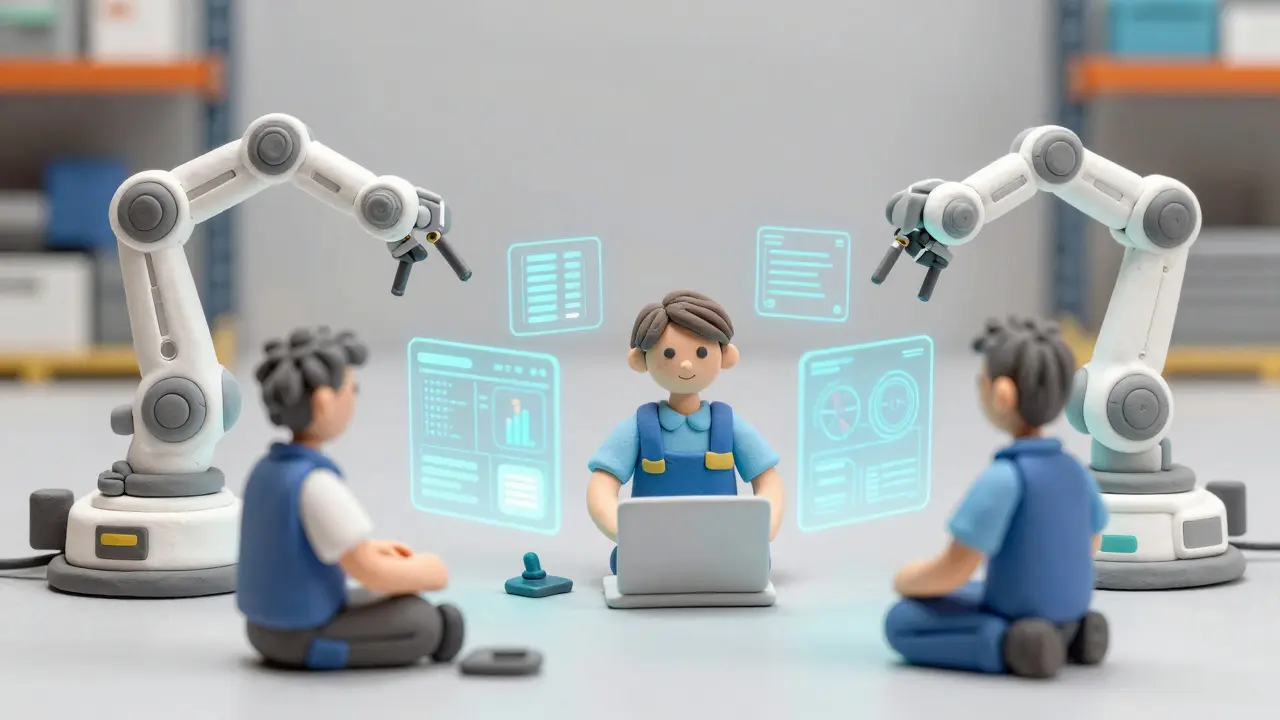
Look at the numbers: 63% of professionals report difficulty finding staff trained on both traditional quality methods and new digital tools. You cannot simply drop an AI-powered inspection robot onto the floor and expect results. You need humans who understand the underlying physics, data patterns, and mechanical logic. Without this knowledge transfer, the tools sit idle or generate bad data. This skills gap widens the fear gap because you know the solution exists, but you don't have the people to execute it.

Metrology and the Precision Paradox
Metrology Technology, the science of measurement, has become the frontline defense against defects. However, adopting these tools comes with its own set of headaches. Manufacturers are facing increasing product complexity. Electric vehicle parts, smart sensors, and connected devices require measurements at microscopic levels. A deviation of a few microns can ruin a batch worth millions.
In the past, you might check every tenth part. Today, the demand is for real-time monitoring throughout the entire lifecycle. The problem? Traditional inspection processes consume 47% of manufacturers' time. That is almost half your day spent checking things instead of making things. To combat this, 66% of manufacturers are planning to invest in more than one metrology technology. Why multiple? Because one tool rarely measures everything perfectly.
We see a clear divide emerging between those who integrate these systems and those who treat them as separate silos. Reader Precision reported that automation and robotics are often implemented without proper system integration. This creates a scenario where machines talk to each other, but nobody listens. A quality engineer at an automotive supplier shared a success story: implementing AI-enhanced software improved defect detection by 37%. Contrast that with an electronics manufacturer that spent $2.3 million on automation without training staff, resulting in 40% higher error rates initially.
How Quality Impacts Brand Psychology
This is where the topic gets deeper than just operations. Quality assurance is no longer just about compliance; it is a core component of Brand Psychology. In an era where news travels fast, a product recall destroys consumer trust instantly. Customers equate consistency with safety. If a car, medical device, or even a household appliance feels unreliable, the consumer subconsciously associates that risk with the entire company.
Research shows that manufacturers prioritizing quality as a core function will achieve 28% higher profit margins by 2030 compared to those treating it as compliance. This indicates that customers vote with their wallets. They prefer brands that project reliability. Conversely, failing to invest in predictive analytics could lead to 23% higher defect rates by 2027 compared to early adopters. That isn't just a statistic; that is a direct hit on reputation.
There is also a subtle cultural shift happening internally. When quality becomes a strategic advantage rather than a back-office chore, morale improves. Workers feel pride in their output. This contrasts sharply with environments where quality checks feel punitive. By aligning quality metrics with customer experience (CX) goals, companies bridge the gap between the shop floor and the market. The team sees exactly how their work helps the end-user, turning fear into purpose.
| Feature | Traditional Approach | Integrated Digital Approach |
|---|---|---|
| Rework Costs | Higher (Industry Average) | 22% Lower |
| Time-to-Market | Slower | 18% Faster |
| Data Silos | Frequent | Minimal |
| Predictive Capability | Low/Reactive | High/Proactive |
Navigating the Implementation Hurdles
If you want to move forward, the road ahead is bumpy. Full deployment of modern systems typically takes 6-9 months. It is not a weekend fix. The steepest learning curve hits legacy manufacturers transitioning from manual to digital. You have to teach teams to think like data analysts. This requires 73% of hiring managers to look for data literacy skills in quality roles, pushing median salaries for AI-skilled quality pros to $98,500 by mid-2025.
Common challenges include integrating with old hardware (legacy systems), insufficient staff training, and siloed data. 52% of users complain about data living in different departments. Successful implementations involve cross-functional teams working together from the start. You need quality engineers, production managers, and IT specialists collaborating daily. If you wait until the end to call in IT, you will likely fail.
Vendor support varies significantly. Enterprise solutions often offer faster resolution times for complex issues compared to smaller cloud-based providers. However, cloud options provide greater accessibility. Cloud-based Quality Management Systems (QMS) captured 68% of new enterprise deployments in 2025. These allow geographically dispersed operations to maintain consistent standards, which is vital as factories grow globally.
The Road Ahead: From Compliance to Competence
By 2027, predictions indicate that 89% of leading manufacturers will have integrated AI-driven quality analytics. Those who delay face 19% higher operational costs on average. This trend isn't slowing down. Regulatory pressures are intensifying, with 63% reporting increased documentation requirements in 2025 compared to the previous year. Global trade policies and sustainability mandates are forcing lean manufacturing operations to remain a priority for long-term viability.
Dr. Evelyn Rodriguez from MIT emphasized that Cyber-Physical Systems (CPS) will play a pivotal role in monitoring processes. These systems ensure adherence to standards while optimizing efficiency. Yet, skepticism remains. Some argue that without addressing fundamental workforce training, technology is useless. That argument holds weight. You cannot automate away the need for human oversight entirely. The most robust strategy combines advanced tools with deep human expertise.
Ultimately, the fear isn't about the machines failing. It's about the gap between capability and execution. Manufacturers who close that gap turn a terrifying landscape into a competitive moat. They stop worrying about whether a part broke and start knowing exactly why it works.
What are the top concerns for manufacturers in 2025?
The top concerns include rising material costs, cited by 44% of manufacturers, and skilled labor shortages affecting 47% of operations. Rework costs and time-consuming inspection processes are also significant pain points impacting profitability.
How does AI improve quality assurance?
AI enhances quality assurance by enabling predictive analytics and real-time monitoring. Users have reported defect detection improvements of up to 37% and reductions in false positives, which speeds up production and lowers labor costs.
Why is the skills gap such a big issue?
63% of professionals find it difficult to locate staff trained on both traditional methods and new digital tools. As automation grows, the need for workers who can interpret complex data is outstripping the available talent pool, threatening operational continuity.
What is the impact of quality on brand reputation?
Quality directly influences consumer trust. Consistent quality signals safety and reliability. Companies prioritizing quality as a core function rather than just compliance are projected to achieve 28% higher profit margins due to stronger brand loyalty.
How long does it take to implement new quality systems?
Full deployment typically takes 6-9 months. Successful cases involve cross-functional teams including quality engineers and IT specialists working collaboratively from the planning phase to mitigate integration issues.
Molly O'Donnell
April 2, 2026 AT 06:36The margin for error has vanished completely.
James DeZego
April 2, 2026 AT 14:42Data literacy is becoming a mandatory skill set for modern QA teams now 😊.
The transition to digital twins requires understanding the underlying metrics deeply.
We need to focus on predictive maintenance to avoid downtime scenarios effectively.
Rocky Pabillore
April 3, 2026 AT 11:09That viewpoint is far too simplistic for the nuances involved here.
Most operators do not possess the requisite intellectual capacity to interpret such complex datasets accurately.
It requires a certain caliber of mind to handle metrology properly.
Callie Bartley
April 5, 2026 AT 05:30Domestic production standards are slipping due to foreign outsourcing pressures clearly.
We cannot rely on external vendors to maintain our safety protocols anymore.
American manufacturing needs to take control back immediately.
Cullen Zelenka
April 6, 2026 AT 08:18There is plenty of room for growth in this sector despite the challenges ahead.
Teams are resilient and will adapt to these new digital requirements soon enough.
Positive engagement drives better retention rates within factories consistently.
Sharon Munger
April 7, 2026 AT 04:30Collaboration helps most
People share ideas better when barriers go down
We should work together on this
Eleanor Black
April 7, 2026 AT 04:59The current state of workforce preparedness is fundamentally concerning regarding long-term stability.
Many organizations assume technology will solve issues without adequate human training protocols 😟.
We observe a disconnect between boardroom strategy and floor-level reality constantly.
Investment dollars flow toward automation before the people are ready to manage it.
This sequence of events leads directly to the error rates reported in recent industry studies.
A skilled technician understands the physics behind the measurements unlike a generic operator.
Replacing intuition with screens removes essential diagnostic capabilities from the workflow.
When a sensor fails the backup plan relies heavily on human judgment and speed.
If the staff lacks deep knowledge the entire system becomes vulnerable to minor glitches.
We must recognize that culture shapes how new tools get integrated successfully 🛠️.
Management needs to listen to feedback from those actually running the machines daily.
Ignoring the frontline perspective results in costly mistakes during implementation phases.
Sustainability depends on retaining institutional memory while upgrading hardware simultaneously.
Failure to bridge the skills gap threatens the viability of future production goals significantly.
Strategic planning must prioritize education alongside capital expenditure from the outset always.
True excellence emerges only when people and technology align perfectly together.
Russel Sarong
April 7, 2026 AT 16:29You are absolutely right about the human element being critical!!!
Nothing matters more than having trained staff on site!!!!
The risks are high and we must act fast!!!!!!
Arun Kumar
April 8, 2026 AT 13:03Perhaps we can find common ground in acknowledging diverse skill levels among workers.
Everyone brings value regardless of their technical background currently.
Fostering inclusivity allows us to tap into a wider pool of problem-solving potential naturally.