

Imagine taking a medication where a tiny shift in the dose-something as small as a few milligrams-could be the difference between a treatment that works and one that is suddenly toxic or completely ineffective. This is the reality for patients using NTI drugs. Because the window between a safe dose and a dangerous one is so slim, the FDA can't treat these generics like a standard bottle of ibuprofen. For these specific medications, the usual rules of "close enough" don't apply.
To keep patients safe, the FDA enforces a much stricter set of hurdles for generic versions of these drugs. While most generics just need to be "roughly equivalent" to the brand name, Narrow Therapeutic Index drugs must meet incredibly tight quality and performance specifications. If they don't, they don't hit the market.
Quick Summary of NTI Standards
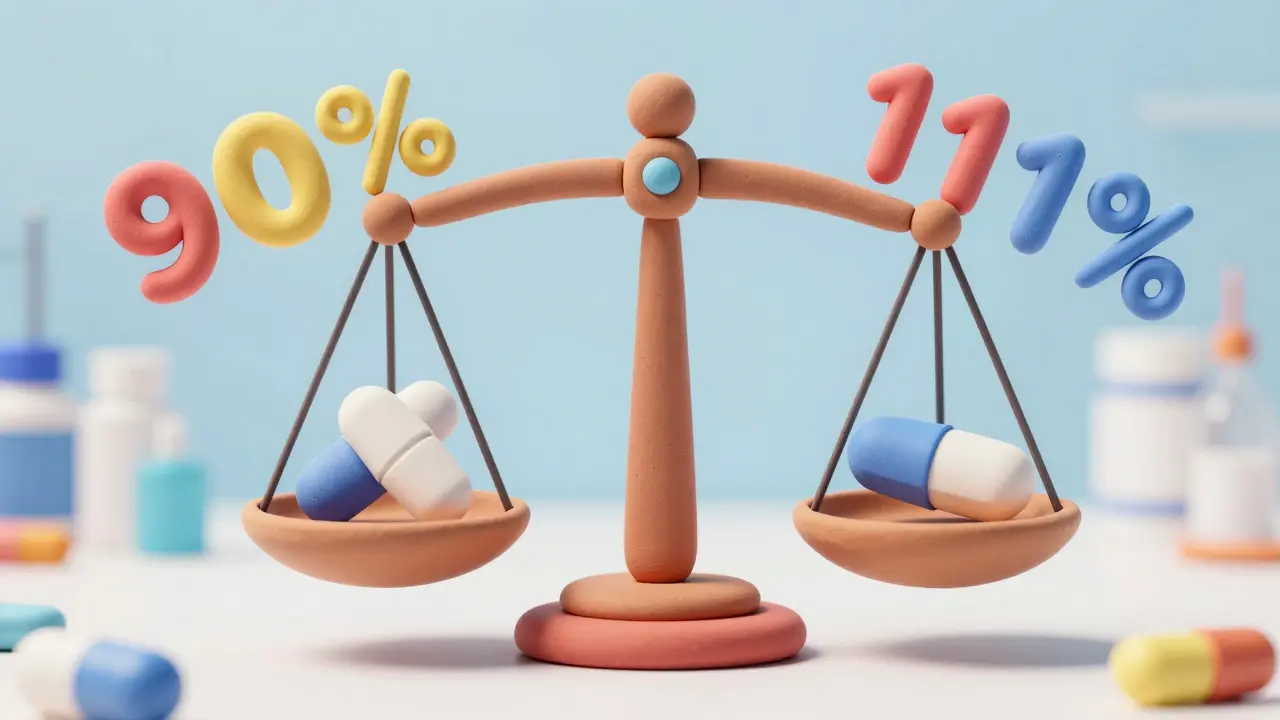
- Tighter Bioequivalence: Instead of the standard 80-125% range, NTI drugs often must fall within a narrow 90-111% window.
- Strict Quality Control: Assay acceptance ranges are tightened from 90-110% to 95-105%.
- Complex Testing: The FDA requires replicate studies and often uses a "scaled" approach based on the brand drug's variability.
- Specific Identification: There isn't one master list; instead, the FDA provides product-specific guidelines to identify NTI requirements.
What Exactly Makes a Drug "Narrow Therapeutic Index"?
A Narrow Therapeutic Index (NTI) drug is a medication where small differences in blood concentration can lead to serious therapeutic failures or adverse reactions. Think of it like walking a tightrope: if you lean too far one way, the drug doesn't work; lean too far the other, and you're in the emergency room.
But how does the FDA actually decide if a drug is NTI? They don't just guess. According to a 2022 pharmacometric study, the FDA uses a therapeutic index of 3 or less as a reasonable cutoff. Basically, if the dose required to cause toxicity is less than three times the dose required for a therapeutic effect, it's flagged as NTI. They also look for other clues, such as whether the drug requires routine blood monitoring or if doctors typically adjust doses in tiny increments of less than 20%.
The High Bar for Bioequivalence
For most generic drugs, bioequivalence (BE) is measured by a 90% confidence interval between 80.00% and 125.00%. For a standard drug, a 20% difference in exposure is usually fine. But for NTI drugs, that 20% gap could be lethal or lead to a seizure.
Because of this, the FDA shifted the goalposts. Following an Advisory Committee meeting in 2010, they recommended much narrower limits. Now, many NTI drugs must hit a target of 90.00% to 111.11%. This means the generic must be almost an exact mirror of the brand-name product in how it enters the bloodstream.
The FDA also uses a sophisticated method called Scaled Average Bioequivalence (SABE). Instead of a one-size-fits-all limit, they scale the requirements based on the variability of the reference drug. If the brand-name drug itself varies a lot from person to person, the FDA adjusts the limits, but the generic must still pass the conventional 80-125% test as a baseline.
| Feature | Standard Generic Drugs | NTI Generic Drugs |
|---|---|---|
| BE Acceptance Range | 80.00% - 125.00% | 90.00% - 111.11% |
| Quality Assay Range | 90% - 110% | 95% - 105% |
| Study Design | Standard BE study | Replicate studies required |
| Dose Sensitivity | Moderate to Low | High (Small shifts = big risk) |
Which Drugs Fall Under These Strict Rules?
You won't find a single "Official NTI List" on the FDA website. Instead, the agency uses product-specific guidances. However, several well-known medications are consistently treated as NTI. For example, Digoxin (used for heart failure) and Warfarin (a blood thinner) are classic examples. A tiny bit too much Warfarin can cause internal bleeding, while too little can lead to a stroke.
Other common NTI categories include:
- Antiepileptics: Drugs like Phenytoin, Carbamazepine, and Valproic Acid.
- Immunosuppressants: Medications like Tacrolimus, Cyclosporine, and Sirolimus, which prevent organ transplant rejection.
- Other: Digoxin and Lithium Carbonate (used for mood stabilization).
The Real-World Debate: Is "Bioequivalent" Always "Interchangeable"?
Here is where things get spicy. The FDA maintains that if a generic NTI drug meets these strict standards, it is therapeutically equivalent and safe to swap. Dr. Honghui Zhou from the Office of Generic Drugs has stated that these tighter criteria ensure generic NTI drugs are clinically substitutable with their brand-name versions.
However, not everyone is convinced. Many clinicians and patients, especially those dealing with epilepsy, remain skeptical. There are reports of patients experiencing "breakthrough" seizures when switching from a brand-name antiepileptic to a generic, even if that generic passed the FDA's 90-111% test. This has led to a confusing patchwork of laws: some U.S. states require a pharmacist to get the patient's specific consent before substituting an NTI drug, while others allow it automatically.
The friction comes from the fact that while two drugs might be bioequivalent on average across a study group, an individual patient's body might react differently to a slight change in an inactive ingredient or a tiny fluctuation in the active dose.

How the FDA Validates NTI Generics in the Lab
To prove a drug is truly equivalent within that razor-thin 90-111% margin, the FDA doesn't just run one test. They require replicate studies. This means the same subjects are given the drug multiple times to see how much the concentration varies within the same person over different doses.
They also look at the within-subject standard deviation. Essentially, they want to make sure that the generic drug isn't significantly more "unpredictable" than the brand name. Specifically, the upper limit of the 90% confidence interval for the ratio of the generic's variability to the brand's variability must be ≤ 2.5. If the generic is too erratic, it fails, regardless of the average concentration.
Why can't NTI drugs use the standard 80-125% bioequivalence limit?
Because for NTI drugs, a 20% difference in blood concentration can be clinically dangerous. In medications like blood thinners or anti-seizure drugs, such a gap could lead to the drug becoming toxic or failing to prevent a medical emergency.
Where can I find the full list of FDA-recognized NTI drugs?
The FDA does not maintain a single public master list. Instead, they publish product-specific guidance documents for individual medications. If a drug's guidance specifies tighter bioequivalence limits, it is being treated as an NTI drug.
Are generic NTI drugs actually the same as brand names?
According to the FDA, yes. When a generic NTI drug passes the tighter 90-111% bioequivalence and 95-105% quality tests, it is approved as therapeutically equivalent. However, some doctors suggest caution during the transition period for highly sensitive patients.
What is the "therapeutic index ≤ 3" rule?
This is a quantitative measure used by the FDA to classify NTI drugs. It means the dose that causes toxicity is no more than three times the dose that provides the desired therapeutic effect.
Do other countries use the same standards as the FDA?
Not exactly. While the EMA (Europe) and Health Canada also tighten limits for NTI drugs, the FDA's approach is more nuanced, often using "scaled" average bioequivalence based on the reference drug's specific variability rather than just a flat tighter range.
Next Steps for Patients and Providers
If you are a patient taking an NTI medication, the best move is to be consistent. If your pharmacy switches you from a brand-name to a generic (or between different generic manufacturers), notify your doctor. While the FDA considers them equivalent, your doctor may want to monitor your blood levels more closely during the first few weeks of the switch.
For pharmacists and providers, the priority is education. Understanding that NTI substitution isn't the same as substituting a generic statin or blood pressure medication is key. In some jurisdictions, verifying patient consent for NTI swaps is not just a policy, but a safety precaution to ensure the patient and doctor are in the loop.
Jon Moss
April 23, 2026 AT 13:25It's honestly a bit scary how much we rely on these tiny margins for things like epilepsy meds.
Majestic Blue Band
April 25, 2026 AT 03:16Oh please, as if we are actually expected to believe that a government agency like the FDA is meticulously enforcing these 90-111% windows when the pharmaceutical lobby spends billions to ensure that the most profitable, barely-functional generic is the one that ends up in our medicine cabinets, likely with fillers that are designed to make us dependent rather than cured, and it's absolutely terrifying that people just trust a table in a blog post without considering the systemic corruption that allows these "bioequivalent" drugs to be swapped by pharmacies who are probably getting kickbacks from the manufacturers to push specific brands of generics while the patients are the ones suffering through breakthrough seizures and mysterious side effects that are conveniently labeled as "patient variability" to keep the corporate giants from facing any real legal repercussions for their negligence in the pursuit of profit margins over human lives.
Andre Ojakäär
April 26, 2026 AT 20:01absolute joke that anyone thinks 11% is a "tight" window when you're talking about something like warfarin
literally life or death and they're over here playing with percentages like it's a math quiz
Jaclyn Vo
April 27, 2026 AT 00:05Um, hello?? The post literally says they use SABE for variability! 🙄 It's not just a flat range, maybe read a bit closer! 💅
Anand Mehra
April 27, 2026 AT 02:27SABE is just a fancy way to hide failures
Edwin Perez
April 27, 2026 AT 08:24The FDA basically just rubber stamps whatever the big labs tell them. If you think they are actually checking every batch of generic phenytoin, you are delusional. They want the cheap stuff on the market to keep the healthcare system from collapsing under its own weight, and the "strict standards" are just a PR move to keep us from rioting when we start having seizures in the middle of the grocery store because our "equivalent" med is actually garbage.
Beena Garud
April 28, 2026 AT 10:54One must contemplate the inherent tension between the pursuit of affordable medicine and the absolute necessity of precision in pharmacology. The duality of the generic drug existence represents a broader societal struggle to balance utilitarian efficiency with the sanctity of individual biological uniqueness.
Hayley Redemption
April 29, 2026 AT 14:15The intellectual dishonesty in suggesting that "patient variability" is a valid excuse for breakthrough seizures is staggering. It's a failure of the regulatory framework, plain and simple.
Michael Chukwuma
April 30, 2026 AT 00:50I can see why patients would be terrified of a switch. It's a lot to handle when your stability depends on a tiny milligram difference.
Eric Mwiti
May 1, 2026 AT 10:06Wow, a 90-111% window. I'm sure that's just a foolproof system with zero chance of human error in the lab. Truly inspiring.
Gauri Parab
May 2, 2026 AT 03:55Imagine thinking a 5% assay range is a gold standard in the modern era. It's quaint, really, that some people think this is "strict." In any actual precision industry, these tolerances would be laughed at. The FDA is merely performing a theater of safety while the industry continues to iterate on the absolute minimum requirements just to get a stamp of approval. It is an embarrassment to the scientific method that we even call this "bioequivalence" when the clinical outcome is so wildly disparate for a significant portion of the population. The sheer arrogance of the regulatory body to claim these are interchangeable is a masterclass in gaslighting the medical community.
suresh kumar
May 3, 2026 AT 19:58This whole thing is a circus of numbers! 🤡 Who cares about the 90% confidence interval when the pharmacist is just tossing pills from a different bottle every month like it's a game of roulette with your brain!
Kristen O'Neal
May 4, 2026 AT 19:42I think we need to focus on how we can better communicate these risks to patients. Maybe a mandatory flag on the prescription for NTI drugs would help everyone stay on the same page.
Karyn Tindall
May 5, 2026 AT 14:45It is absolutely heartbreaking to think of someone having a medical emergency just because a generic wasn't a perfect match! We have to protect our patients at all costs!