

Every year, millions of older adults take over-the-counter antihistamines like Benadryl to help with allergies or sleep. What they don’t know is that these pills aren’t just sleepy makers-they’re powerful blockers of a brain chemical called acetylcholine. And when you stack them with other common meds, the effect adds up. This buildup is called cumulative anticholinergic burden, and it’s quietly raising the risk of memory loss, falls, confusion, and even dementia in people over 65.
What Exactly Is Anticholinergic Burden?
Anticholinergic burden isn’t about one drug. It’s the total impact of all the drugs in your system that block acetylcholine. This neurotransmitter helps with memory, muscle control, digestion, and even bladder function. When too many medications interfere with it, your body starts to struggle. Think of it like turning off multiple lights in a house-you can still walk around, but everything feels slower, blurrier, and harder to manage. The most widely used tool to measure this burden is the Anticholinergic Burden (ACB) Scale. It rates medications on a scale from 0 to 3:- Score 0: No anticholinergic effect (like loratadine or cetirizine)
- Score 1: Mild effect (some diuretics, certain antidepressants)
- Score 2-3: Strong effect (diphenhydramine, chlorpheniramine, amitriptyline, oxybutynin)
Why Antihistamines Are the Hidden Culprit
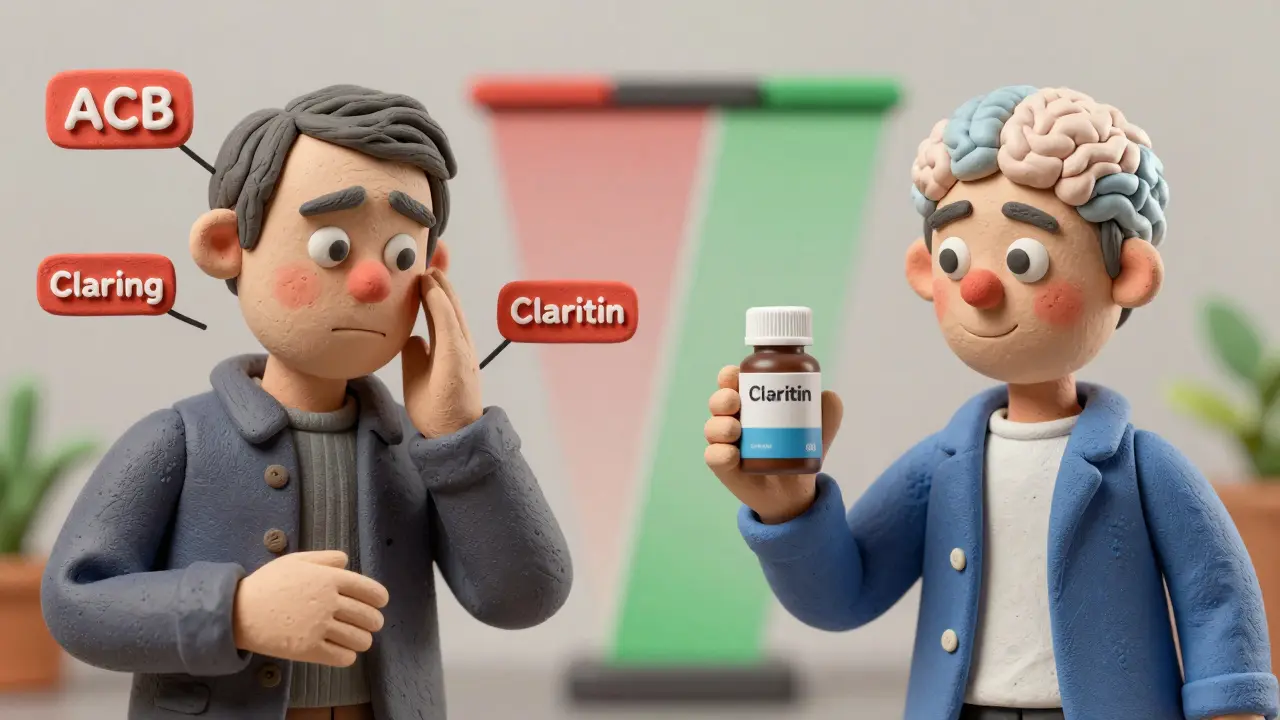
Not all antihistamines are the same. Second-generation ones like Claritin (loratadine), Zyrtec (cetirizine), and Allegra (fexofenadine) barely touch acetylcholine. Their ACB score is 0 or 1. But first-generation antihistamines? They’re strong offenders.- Diphenhydramine (Benadryl): ACB score 3
- Chlorpheniramine (Chlor-Trimeton): ACB score 3
- Hydroxyzine (Vistaril): ACB score 3
When Antihistamines Meet Other Medications
The real danger isn’t just one antihistamine. It’s what happens when it teams up with other drugs. Many older adults take multiple prescriptions. A typical combination might look like this:- Diphenhydramine (Benadryl) for sleep - ACB 3
- Amitriptyline for nerve pain or depression - ACB 3
- Oxybutynin for overactive bladder - ACB 3
What Happens When the Burden Builds Up
The effects aren’t subtle. They creep in slowly and get mistaken for aging:- Memory lapses - forgetting names, missing appointments
- Confusion - feeling foggy, disoriented, or paranoid
- Falls - dizziness, dry mouth, blurred vision, slow reflexes
- Urinary retention - trouble peeing, needing to strain
- Constipation - slowed digestion, bloating
- Heart palpitations - racing or irregular heartbeat
How to Check Your Burden
You don’t need a doctor to start checking. Here’s how to take control:- Make a full list - write down every prescription, OTC pill, supplement, and sleep aid you take. Include dosages and how often.
- Look up each one - use the ACB Scale (available online from IU Center for Aging Research or NPS MedicineWise) to find the score. Focus on first-gen antihistamines, tricyclic antidepressants, bladder meds, and Parkinson’s drugs.
- Add them up - if the total is 3 or more, you’re in the danger zone.
- Ask your pharmacist - pharmacists are trained to spot these interactions. Bring your list to your next visit.

What to Do Next
If your score is high, don’t panic. But don’t wait either. Here’s what works:- Swap first-gen for second-gen - Replace Benadryl with Claritin or Zyrtec. You’ll still get allergy relief without the brain fog.
- Find non-anticholinergic sleep aids - Melatonin, cognitive behavioral therapy for insomnia (CBT-I), or magnesium glycinate are safer options.
- Ask about alternatives - For bladder issues, ask about mirabegron instead of oxybutynin. For depression, try SSRIs instead of amitriptyline.
- Taper slowly - Never stop cold turkey. Work with your doctor to reduce doses over weeks.
Why This Isn’t Just an Older Adult Problem
Yes, older adults are most at risk. But the problem is growing. In 2023, the FDA updated warnings on first-gen antihistamine labels to include cognitive risks. The European Medicines Agency now advises against chronic use in people over 65. And in the U.S., Medicare Advantage plans are starting to tie quality ratings to how well clinics reduce anticholinergic burden. The bottom line? This isn’t about being “old.” It’s about being informed. Millions of people are taking these drugs because they think they’re harmless. They’re not. And the longer you take them, the more damage piles up.FAQ
Can I still use Benadryl occasionally for allergies?
Occasional use (once or twice a month) is generally low risk. But if you’re over 65 or taking other medications, even occasional use can add up over time. Switching to a second-generation antihistamine like Claritin or Zyrtec eliminates the risk while giving the same relief.
Do all sleep aids have anticholinergic effects?
No. Many OTC sleep aids contain diphenhydramine or doxylamine-both strong anticholinergics. But melatonin, valerian root, or magnesium supplements don’t block acetylcholine. If your sleep aid says "helps with allergy symptoms" on the label, it likely has an anticholinergic ingredient.
How long does it take to reverse cognitive effects?
Improvement can start within weeks. A 2021 case study showed memory and balance improved noticeably in 6-8 weeks after stopping anticholinergics. Full recovery may take 3-6 months, depending on how long the burden lasted. The brain has remarkable plasticity-especially when you remove the stressor.
Are there any apps or tools to track anticholinergic burden?
Yes. The IU Center for Aging Research offers a free ACB calculator online. Many pharmacy apps like MyTherapy and Medisafe now include anticholinergic risk alerts. Ask your pharmacist if your pharmacy uses one.
Why don’t doctors always warn patients about this?
Many doctors weren’t trained on anticholinergic burden until recently. Also, patients often don’t mention OTC meds. A 2022 survey found 70% of older adults didn’t tell their doctor about using Benadryl regularly. That’s why it’s up to you to bring your full list to every appointment.
APRIL HARRINGTON
March 10, 2026 AT 16:32So I just found out my mom’s been taking Benadryl every night for 12 years because she said it "helps her chill"
She’s been forgetting where she put her keys, tripping over rugs, and acting like she’s in a fog
Turns out her ACB score was 7
She switched to melatonin and now she’s asking me about my job again like she used to
Why the hell is this not on every OTC label??
Leon Hallal
March 12, 2026 AT 02:52This is real and nobody talks about it
My uncle took amitriptyline and Benadryl for years
He stopped both and within 6 weeks he remembered my name
That’s not magic that’s medicine
Nicholas Gama
March 13, 2026 AT 15:42The pharmaceutical industry deliberately obscures anticholinergic risk because dementia is a multibillion dollar market
They profit from cognitive decline
They don’t want you to know Claritin works just as well as Benadryl
It’s not negligence it’s capitalism
Dan Mayer
March 13, 2026 AT 23:36my dr said benadryl was fine for sleep but i read this and checked my med list
turns out i was on oxybutynin and amitriptyline too
total acb 8
im freaked out
im gonna see my pharmacist tomorrow
thanks for this post
Janelle Pearl
March 15, 2026 AT 20:10I work in geriatric care and this is one of the most preventable causes of cognitive decline we see
So many families think "it’s just aging" when it’s really a medication pileup
But here’s the hope: once you stop the heavy anticholinergics, people often bounce back
Not always fully, but enough to reclaim their dignity
It’s not too late to make a change
Bring your meds list to your next visit
Even if it’s just one pill that’s been hiding in the cabinet for a decade
Peter Kovac
March 16, 2026 AT 09:44The data is robust and replicated across multiple longitudinal cohorts
ACB score ≥3 correlates with a 1.54-fold increase in dementia incidence (HR 1.54, 95% CI 1.27–1.87)
First-generation antihistamines contribute disproportionately due to high CNS penetration
Pharmacokinetic studies confirm prolonged receptor occupancy in elderly populations
Policy responses remain inadequate
rafeq khlo
March 17, 2026 AT 15:40Western medicine is built on profit not prevention
Doctors are paid to prescribe not to educate
Pharmacies push OTC anticholinergics because they are cheap and profitable
Meanwhile the elderly are left confused and falling
This is systemic neglect disguised as healthcare
Morgan Dodgen
March 19, 2026 AT 10:12They’re not just hiding this-they’re weaponizing it
Every time you take diphenhydramine you’re feeding the dementia-industrial complex
Big Pharma knows the brain can’t regenerate once acetylcholine is suppressed long-term
That’s why they market sleep aids like candy
And why your pharmacist doesn’t blink when you buy 3 bottles a month
It’s not an accident
It’s a business model
And we’re all the product