
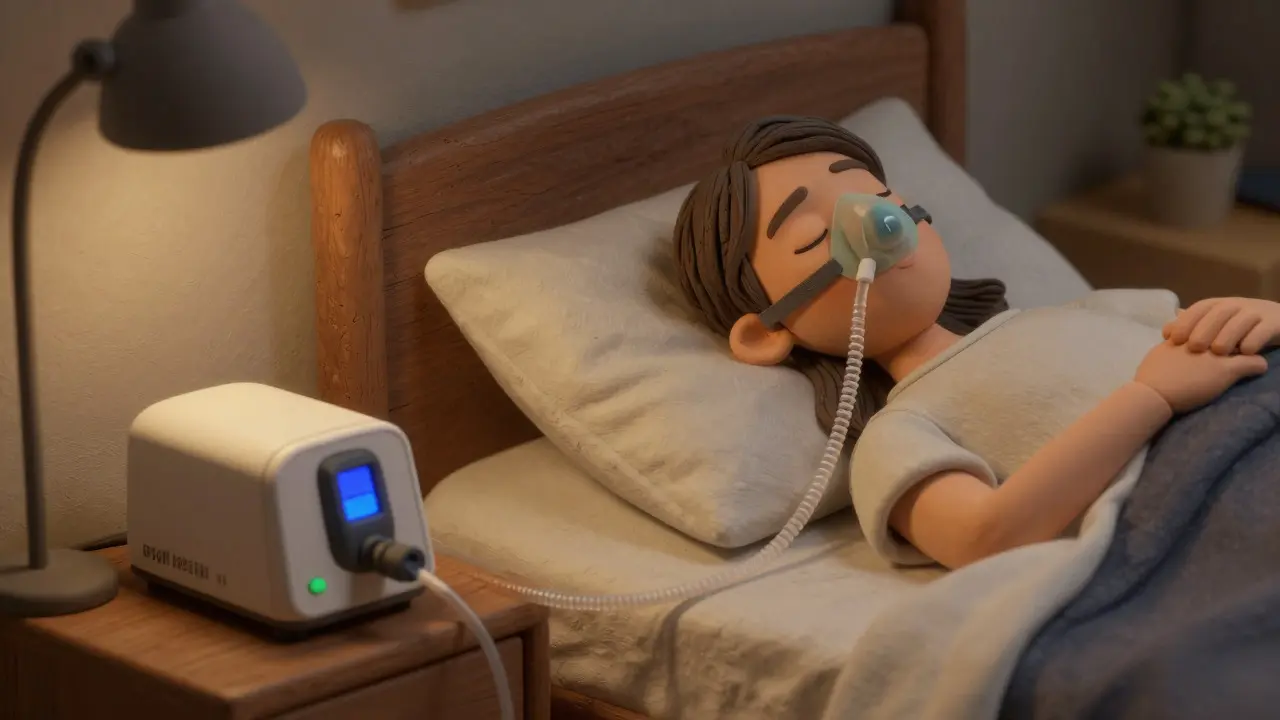
Waking up exhausted despite sleeping eight hours? You are not alone. Millions of people struggle with sleep apnea, a condition where breathing repeatedly stops and starts during sleep. For most, the solution involves a machine that pushes air into your lungs while you rest. But here is the confusing part: doctors talk about CPAP and BiPAP as if they are interchangeable, yet they work very differently. Choosing the wrong one can mean uncomfortable nights, poor adherence, and continued health risks. This guide cuts through the medical jargon to explain exactly how these devices differ, who needs which one, and what to expect in terms of cost and comfort.
What Is CPAP and How Does It Work?
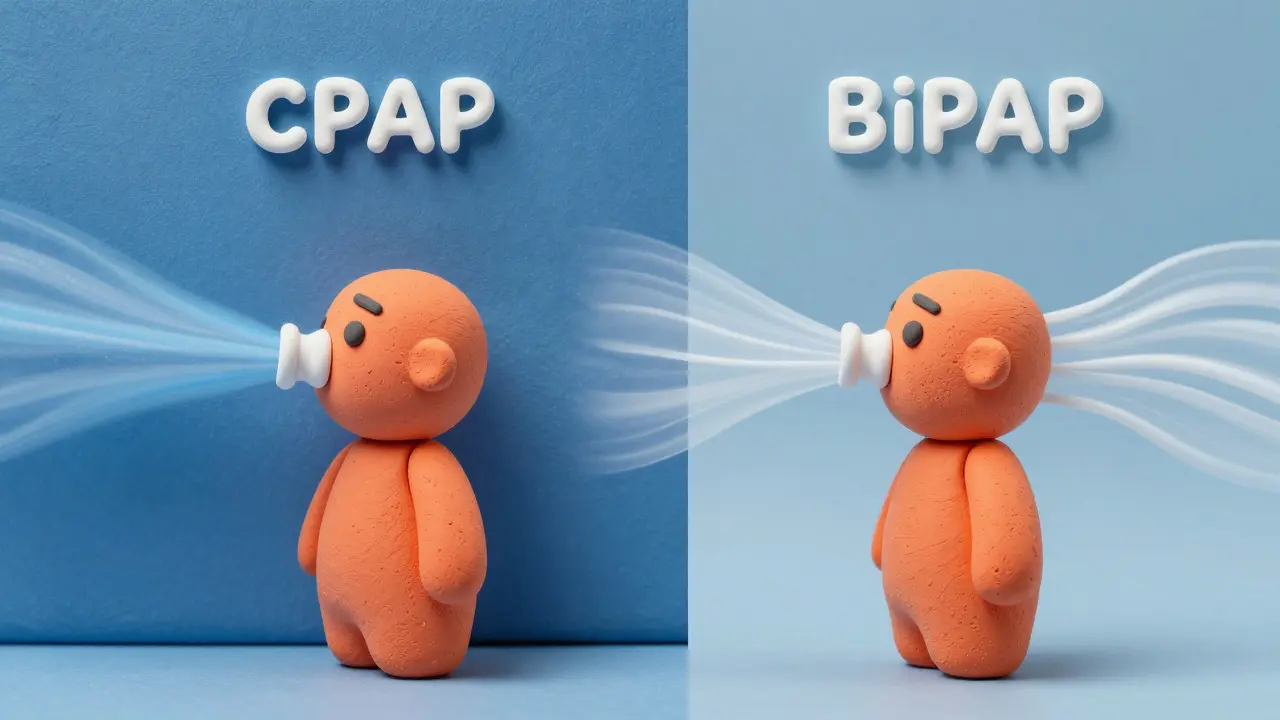
Continuous Positive Airway Pressure (CPAP) is the gold standard for treating obstructive sleep apnea (OSA). Think of it as a pneumatic splint for your throat. When you fall asleep, the muscles in your airway relax. In OSA, this relaxation causes the tissue to collapse, blocking airflow. A CPAP machine solves this by delivering a single, constant stream of pressurized air through a mask. This pressure keeps the airway open all night long, preventing those dangerous pauses in breathing.
The technology has been around since the early 1980s, pioneered by Dr. Colin Sullivan in Australia. Today’s models, like the ResMed AirSense 11 or Philips DreamStation 2, are compact, quiet, and smart. They typically deliver pressure between 4 and 20 cm H2O. The key word here is constant. Whether you are inhaling or exhaling, the pressure remains the same. For many users, this feels like trying to blow out a candle against a steady breeze-it requires effort, but it works. About 85% to 90% of patients with standard obstructive sleep apnea respond well to CPAP therapy.
What Is BiPAP and Why Does It Exist?
If CPAP is a steady breeze, Bilevel Positive Airway Pressure (BiPAP) is more like a helpful partner breathing with you. BiPAP was developed in the late 1980s specifically for patients who could not tolerate the constant pressure of CPAP or who had more complex breathing issues. Instead of one setting, BiPAP provides two distinct pressure levels:
- Inspiratory Positive Airway Pressure (IPAP): A higher pressure delivered when you inhale, helping pull air into your lungs.
- Expiratory Positive Airway Pressure (EPAP): A lower pressure delivered when you exhale, making it easier to breathe out.
This difference matters. If you have severe sleep apnea requiring high pressures (above 15 cm H2O), exhaling against that constant CPAP force can feel suffocating. BiPAP drops the pressure when you breathe out, reducing the work of breathing by 30-40%. Modern BiPAP machines also feature "backup rates"-if you stop breathing entirely (common in central sleep apnea), the machine will gently nudge you to take a breath. This makes BiPAP essential for conditions beyond simple OSA, such as chronic obstructive pulmonary disease (COPD), obesity hypoventilation syndrome, and neuromuscular disorders.
Key Differences: CPAP vs. BiPAP at a Glance
| Feature | CPAP | BiPAP |
|---|---|---|
| Pressure Settings | Single constant pressure (4-20 cm H2O) | Two pressures: IPAP (8-30) and EPAP (4-25) cm H2O |
| Primary Use Case | Obstructive Sleep Apnea (OSA) | Complex Sleep Apnea, COPD, Central Sleep Apnea |
| Comfort Level | Good for low-to-moderate pressures | Better for high-pressure tolerance |
| Cost (Out-of-Pocket) | $500 - $1,200 | $800 - $1,800 |
| Learning Curve | Low (simple operation) | Moderate (mode settings, synchronization) |
| Backup Breathing Rate | No | Yes (in S/T mode) |
Clinical Indications: Who Needs Which Device?
Choosing between CPAP and BiPAP isn't about preference; it's about physiology. Your doctor will determine the right device based on your sleep study results (polysomnography). Here is how the decision usually breaks down:
Stick with CPAP if:
- You have uncomplicated obstructive sleep apnea.
- Your required pressure is below 15 cm H2O.
- You prefer simplicity and ease of use.
- You do not have other lung diseases like COPD.
Consider BiPAP if:
- You cannot tolerate CPAP due to high pressure discomfort (often defined as failing to use CPAP ≥4 hours/night for 30 days at pressures ≥15 cm H2O).
- You have central sleep apnea, where the brain fails to signal the muscles to breathe.
- You suffer from COPD overlap syndrome (having both COPD and sleep apnea).
- You have obesity hypoventilation syndrome (BMI ≥30 with elevated carbon dioxide levels).
- You have a neuromuscular disorder affecting respiratory muscles.
Dr. David White, former president of the American Academy of Sleep Medicine, notes that BiPAP should be reserved for these specific indications. Using it for simple OSA adds complexity without significant benefit for most patients. However, some experts argue that patients with severe OSA and high BMI may find BiPAP more comfortable initially, potentially improving early adherence.
Cost, Insurance, and Practical Considerations
Money and logistics play a huge role in therapy success. CPAP machines are generally cheaper, ranging from $500 to $1,200 for basic models. BiPAP machines cost more, typically between $800 and $1,800. But out-of-pocket costs depend heavily on insurance coverage.
In the US, Medicare covers 80% of CPAP costs. Getting BiPAP covered is stricter. Medicare requires documented "CPAP failure." This means you must prove you tried CPAP, used it correctly, and still couldn't tolerate the pressure or achieve adequate oxygenation. Without this documentation, insurers often deny BiPAP claims. According to CMS guidelines, you need evidence of using CPAP for at least 4 consecutive hours per night over 30 days before switching is considered medically necessary.
Adherence is another factor. Both devices require an acclimatization period. CPAP users typically adjust within 2-4 weeks. BiPAP may take 3-6 weeks due to its complex settings. Data shows that 78% of CPAP users report satisfaction, compared to 72% for BiPAP users. However, among those with specific indications (like COPD), BiPAP users often report higher usage rates because the therapy actually feels better to them.
Troubleshooting Common Issues
Even the best machine won't help if you aren't using it. Here are common pitfalls and how to avoid them:
Mask Fit Problems: Seventy percent of initial discomfort comes from improper mask fit. Don't guess. Work with a respiratory therapist to try different styles (nasal pillows, nasal masks, full face). Leaks cause dry eyes and reduced therapy effectiveness.
Dry Mouth and Nose: Both machines come with heated humidifiers. Adjust the humidity level gradually. Too much moisture can cause condensation in the tube (rainout); too little causes irritation. Most modern machines auto-adjust this.
BiPAP Cycling Issues: Some BiPAP users report the machine "fighting" their breathing. This happens if the sensitivity settings are off. Ensure your provider sets the correct trigger and cycle sensitivities during titration. If you feel short of breath, check if the backup rate is set too high or low.
Aerophagia (Swallowing Air): High pressures can cause you to swallow air, leading to bloating and gas. If this happens with CPAP, BiPAP might help because the lower expiratory pressure reduces air swallowing. Alternatively, adjusting the pressure slightly downward or using a different mask style can help.
Future Trends in Sleep Therapy
The landscape of sleep apnea treatment is evolving. By 2026, we are seeing a shift toward "smart" PAP devices. Newer models from ResMed and Philips incorporate artificial intelligence to automatically adjust pressures in real-time based on your breathing patterns. Integrated oximetry allows the machine to monitor blood oxygen levels and adjust therapy accordingly. While BiPAP adoption is growing faster than CPAP (projected 9.2% CAGR vs 6.8%) due to rising obesity and aging populations, the goal remains the same: personalized, comfortable, and effective therapy that lets you wake up refreshed.
Can I switch from CPAP to BiPAP on my own?
No. BiPAP settings (IPAP and EPAP) must be precisely titrated via a sleep study. Using incorrect settings can lead to inadequate ventilation or discomfort. Always consult your sleep specialist before switching devices.
Is BiPAP better than CPAP for snoring?
Not necessarily. If snoring is caused by mild obstructive sleep apnea, CPAP is usually sufficient and simpler. BiPAP is reserved for complex cases. Treating the underlying apnea will stop the snoring, regardless of the device type.
How long does it take to get used to BiPAP?
Most users adapt within 3 to 6 weeks. The dual-pressure mechanism feels more natural once you get used to it, but the learning curve is steeper than CPAP due to additional settings and potential synchronization issues.
Does insurance cover BiPAP if I just hate CPAP?
Usually no. Insurers like Medicare require proof of "medical necessity," such as intolerance to high CPAP pressures or co-existing conditions like COPD. Simply preferring BiPAP is rarely enough for coverage without clinical justification.
What is the main advantage of BiPAP over CPAP?
The primary advantage is comfort during exhalation. By lowering the pressure when you breathe out, BiPAP reduces the work of breathing, making it tolerable for patients who need high pressures or have weakened respiratory muscles.
Laura Odom
July 24, 2026 AT 22:34honestly this whole thing is just corporate greed disguised as medical necessity. you dont need a machine to breathe, you need to stop eating like a pig and start walking. its that simple. the doctors are just selling you expensive plastic boxes because they want their bonuses. i bet if you cleaned your airways with some natural herbs youd be fine without spending thousands. its all about control really. making people dependent on technology for something as basic as breathing is dystopian. why do we trust these machines more than our own bodies? probably because weve been brainwashed to think we are broken. its not sleep apnea, its weak willpower.
Katie Caruthers
July 25, 2026 AT 12:13i feel so bad for everyone who has to deal with this. it must be terrifying to not know if you will wake up in the morning. please take care of yourselves and listen to your doctors. it is selfish to ignore the symptoms because then you burden the healthcare system when things go wrong. we have a moral obligation to stay healthy for our families. nobody wants to be the reason someone else suffers. please wear the mask every night.
Megan Crossland
July 26, 2026 AT 08:24biPap is better obviously. cpap is for people who cant afford real treatment. if you have money get the biPap. its simpler to use once you understand it. dont let insurance companies tell you what to do. they just want to save pennies while you suffer. buy the good stuff.
Jairam Prasad
July 27, 2026 AT 23:17in india we often see similar issues but the cost barrier is much higher there. it is ironic that in america you worry about which mask fits best while elsewhere people simply cannot access any therapy at all. perhaps the solution is not just better machines but a better understanding of lifestyle factors that contribute to obesity. sarcasm aside, the technology is impressive but accessibility remains a global crisis.
Gary Hull
July 28, 2026 AT 14:58nah cpap is fine for most ppl. bipap is overkill unless u r dying. everyone whines about the pressure but thats just weakness. if u can handle a gym workout u can handle exhaling against air. stop being so sensitive. the article makes it sound like bipap is magic but its just another bill from the hospital. keep it simple stupid.
Padraic Cepek
July 29, 2026 AT 12:20why is this even a discussion? american healthcare is a scam. they make you jump through hoops to get covered. first cpap then bipap then what? next year theyll charge you for the electricity to run it. typical us government waste. we should just ban these machines and force people to sleep on the floor like normal humans. its pathetic how we rely on tech for everything now.
Mildred Fierce
July 30, 2026 AT 20:14the data clearly shows that adherence rates drop significantly with bipap due to complexity yet here we are pretending it is superior. this is classic misdirection by the industry. they push the more expensive device because the margins are higher. look at the statistics provided in the text. 78% satisfaction for cpap vs 72% for bipap. the numbers do not lie. only an idiot would choose bipap without severe indications. stop letting marketing dictate your health choices.
Trey Newkerk
August 1, 2026 AT 05:05you guys are missing the point entirely! it is not about the machine it is about the soul of the sleeper. when you fight the air you fight life itself. cpap is oppression. bipap is liberation. feel the difference in your chest! do not let them silence your breath with constant pressure. break free from the tyranny of the single setting. embrace the duality of inhale and exhale. it is a spiritual journey not a medical one.
Charles PINSON
August 1, 2026 AT 17:18one must consider the aesthetic implications of the tubing as well. a true gentleman does not allow his bedside to resemble a submarine cockpit. the philips dreamstation is marginally less obtrusive than the resmed models. furthermore the noise profile is critical for maintaining a dignified sleeping environment for one's partner. cheap masks leak and cause dry eyes which ruins one's complexion. invest in quality or perish in mediocrity.
John Anderson
August 3, 2026 AT 15:57just use the mask. stop complaining. if you dont use it you die. simple as that. no excuses needed. buy the machine put it on sleep. done.