
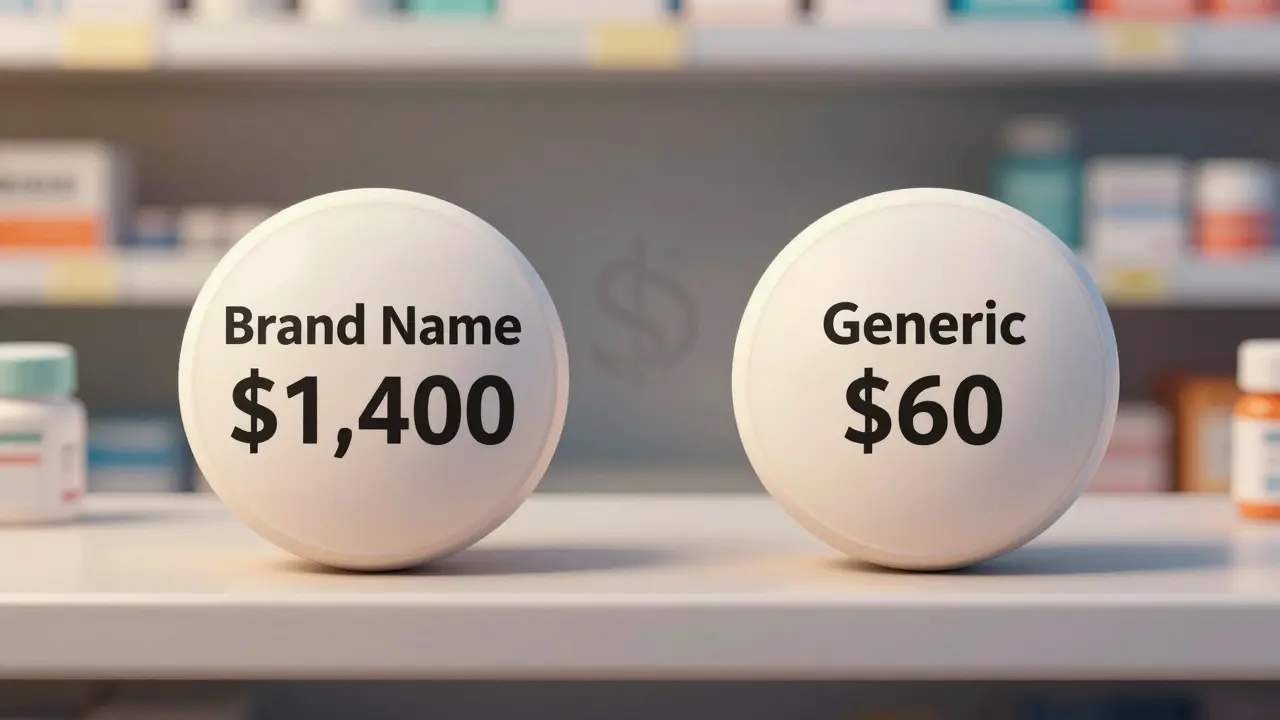
When you pick up a prescription, you might notice two options on the label: a brand-name drug and a generic version. The generic looks different-different color, shape, maybe even a different name-but it’s meant to do the exact same thing. And it usually costs a fraction of the price. So why? How can two pills with the same active ingredient cost so differently? The answer isn’t magic. It’s economics, regulation, and competition.
Same Drug, Different Price
Generic medications contain the same active ingredients, strength, dosage form, and route of administration as their brand-name counterparts. The FDA requires them to be bioequivalent, meaning they work the same way in your body. A study from the FDA found that 99% of generic drugs perform identically to brand-name drugs in clinical settings. So if they’re the same, why does the brand-name version cost 10 times more?
The answer lies in what happens before the drug hits the shelf. Brand-name companies spend years and millions-sometimes billions-on research, clinical trials, and marketing. A single new drug can cost over $2 billion to develop, according to data from the Tufts Center for the Study of Drug Development. That includes failed attempts, regulatory hurdles, and advertising campaigns. Once the patent runs out, other companies can make the same drug without paying those upfront costs. They don’t need to repeat the clinical trials. They only need to prove their version works the same way. That’s called an Abbreviated New Drug Application (ANDA), created by the Hatch-Waxman Act in 1984. That law was designed to balance innovation with access. And it worked.
How Competition Drives Prices Down
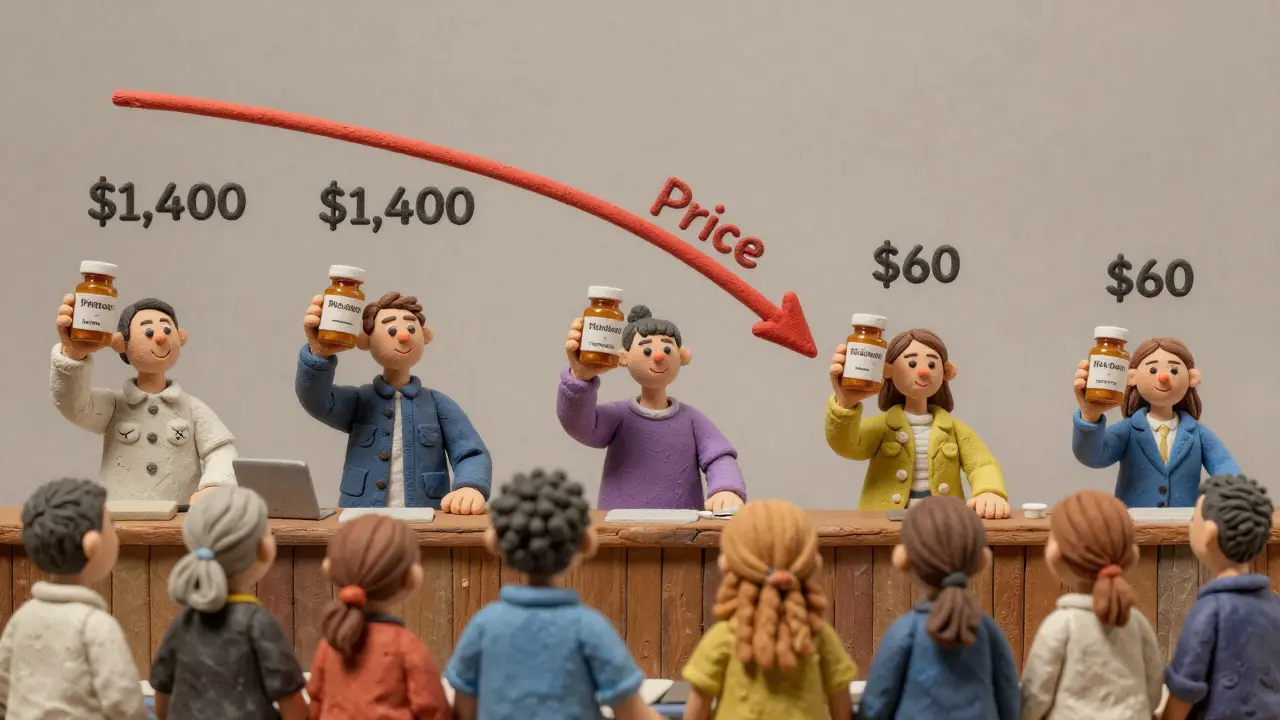
When a brand-name drug loses patent protection, the first generic manufacturer enters the market. Prices drop-often by 50% or more. But the real savings come when more companies join. The FDA found that with just three generic competitors, prices fall to about 15-20% of the original brand price. With five or more, prices can drop below 10%. Take lurasidone (brand name Latuda). Before generics, a 30-day supply cost around $1,400. After competition kicked in, the same dose dropped to under $60. That’s a 96% price drop. Pemetrexed (Alimta) followed the same pattern: from $3,800 per month to $500. In both cases, savings totaled hundreds of millions of dollars in just one year.
It’s simple math: more suppliers = more competition = lower prices. The Federal Trade Commission confirms that generics typically cost 80-85% less than brand-name drugs. That’s not a rumor. It’s backed by data from over 100,000 prescriptions tracked by IQVIA. In 2022 alone, generic drugs saved Americans $408 billion. Over the last decade, that total reached $2.9 trillion. Those savings go to patients, insurers, Medicare, and Medicaid.
What You Pay vs. What the System Pays
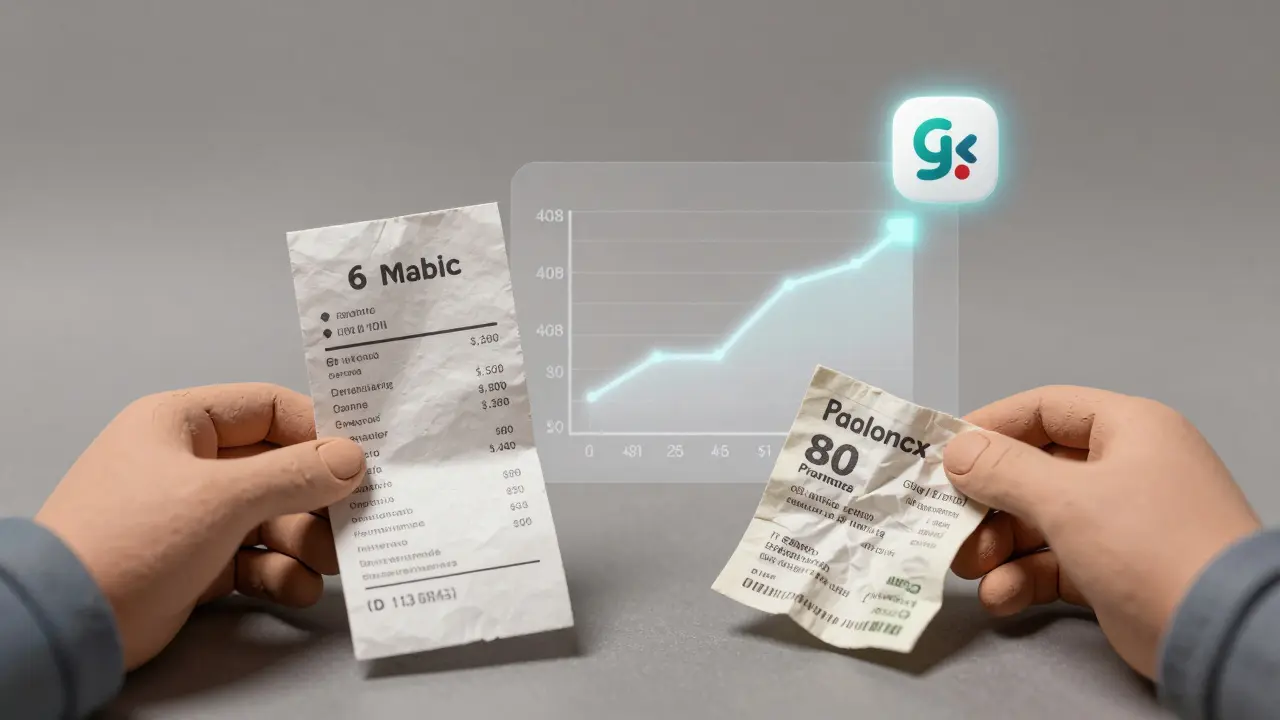
If you’ve ever checked your pharmacy receipt, you’ve probably noticed something odd: your copay for a generic is usually $6-$10, while the brand-name version costs $50-$70. According to the 2023 U.S. Generic and Biosimilar Medicines Savings Report, the average generic copay is $6.16. The average brand-name copay? $56.12. That’s nearly nine times higher. And here’s the kicker: 93% of generic prescriptions cost less than $20. Only 59% of brand-name prescriptions do.
But it’s not just about what you pay at the counter. Insurers pay more too. A 2022 study in JAMA Network Open looked at 45 high-cost generic drugs and found that some were priced 15.6 times higher than other, equally effective alternatives. In Colorado, replacing just those high-cost generics would have cut spending from $7.5 million down to $873,711. That’s an 88% reduction. So even within the generic category, not all drugs are created equal. Some generics are priced higher because of how pharmacy benefit managers (PBMs) structure deals. PBMs sometimes profit from “spread pricing”-the difference between what they charge insurers and what they pay pharmacies. If a generic is priced at $50 but the PBM negotiates a $40 payment, they pocket the $10 difference. That’s not always passed on to you.
How to Save More on Generics
Knowing generics are cheaper doesn’t always mean you’re getting the best price. The key is shopping around. A study in the Journal of the American Medical Association Internal Medicine found that patients with chronic conditions who compared prices saved an average of $287 per year. Here’s how:
- Ask your doctor to write your prescription as "dispense as written"-this lets your pharmacist substitute a generic if available.
- Use free tools like GoodRx, SingleCare, or the Mark Cuban Cost Plus Drug Company. GoodRx users report an average 67% discount on depression meds, 58% on blood pressure drugs, and 57% on weight loss drugs.
- Try cash prices. In a Reddit survey of 1,450 users, 78% found cash prices cheaper than insurance, especially with high-deductible plans.
- Consider mail-order pharmacies for maintenance meds. Many insurers offer discounts for 90-day supplies.
One user in Portland told me she switched her statin from insurance to GoodRx and saved $120 a month. Another found his insulin generic for $25 cash, while his insurance copay was $80. These aren’t outliers. They’re common.
When Generics Don’t Save You Money
It’s not always black and white. Some generics are expensive because there’s little competition. The FDA flagged 202 "at-risk" generic drugs in early 2023 due to manufacturing shortages or low supplier numbers. If only one company makes a drug, it can charge more. That’s why some generics cost more than others.
Also, some PBMs push higher-priced generics onto formularies because they earn more from the spread. That’s why checking your own price matters. A 2023 study in PMC11179122 found that patients using the Mark Cuban Cost Plus Drug Company saved $4.96 per prescription on average-but only if the drug was available there. At the time, MCCPDC carried only 26% of expensive generics. So even the best option isn’t always an option.
The Bigger Picture
Generics make up 90% of all prescriptions filled in the U.S., but they account for just 1.5% of total drug spending. That’s the power of competition. The Inflation Reduction Act of 2022 is expected to save Medicare beneficiaries $105 billion by 2031, mostly through generic and biosimilar use. More biologics-complex drugs like Humira and Enbrel-are losing patents now, which means more generics will hit the market. Analysts project $150 billion in savings from biosimilars alone between 2023 and 2027.
But challenges remain. "Pay-for-delay" deals-where brand companies pay generics to delay entry-still happen. The Department of Justice is investigating. And while the FDA approves hundreds of generics each year (700 in 2022), supply chain issues and manufacturing consolidation keep some prices high.
Still, the trend is clear: more competition means lower prices. And for patients, that means more access. For insurers, it means lower costs. For the system as a whole, it means sustainability.
What You Can Do Today
Don’t assume your insurance gives you the best price. Compare cash prices with GoodRx or SingleCare before filling your prescription. Ask your pharmacist if there’s a cheaper generic alternative. If you’re on a high-deductible plan, paying cash might save you more than your insurance copay. And if your doctor says "this is the only option," ask if there’s another drug in the same class that’s cheaper. Sometimes, switching from one generic to another can save you hundreds.
Generics aren’t a loophole. They’re the rule. And when you use them wisely, they’re one of the most powerful tools you have to lower your healthcare costs.
Alexander Pitt
March 19, 2026 AT 17:48Generics aren't just cheaper-they're just as effective. I've been taking generic lisinopril for years. My blood pressure is stable, no side effects, and I pay $4 a month instead of $80. The FDA's bioequivalence standards aren't suggestions; they're enforced. If a generic fails to match the brand in absorption or efficacy, it gets pulled. There's no wiggle room.
Pharmacists don't randomly substitute. They follow state laws and pharmacy protocols. If your doctor says "dispense as written," that's their call. But if they don't, you're already getting the best value.
The real issue isn't generics. It's PBMs. They're the middlemen who negotiate with manufacturers and insurers, then pocket the difference. That's why two pharmacies down the street can charge $15 and $45 for the same pill. It's not about cost-it's about who gets the cut.
And yes, cash prices often beat insurance. Especially with high-deductible plans. You're paying for coverage you haven't met yet, while the generic costs less than your coffee.
Stop trusting your insurer's formulary. Check GoodRx before you walk in. It takes 30 seconds. You'll be shocked.
Manish Singh
March 21, 2026 AT 12:37In India, generics are the only option. Brand drugs? Unaffordable. I remember my father taking a generic version of metformin-same tablet, same results, one-tenth the price. We didn’t have insurance. We didn’t need it.
Here’s the truth: in the U.S., you’re paying for marketing, not medicine. The brand-name companies spend more on ads than R&D. They convince doctors and patients that color and shape matter. They don’t. A pill is a pill.
And yes, some generics are overpriced because only one factory makes them. That’s a supply chain failure, not a market failure. Governments need to incentivize multiple manufacturers-not just approve them.
But overall? Generics saved my family. They’ll save yours too. Just ask for them. Don’t let fear or habit cost you.
Nilesh Khedekar
March 22, 2026 AT 16:35you think this is about drugs? nah. this is about the feds and big pharma playing keep away with your money. they let generics in… but only if they’re made in china or india. why? because they want you to get the drug, but not the *real* savings. the real profit is in the pbsm thingy-pharmacy benefit managers. they’re not even pharmacists. they’re corporate middlemen who make deals behind closed doors.
and dont get me started on how the fda approves generics but still lets brand names charge $500 for a 30-day supply of something that’s been off patent for 15 years. its a scam. they want you to think you’re saving money… but you’re just paying someone else to profit from your desperation.
and why do you think they let you use goodrx? because it looks like you’re in control. you’re not. you’re just being led to a different part of the maze.
ask yourself: who benefits if you save $120 on statins? not you. not the pharmacy. the system wins. always.
Robin Hall
March 23, 2026 AT 08:02It is imperative to underscore the regulatory integrity of the Abbreviated New Drug Application (ANDA) process as codified under the Hatch-Waxman Act. The FDA's bioequivalence requirement is not a mere suggestion; it is a scientifically rigorous, statistically validated benchmark requiring demonstration of pharmacokinetic equivalence within a 80%-125% confidence interval for AUC and Cmax parameters.
Furthermore, post-market surveillance systems such as MedWatch and the Sentinel Initiative ensure ongoing pharmacovigilance. Any deviation in therapeutic equivalence triggers immediate recall and investigation.
Consequently, the assertion that generics are inferior is not merely inaccurate-it is scientifically indefensible. The 99% clinical equivalency rate is not an outlier-it is the empirical consensus across 12,000+ comparative studies.
That said, the systemic dysfunction lies not in manufacturing, but in opaque pricing architectures orchestrated by pharmacy benefit managers, whose fiduciary obligations are misaligned with patient welfare. This constitutes a market failure requiring legislative intervention, not consumer workaround.
jared baker
March 23, 2026 AT 11:22Simple truth: generics are the same pill, cheaper. No magic. No trick. Just no need to pay for ads and failed experiments.
I used to pay $70 for my blood pressure med. Switched to generic. Now I pay $8. Same results. No side effects. My doctor didn’t even notice.
Use GoodRx. Always. Even if you have insurance. Cash is often cheaper. Pharmacies hate it, but it works.
And if your pharmacist says "this is the only option," ask: "Is there another generic?" Sometimes there are three, and one costs $3.
Stop overpaying. It’s not hard.
Michelle Jackson
March 23, 2026 AT 15:13Okay, but let’s be real-why do some generics cost MORE than others? And why do some pharmacies charge $10 and others $50 for the exact same drug? It’s not just PBMs… it’s the entire system rigged to keep you confused.
I had a friend who took a generic for depression-same active ingredient, same dosage-and her insurance paid $40, but cash was $12. She asked why, and the pharmacist said, "We have a contract." What contract? Who signed it? No one knows.
And don’t even get me started on how some "generics" are actually made by the same company that makes the brand name. Yeah. That’s not a loophole. That’s a fraud.
So yes, generics save money… but only if you’re lucky, informed, and willing to hunt like a detective. The system doesn’t want you to win. It wants you to keep paying.
And don’t tell me to "just use GoodRx." What if your drug isn’t on there? What if the discount disappears next month? What if the pharmacy says "we can’t honor it?"
This isn’t empowerment. It’s exhaustion.
Andrew Mamone
March 25, 2026 AT 06:55👏👏👏 I love how this post breaks it down without the usual fear-mongering. Generics aren’t "cheap"-they’re efficient. And the data doesn’t lie.
One thing people miss: when multiple generics enter the market, it’s not just about price. It’s about reliability. More manufacturers = less risk of shortages. If one factory goes down, another picks up. That’s why competition saves lives, not just money.
Also-thank you for calling out PBMs. They’re the hidden villains. The same way cable companies charge $150 for 3 channels, PBMs charge insurers $50 for a $10 drug and pocket $40. No transparency. No accountability.
And yes, cash prices are often better. Especially for chronic meds. I switched my asthma inhaler to cash via Cost Plus Drug Co. Saved $120/month. No insurance needed. No hassle.
Knowledge is power. And this post? It’s the cheat code.
MALYN RICABLANCA
March 25, 2026 AT 23:12OH MY GOD. OH MY GOD. OH MY GOD. Did you know that some "generic" insulin is actually made by the SAME COMPANY that makes the brand-name version? And they charge 3x more for the generic because they can?!!
And don’t even get me started on the fact that pharmacy benefit managers are literally PROFITING from the difference between what they charge insurers and what they pay pharmacies. That’s not a business model-that’s a HEIST.
I had a patient last week who was paying $90 for her generic metformin. I looked it up on GoodRx. Cash price? $3.33. THREE DOLLARS AND THIRTY-THREE CENTS. She cried. I cried. The pharmacist looked away.
And now, because of this post, I’m going to start a movement. A movement called "FIGHT THE PBM." We need to boycott pharmacies that don’t honor cash discounts. We need to demand transparency. We need to make them PAY for their greed.
Also-why are there 202 "at-risk" generics? Because the FDA is understaffed. Because manufacturing is consolidated in China. Because capitalism is broken. And we’re all just pawns in a game we didn’t even know we were playing.
THIS IS A CRISIS. AND NO ONE IS TALKING ABOUT IT.
WE NEED A REVOLUTION.
Also, if you’re reading this and you’re not using GoodRx right now… you’re part of the problem.
gemeika hernandez
March 27, 2026 AT 09:50Ugh I just hate how people act like generics are this magic solution. Yeah they’re cheaper-but sometimes they’re just worse. I had a friend take a generic for thyroid meds and her TSH went crazy. She had to switch back. The brand worked fine. The generic? Didn’t. So don’t just assume.
And why do you think they let you use GoodRx? So you think you’re saving money when really you’re just being manipulated into buying from a different vendor that still makes money off you.
Also, why do some generics cost more than others? Because some companies are just greedy. And the FDA doesn’t regulate prices. Only ingredients. So you can have the same pill, same dose, same everything-and still pay $50 for one and $4 for another. That’s not fair. That’s not science. That’s just capitalism.
And don’t tell me to "ask my doctor." My doctor doesn’t even know which generics are actually good. He just prescribes what’s on the formulary. Which is usually the one the PBM pushed.
So yeah. Generics help. Sometimes. If you’re lucky. If you’re smart. If you have time to hunt. If you’re not on Medicaid. If you’re not in rural America. If you’re not elderly. If you’re not disabled. If you’re not broke.
It’s not a solution. It’s a gamble.