

Imagine you are a physician. You have carefully managed a patient's condition for years using a specific brand-name medication. The levels are stable. The side effects are minimal. You write the prescription, confident that your patient will get exactly what they need. But when they pick it up, the pharmacist hands them a generic version. The patient takes it, their levels spike or drop, and they end up in the emergency room. This is not just a hypothetical nightmare; it is a documented reality for many clinicians dealing with narrow therapeutic index drugs.
This scenario highlights the critical importance of prescriber override. It is the legal mechanism that allows doctors to mandate that a specific brand-name medication be dispensed rather than a generic equivalent. While generic substitution saves the healthcare system billions, there are times when clinical necessity trumps cost savings. Understanding how to properly execute an override is essential for patient safety and avoiding costly medical errors.
The Legal Foundation of Generic Substitution
To understand why overrides exist, we first need to look at the framework that created generics as we know them today. The Hatch-Waxman Act, officially known as the Drug Price Competition and Patent Term Restoration Act of 1984, revolutionized the pharmaceutical industry. It established a streamlined pathway for approving generic drugs while protecting patent holders. Crucially, it also gave states the authority to create their own substitution laws.
Today, all 50 U.S. states and territories have implemented these laws. However, they operate differently. According to data from the National Conference of State Legislatures, 35 states use mandatory substitution frameworks. In these states, pharmacists must default to generics for multi-source drugs unless told otherwise. The remaining 15 states maintain permissive substitution laws, giving pharmacists more discretion. This patchwork of regulations means that a prescriber practicing across state lines faces a complex landscape of rules.
The primary goal of these laws is cost containment. Generic drugs saved the U.S. healthcare system approximately $2.2 trillion between 2010 and 2019. But this efficiency comes with a trade-off. If a doctor needs a specific brand for medical reasons, they must actively opt out of the default generic process through a prescriber override.
Understanding DAW Codes: The Language of Overrides
When a physician wants to force brand dispensing, they don't just write "brand" on the script. They use standardized codes known as Dispense as Written (DAW) codes. These are part of the NCPDP Telecommunications Standard, maintained by the National Council for Prescription Drug Programs. These codes tell the pharmacy and the insurance payer exactly why a brand drug is being dispensed.
| Code | Meaning | Who Initiates? |
|---|---|---|
| DAW-1 | Substitution Not Allowed by Prescriber | Physician |
| DAW-2 | Patient Requested Brand | Patient |
| DAW-3 | Pharmacist Selected Generic | Pharmacist |
| DAW-4 | Generic Unavailable | System/Pharmacy |
| DAW-7 | Brand Mandated by Law | Regulation |
For physicians, DAW-1 is the most critical code. It signifies that the prescriber has determined the brand name is medically necessary. However, simply selecting DAW-1 in an electronic health record (EHR) is often not enough. Many states require additional documentation, such as handwritten notes or specific checkboxes, to validate the override. Without this extra step, the claim may be rejected by the insurer, or the pharmacist may substitute anyway if the system defaults incorrectly.
State-Specific Documentation Requirements
One of the biggest pitfalls for prescribers is assuming that one method works everywhere. It does not. State protocols vary significantly, creating administrative burdens and potential for error. For example:
- Illinois: Requires prescribers to mark a designated 'May Not Substitute' box per Section 225 ILCS 85/25.
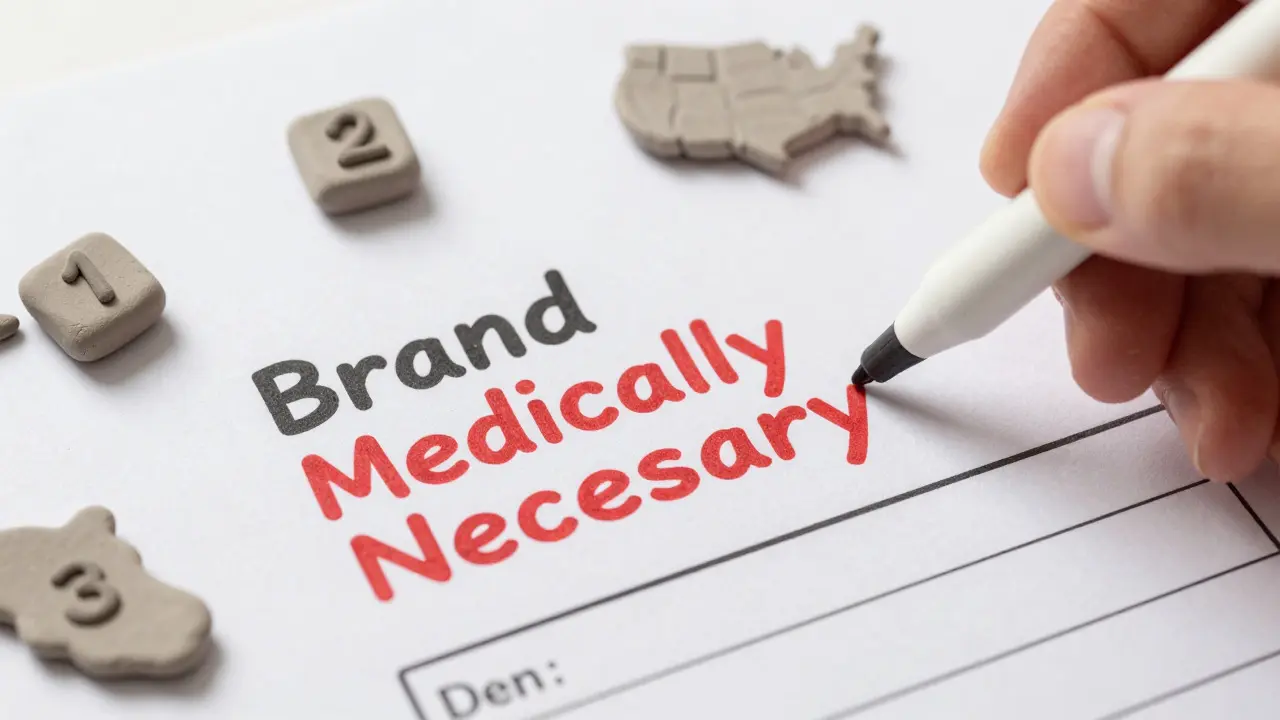
- Kentucky: Demands that 'Brand Medically Necessary' be handwritten directly on the prescription.
- Massachusetts: Accepts a simple 'No Substitution' notation.
- Michigan: Requires 'DAW' or 'Dispense as Written' to be handwritten by the prescriber.
- Oregon: Permits written, telephonic, or electronic communication specifying no substitution but prohibits default values in e-prescribing systems.
In California, physicians must follow Business and Professions Code Section 4050-4070, which requires a 'Brand Medically Necessary' notation along with the prescriber's signature. Texas uses a two-line prescription format mandated by Texas Administrative Code 295.201. If you do not know your state's specific requirement, you are flying blind. A survey found that only 58.3% of physicians correctly understood their state's override requirements. That leaves nearly half of doctors at risk of unintentional substitutions.
Clinical Indications for Override
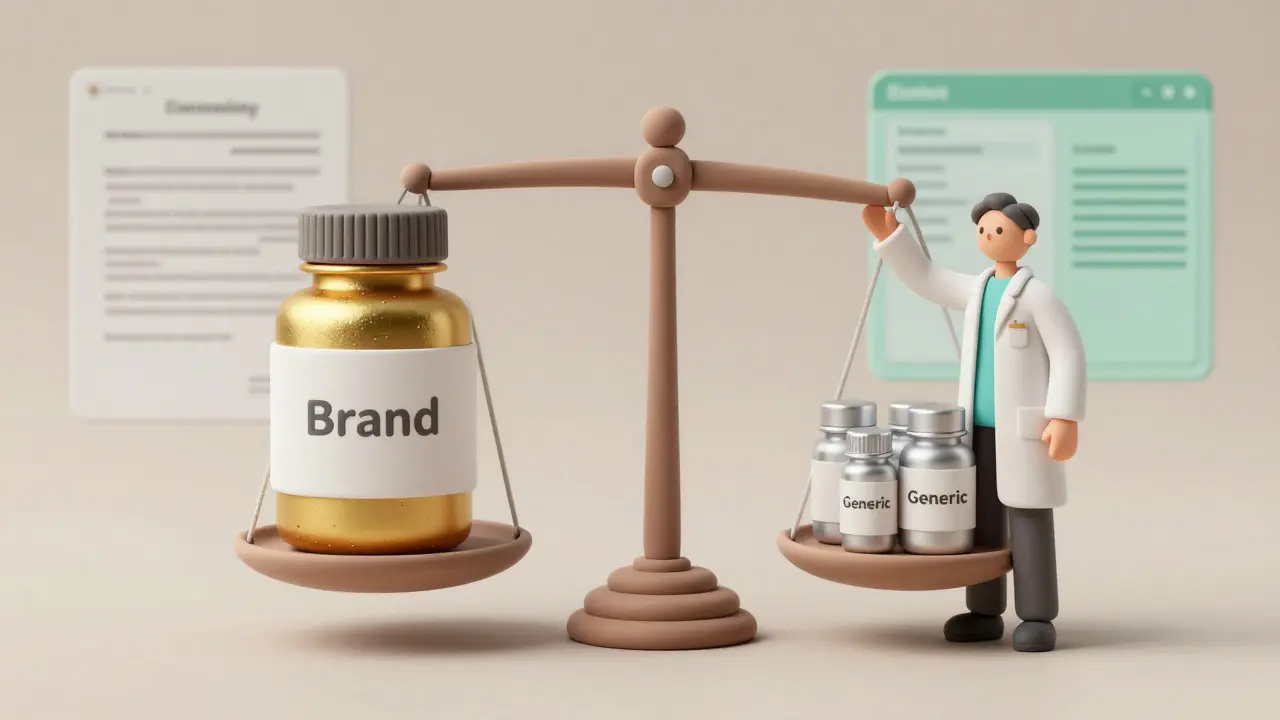
So, when should you actually use an override? It shouldn't be done lightly. Brand-name drugs are significantly more expensive. Research shows that DAW-1 prescriptions cost 32.7% more on average than substituted generics. Inappropriate overrides contribute to an estimated $7.8 billion in unnecessary annual healthcare spending.
However, there are clear clinical scenarios where overrides are justified:
- Narrow Therapeutic Index (NTI) Drugs: These medications have a small window between effective dose and toxic dose. Small variations in bioavailability can lead to treatment failure or toxicity. Examples include warfarin, phenytoin, and levothyroxine. The Institute for Safe Medication Practices documented 27 adverse events between 2018 and 2022 linked to inappropriate substitution of these drugs.
- Allergies to Inactive Ingredients: Generic drugs must have the same active ingredient, but they can have different fillers, dyes, or binders. If a patient reacts to a generic's inactive component, the brand may be the only safe option.
- Documented Therapeutic Failure: If a patient was stable on a brand, switched to a generic, and experienced adverse effects or loss of efficacy, switching back via override is clinically sound.
The FDA's Orange Book, titled 'Approved Drug Products with Therapeutic Equivalence Evaluations,' serves as the federal reference for determining therapeutic equivalence. It assigns 'A' ratings to products considered substitutable and 'B' ratings to those that are not. While the FDA doesn't legally mandate its use, 42 states reference the Orange Book in their pharmacy regulations. Pharmacists rely on this book to verify equivalence before substituting, unless overridden by the prescriber.
The Role of Consent Laws
Another layer of complexity involves patient consent. States fall into two categories regarding who decides on substitution: presumed consent and informed consent.
In presumed consent states (27 as of 2018), pharmacists can substitute without explicit patient permission. In these jurisdictions, the physician's DAW-1 instruction is the primary barrier to substitution. If the doctor doesn't specify, the generic goes out. In informed consent states (23), patients must be notified and agree to the substitution. Here, a patient's refusal acts as an additional override mechanism, sometimes coded as DAW-2. This distinction changes how proactive physicians need to be. In presumed consent states, you must explicitly block substitution. In informed consent states, you still should, but the patient's voice carries more weight.
Implementation Challenges and Solutions
Even when physicians intend to override, things go wrong. EHR templates are a major culprit. A 2022 AMA survey found that 52% of physicians reported inconsistent EHR templates that don't match state requirements. If your EHR defaults to generic substitution and doesn't prompt for the specific handwritten notation required by your state, you are setting yourself up for failure.
Pharmacy technicians report that 68% of override-related claim rejections stem from improper documentation. This often happens when handwritten notes on paper scripts don't translate well to electronic claims processing. To combat this, clinics are adopting standardized DAW documentation protocols. A case study in Michigan showed that implementing such protocols reduced override-related medication errors by 42.3% across 15 clinics.
Here are practical steps to ensure your overrides work:
- Know Your State's Rules: Use the National Association of Boards of Pharmacy's interactive state requirement map. Update your knowledge quarterly as laws change.
- Customize Your EHR: Work with your IT department to create templates that include state-specific checkboxes or fields for handwritten-style notations if required.
- Communicate with Pharmacists: If a patient reports issues after a substitution, call the pharmacy. Document the conversation. Sometimes a quick phone call resolves a systemic error.
- Educate Patients: Tell patients why you are prescribing the brand. If they understand the medical necessity, they are less likely to complain about higher copays and more likely to advocate for themselves if a pharmacy tries to switch them anyway.
Future Trends and Standardization
The landscape is slowly moving toward standardization. The 2023 introduction of the Standardized Prescriber Override Protocol Act in Congress aims to create uniform federal requirements for brand-name dispensing requests. If passed, this would eliminate the current patchwork of state laws, making it easier for multi-state health systems to manage overrides consistently.
Additionally, the NCPDP plans to integrate override requirements directly into the SCRIPT 201905 e-prescribing standard by late 2024. This technical update should reduce errors caused by mismatched EHR and pharmacy system interpretations. Meanwhile, the FDA's modernization of the Orange Book, including biosimilar interchangeability designations, will eventually impact how biologics are handled in override scenarios.
Despite these advancements, reliance on overrides remains high. The California Medi-Cal Rx program reported a 22.3% increase in DAW-1 usage between 2020 and 2022. This suggests that clinicians continue to see value in brand specificity, particularly for complex cases. As long as generic substitution remains the default, prescriber override will remain a vital tool in the physician's arsenal-but only if used correctly.
What is the difference between DAW-1 and DAW-2?
DAW-1 indicates that the prescriber has mandated the brand-name drug due to medical necessity. DAW-2 indicates that the patient requested the brand-name drug, often for personal preference or past experience, even if the prescriber did not specifically require it.
Do I need to write anything on the prescription for an override?
It depends on your state. Some states accept a digital DAW-1 code in the e-prescribe system. Others, like Kentucky or Michigan, require specific handwritten phrases like "Brand Medically Necessary" or "DAW" on the physical prescription or within the electronic note field to satisfy legal requirements.
Why would a pharmacist substitute a drug if I marked DAW-1?
This can happen if the EHR template didn't transmit the code correctly, if the state requires additional documentation that wasn't provided, or if the pharmacy system defaults to generic despite the code. Always verify with the pharmacy if a critical override is involved.
Are generic drugs always therapeutically equivalent to brands?
Generally, yes. The FDA requires generics to have the same active ingredient, strength, dosage form, and route of administration. However, for narrow therapeutic index drugs, minor differences in bioavailability can matter. Also, inactive ingredients differ, which can cause allergic reactions in sensitive patients.
How much more expensive is a brand-name drug compared to a generic?
On average, DAW-1 prescriptions cost 32.7% more than substituted generics. However, this varies widely by drug class. For some older generics, the price difference can be negligible, while for newer off-patent drugs, the brand can be significantly more costly.
Menu