
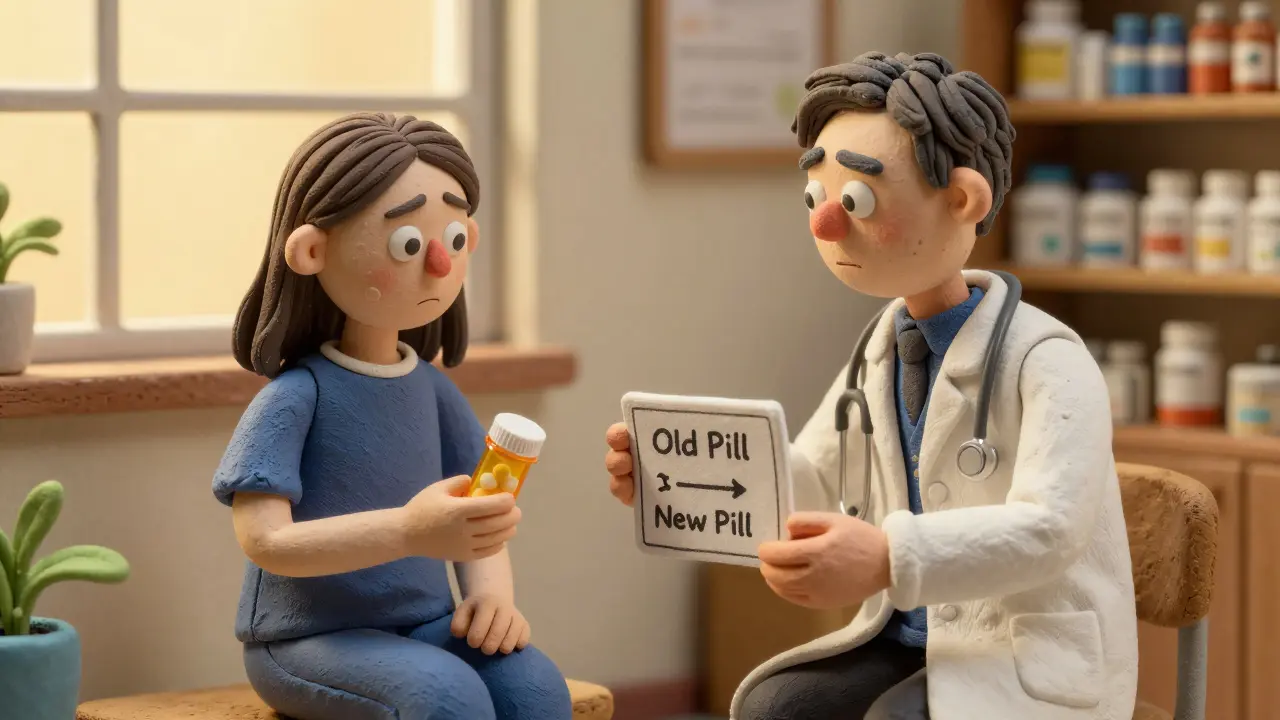
When a medication you’ve been taking for years suddenly disappears from the pharmacy shelf, it’s not just an inconvenience-it’s a crisis. For patients, this isn’t a supply chain issue. It’s a personal threat. And when providers fail to explain what’s happening, trust breaks down. Drug shortages aren’t rare anymore. In 2023, nearly 300 medications were in short supply in the U.S. alone, with heart drugs and cancer treatments among the most affected. The problem isn’t just availability-it’s how providers respond.
What Providers Owe Patients During a Shortage
Providers don’t just need to tell patients a drug is unavailable. They need to explain why, what comes next, and how it affects them. The European Medicines Agency’s 2022 guidance says communication must include four key pieces: the exact name of the drug (brand and generic), how severe the shortage is, when it might end, and safe alternatives. In the U.S., the FDA requires manufacturers to report shortages six months in advance-but that doesn’t help if the provider never acts on the info.Patients aren’t asking for a pharmaceutical report. They’re asking: “Will I be okay?” A 2022 study in the New England Journal of Medicine found that 73% of patients lost trust in their provider when they learned about a shortage from the pharmacy-not their doctor. That’s not a failure of logistics. It’s a failure of responsibility.
How to Communicate Clearly-No Jargon Allowed
Health literacy matters more during a shortage than ever. Nearly half of U.S. adults struggle to understand basic health information. If you tell a patient, “We’re switching you from metoprolol tartrate to metoprolol succinate,” you’ve just confused them. Instead, say: “The pill you’ve been taking isn’t available right now. We’re switching you to a different version of the same medicine that works the same way but lasts longer. You’ll take it once a day instead of twice.”The CDC recommends the “Chunk, Check, Change” method: give information in small pieces, ask the patient to explain it back in their own words, and adjust if they’re lost. Use visuals-simple charts showing old vs. new pill shape, color, or dosing schedule. A 2021 study found that patients who received visual aids were 52% more likely to stick with the new medication.
Alternatives Aren’t Just Substitutions-They Need Proof
Patients don’t want a random replacement. They want to know it’s safe. A 2022 survey of 2,400 patients found that 78% would accept a different drug if they understood why the original was gone. But 72% needed to know the alternative had been proven to work just as well.Don’t say, “This other beta-blocker will do.” Say: “This alternative has been used in over 100,000 patients with the same condition as yours. Studies show it works just as well at controlling your blood pressure. We’ve used it here for years.”
When switching from a brand-name drug to a generic, clarify: “This is the exact same medicine, just made by a different company. It’s not cheaper because it’s worse-it’s cheaper because we’re not paying for the brand name.”
Timing Matters-Don’t Wait for the Pharmacy to Tell Them
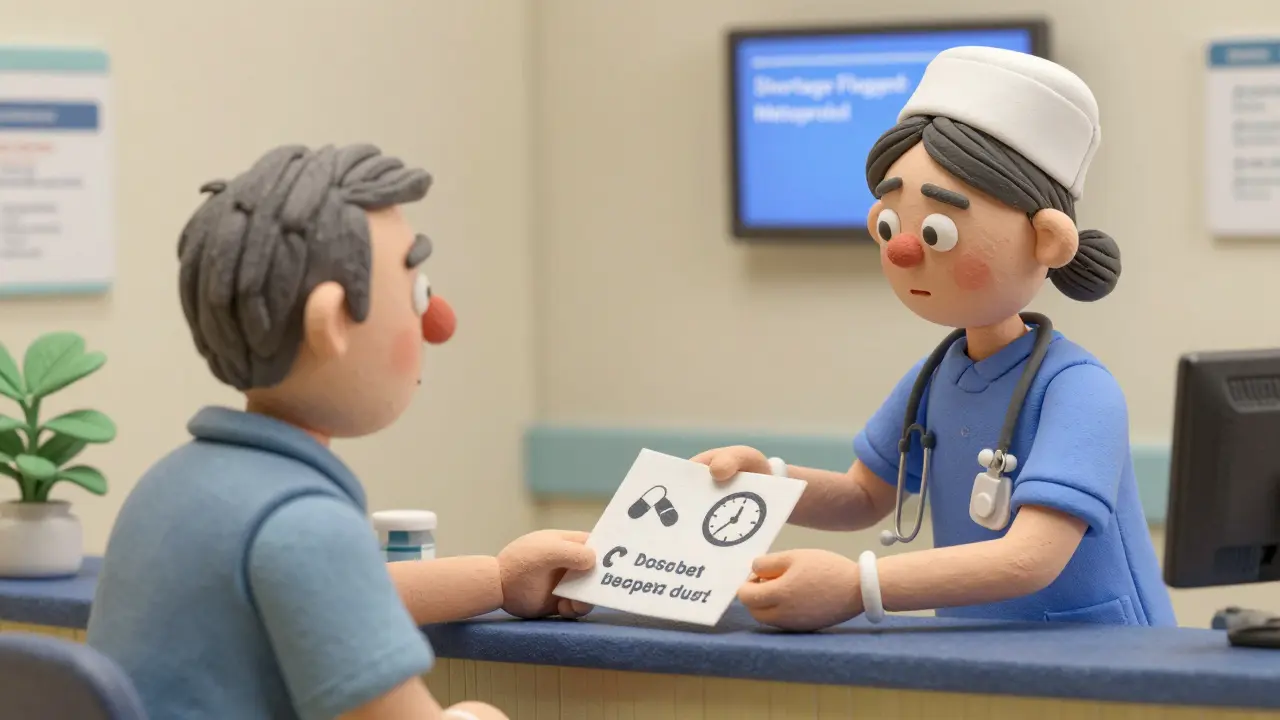
The worst thing a provider can do is wait until the patient shows up at the pharmacy and gets turned away. That’s when panic sets in. The American Medical Association calls this “presumptive communication”-telling patients before they find out on their own.Academic hospitals like Mayo Clinic use automated alerts in their electronic records. When a shortage is confirmed, the system flags patients on that medication. A note goes into their chart, and a letter or secure message is sent days before their refill is due. This reduces anxiety by 41%, according to AMA clinical trials.
Even in busy clinics, this doesn’t have to take long. Kaiser Permanente integrated shortage alerts into routine visit workflows. Instead of adding 10 minutes to each appointment, they added just 2.7 minutes-by using pre-written templates and auto-populated messages in their EHR.
What Happens When Communication Fails
When providers don’t communicate well, patients suffer. On Healthgrades, reviews mentioning drug shortages average just 2.1 stars-far below the site’s 3.8-star average. The top complaints? “No warning before my refill was denied.” “The pharmacist didn’t know anything either.” “They just handed me a different pill and said ‘take this.’”On Reddit, patients share stories like: “I had to stop my heart medication for three weeks because my doctor never told me it was gone. I ended up in the ER.” These aren’t outliers. They’re the result of systemic silence.
And the consequences aren’t just emotional. A 2020 study by the Institute for Safe Medication Practices found that when providers didn’t clearly explain alternatives during shortages, prescribing errors jumped by 28%. Patients took the wrong dose. They mixed up pills. Some stopped entirely.
Special Cases: Rural Patients, Non-English Speakers, and Chronic Illness
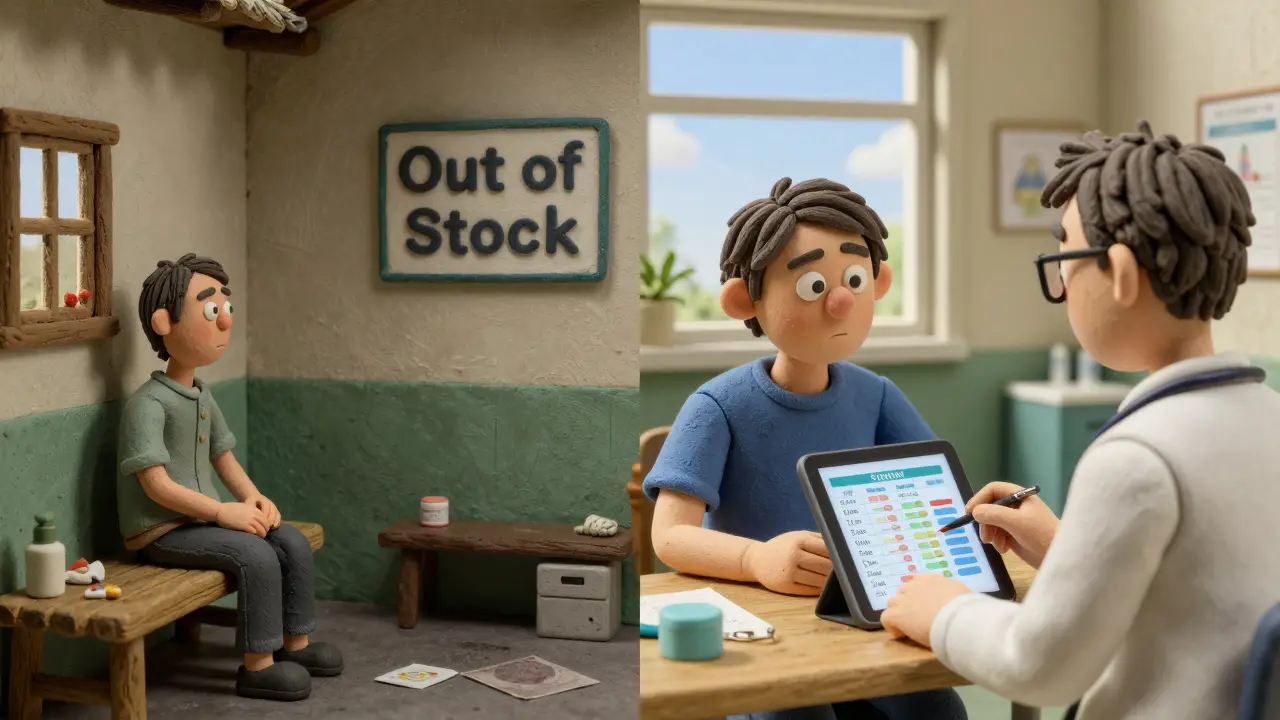
Not all patients experience shortages the same way. In rural areas, 68% of providers say they don’t have real-time access to shortage updates. A patient in Maine might be on a waiting list for a drug while a city hospital has stock. That’s not fair. It’s a gap in care.For non-English speakers, the risk is even higher. Research in JAMA Internal Medicine found they’re 3.2 times more likely to misunderstand shortage information. If your clinic doesn’t have translated materials or access to medical interpreters, you’re putting patients at risk.
For cancer patients, the stakes are life-or-death. Memorial Sloan Kettering assigns dedicated communication specialists to handle every oncology shortage. These staff are trained to manage fear, answer complex questions, and provide emotional support-not just facts. That level of care should be standard, not rare.
What’s Required-Not Just Recommended
Starting in January 2025, the Joint Commission will require all accredited healthcare facilities to have “structured, empathetic communication processes” for drug shortages. Failure to comply could mean losing accreditation. That’s not a suggestion. It’s a rule.Documentation is part of that. If you don’t record that you explained the shortage, why you chose the alternative, and that the patient understood, you’re legally vulnerable. CRICO Strategies found that 92% of malpractice cases tied to shortages involved poor documentation.
And it’s not just about avoiding lawsuits. Systems that communicate well see 23% less patient churn during shortages. People stay with providers who treat them like partners-not afterthoughts.
What You Can Do Today
You don’t need a fancy system to start doing this right.- Check your EHR. Does it flag drug shortages? If not, ask your IT team to add it.
- Create a one-page handout for common shortages in your practice. Include the drug name, why it’s gone, the alternative, how to take it, and a phone number to call.
- Train your staff. Even a 15-minute huddle once a month on how to explain shortages can make a difference.
- Use the “Chunk, Check, Change” method in every shortage conversation.
- Send a message before the refill is due-not after the patient gets denied.
Patients don’t expect you to fix the supply chain. But they do expect you to lead them through it. Clear communication isn’t a nice-to-have. It’s the core of care.
What should I say to a patient when their medication is in short supply?
Start by confirming the shortage is real and explain why it’s happening in simple terms. Say: "The company that makes your medication is having trouble producing enough right now, so it’s not available. We’re switching you to another version that works the same way. Here’s how to take it, and here’s what to watch for." Always use plain language, avoid jargon, and show a visual if possible.
Is it okay to just give a different drug without explaining?
No. Giving a replacement without explanation increases anxiety, reduces trust, and raises the risk of patients stopping their medication entirely. Studies show patients are far more likely to follow a new plan if they understand why the change was necessary and that the alternative is safe and proven.
How do I know if my patient understood what I told them?
Use the teach-back method. Ask: "Can you tell me in your own words how you’ll take this new medicine?" If they can’t explain it clearly, go over it again. Don’t assume understanding just because they nodded. Research shows only 20% of patients fully understand medical info after a single explanation-even if they say they do.
What if the alternative is more expensive?
Be upfront. Say: "This alternative might cost more. Let me check if your insurance covers it or if there’s a patient assistance program. We can also see if a lower-dose version works for you to save money." Never assume patients know how to navigate costs. Offer help.
Do I need to document every shortage conversation?
Yes. If you don’t document what you told the patient, why you chose the alternative, and that they understood, you’re at risk in a legal or accreditation review. Even a few bullet points in the chart-"Explained shortage of metoprolol. Switched to metoprolol succinate. Patient repeated back dosing schedule correctly."-makes a big difference.
What’s Next for Patient Communication in Shortages
The future is moving fast. AI tools are being tested to predict which drugs will run short before it happens. The International Pharmaceutical Federation is creating standardized patient communication templates set to launch in late 2024. And payers like Medicare are starting to tie reimbursement to how well providers handle shortages.But the biggest change won’t come from technology. It’ll come from culture. When providers stop seeing shortages as a pharmacy problem and start seeing them as a communication responsibility, patients will feel safer. And that’s the only thing that really matters.
Brian Furnell
December 21, 2025 AT 13:40Okay, so let’s break this down: we’ve got a systemic failure in communication, not just supply. The FDA’s 6-month advance notice? Meaningless if the EHR doesn’t auto-flag it. And why aren’t we integrating shortage alerts into clinical decision support? We’re talking about beta-blockers, insulin, chemo agents-this isn’t ‘oops, we’re out of aspirin.’ We need real-time, interoperable, HL7-compliant triggers that push alerts to both clinician dashboards AND patient portals. Otherwise, we’re just rearranging deck chairs on the Titanic.
Siobhan K.
December 23, 2025 AT 11:46Let me guess-the next step is mandatory empathy training with a quiz at the end. Because nothing says ‘patient-centered care’ like a corporate LMS module titled ‘Communicating While Your System Is Broken.’
Meina Taiwo
December 25, 2025 AT 03:14Simple fix: send text alerts before refill. No jargon. Just: ‘Your med is out. New one: X. Take Y. Call if unsure.’ Works in Lagos, works in Maine.
Jon Paramore
December 25, 2025 AT 15:47From a clinical pharmacy standpoint, the real bottleneck isn’t communication-it’s formulary alignment. If your hospital’s P&T committee doesn’t pre-approve alternatives before shortages hit, you’re already behind. And no, ‘we’ll just use the generic’ doesn’t fly when the generic’s not on formulary. We need proactive therapeutic substitution protocols, not reactive triage.
Swapneel Mehta
December 27, 2025 AT 04:18This is the kind of post that makes you feel like maybe things can get better. Small steps, real talk, no fluff. Keep pushing this. Patients notice when someone actually cares.
Adrian Thompson
December 28, 2025 AT 15:06Who’s really behind this? Big Pharma’s been stockpiling generics since 2020. The FDA’s in bed with the manufacturers. They let shortages happen so they can jack up prices on the ‘alternatives.’ And now they want us to trust their ‘safe’ replacements? LOL. You think metoprolol succinate is really the same? Tell that to the guy who got arrhythmia after the switch.
Southern NH Pagan Pride
December 30, 2025 AT 00:08they say ‘structured empathetic communication’ but what they really mean is ‘stop being lazy and do your job.’ also the joint commission is just another gov agency that doesn’t know how to fix anything. they just make checklists. and who’s gonna pay for all these ‘dedicated communication specialists’? the patients? lol. also, why is everyone suddenly obsessed with ‘chunk, check, change’? it’s not magic, it’s just basic human decency.
John Hay
December 31, 2025 AT 08:25As someone who’s been on the front lines, I’ve seen this play out too many times. The problem isn’t the lack of guidelines-it’s the lack of time. We’re running 20 minutes behind every shift. So yes, templates help. Yes, EHR flags help. But we need more staff, not more paperwork. And if you’re not documenting, you’re not caring. Plain and simple.
Jason Silva
December 31, 2025 AT 09:29💯 THIS. I’m a cancer survivor. My chemo got pulled without warning. I had to beg my nurse for 3 days just to get a replacement. No one called. No one explained. I cried in the parking lot. If this post saves even one person from that, it’s worth it. 🙏