
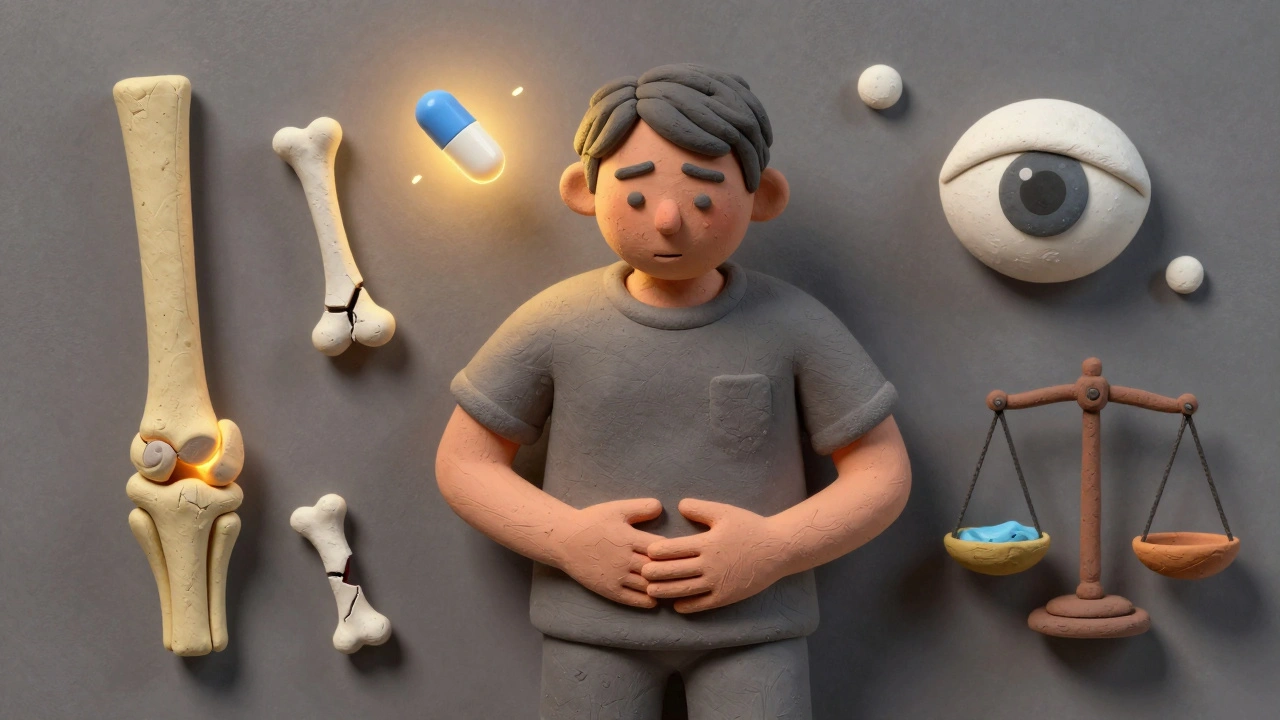
When you're in severe pain from a flare-up of rheumatoid arthritis, or struggling to breathe during a COPD attack, corticosteroids can feel like a miracle. Within 24 to 48 hours, the swelling drops, the fever breaks, the wheezing fades. But that relief doesn't come free. Every dose carries a hidden cost-one that shows up months or years later in the form of broken bones, high blood sugar, or cataracts. This isn't a hypothetical risk. It's a documented pattern seen in millions of patients.
How Corticosteroids Work (And Why They're So Fast)
Corticosteroids are synthetic versions of cortisol, the stress hormone your body naturally makes. They don't just calm inflammation-they shut it down hard and fast. Unlike disease-modifying drugs that take weeks to build up in your system, corticosteroids act like a fire extinguisher. A single oral dose of prednisone can reduce joint swelling by 70% in two days. An injection into a painful knee can mean walking without a cane within a week.
The speed is why doctors reach for them. For a sudden lupus flare, a severe asthma attack, or even a peritonsillar abscess, corticosteroids are often the difference between hospitalization and home. A 2019 NEJM study showed they cut hospital stays for asthma by nearly two days. Another study found they reduced the need for surgery in throat infections by 27%.
But here’s the catch: the same mechanism that makes them powerful also makes them dangerous. They don’t just target the bad inflammation-they disrupt your entire hormonal balance. That’s why side effects show up so quickly.
The Short-Term Side Effects You Can’t Ignore
Even a short course-say, five to ten days of prednisone-can trigger noticeable changes. Most people don’t realize how fast this happens. Within days:
- Weight gain: Fluid retention adds 5 to 10 pounds, mostly around the belly and face. This isn’t fat-it’s water, but it looks like it.
- Insomnia: Many report being wide awake at 3 a.m., even if they’ve never had trouble sleeping before.
- Mood swings: Irritability, anxiety, or even sudden depression can surface. Some describe it as feeling "like a different person."
- High blood sugar: Even people without diabetes can see their levels spike. One study found 41% of users needed new or adjusted diabetes meds during treatment.
These aren’t rare side effects. In a 2023 survey of 1,200 corticosteroid users, 87% gained weight, 63% had trouble sleeping, and 41% saw blood sugar changes. And these are the "mild" ones. The real danger starts after the first month.
Long-Term Risks: The Hidden Damage
Long-term use-anything beyond 3 months-is where the damage becomes permanent. The body doesn’t bounce back the same way after prolonged exposure.
- Bone loss: Corticosteroids block bone-building cells and increase calcium loss. Within 6 months, users lose 3% to 5% of bone density per year. That’s 10 times faster than normal aging. One in eight long-term users develops osteoporosis.
- Cataracts: Clouding of the eye lens happens in 12% of those on steroids for more than a year. Surgery is often needed.
- Diabetes: New-onset diabetes develops in 7% of long-term users. For some, it never goes away-even after stopping the drug.
- Infections: Your immune system slows down. A 2021 study showed a 430% increase in sepsis risk within just 30 days of starting steroids. Pneumonia risk jumps 15% in COPD patients on even short courses.
- Adrenal suppression: Your body forgets how to make its own cortisol. If you stop suddenly, you can go into adrenal crisis-low blood pressure, vomiting, collapse. That’s why tapering isn’t optional.
These aren’t theoretical risks. A 2023 meta-analysis found that each extra month of steroid use beyond three months raised the 10-year risk of death by 4.7%. That’s not a small number. It’s the difference between living and dying from something preventable.
Who Gets Prescribed Them-and Why It’s Often Wrong
Over 22 million corticosteroid prescriptions are written each year in the U.S. That’s more than one in five adults. But nearly half of those prescriptions are for conditions where they don’t work.
Doctors still give them for:
- Common colds and sinus infections
- Uncomplicated bronchitis
- Lower back pain without nerve involvement
There’s no evidence they help here. Yet they’re prescribed anyway. Why? Because patients want relief, and doctors want to give it. But the cost? A 2021 study found this inappropriate use costs the U.S. system $1.2 billion a year-mostly from treating the side effects.
Older adults are hit hardest. People over 65 get prescriptions 2.3 times more often than those under 45. Rural patients get them 1.7 times more often than urban ones-often without proper follow-up. These aren’t just medical errors. They’re systemic failures.
How to Use Them Safely (If You Must)
If your doctor says you need corticosteroids, ask these questions:
- What’s the exact diagnosis? Are we sure this is the right treatment?
- What’s the shortest possible course? Can we aim for 7 days instead of 14?
- What’s the lowest effective dose? Is 5mg of prednisone enough, or do we really need 20mg?
- Will I need a taper? And how long will it take?
- What monitoring do I need? Blood sugar? Bone scan? Eye exam?
For anyone on more than 7.5mg of prednisone daily for over 3 months, you should get:
- A baseline DEXA scan for bone density
- Monthly blood sugar checks
- Quarterly eye exams
- Calcium (1,200 mg) and vitamin D (800 IU) daily
- Annual bone-strengthening shot (zoledronic acid) if on high doses
And never stop cold turkey. Even after a 10-day course, your body needs time to restart cortisol production. A sudden stop can be life-threatening.
What’s Changing-And What’s Coming
The medical world is waking up. In December 2023, the FDA approved the first new type of steroid-like drug: fosdagrocorat. It works like a steroid to reduce inflammation but with 63% fewer blood sugar spikes. Early trials show promise for arthritis patients who need long-term control without the metabolic damage.
Hospitals are also changing. In 87% of U.S. hospitals, electronic systems now flag inappropriate steroid prescriptions. If your doctor tries to order steroids for a cold, the system pops up: "Evidence does not support use for acute bronchitis."
Major groups like the American College of Physicians now require pre-authorization for any course longer than 10 days in Medicare plans. That’s cutting down misuse.
But the biggest shift is cultural. Doctors are learning to say no. "Corticosteroids are the fire extinguisher of rheumatology," says Dr. Susan Baker, past president of the American College of Rheumatology. "Indispensable in emergencies-but dangerous if left running continuously."
Real Stories: Relief and Regret
On Reddit, u/RheumWarrior wrote: "Prednisone 20mg saved me from hospitalization during my lupus flare. Within 48 hours, my fever broke and joint swelling dropped by 70%." That’s the good side.
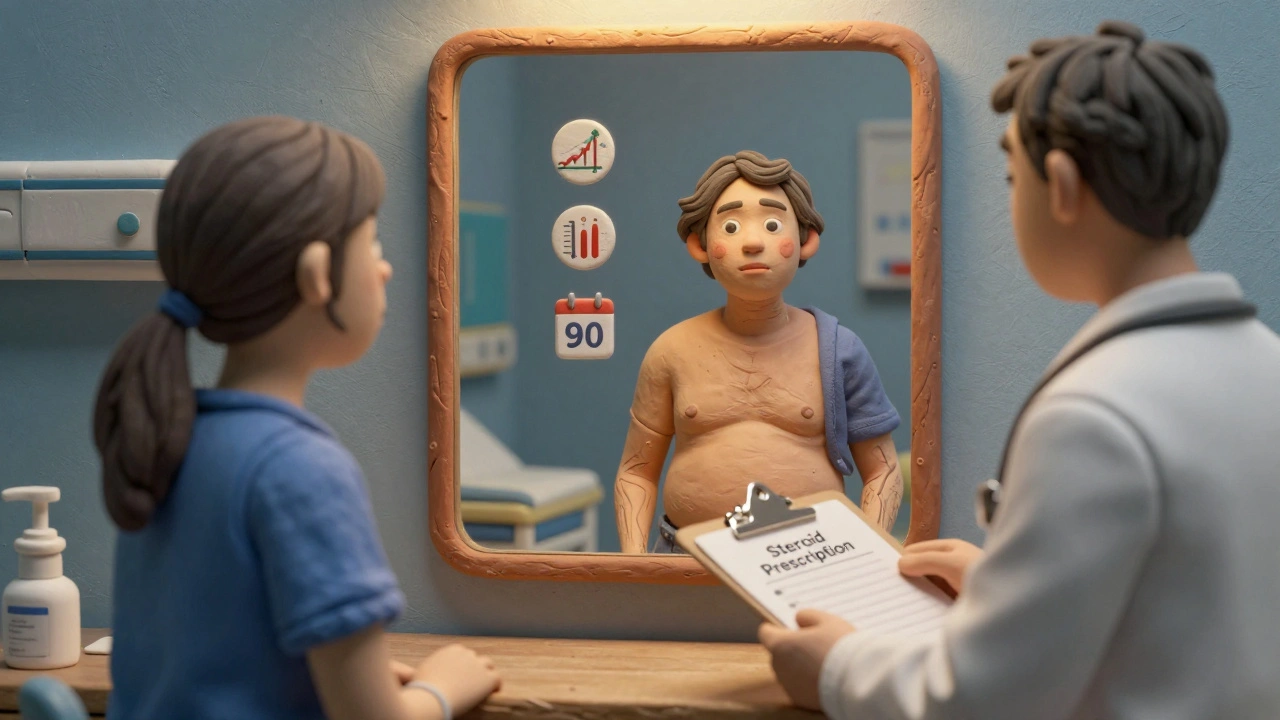
But on HealthUnlocked, 42 patients described the same thing: "Moon face within two weeks. I didn’t recognize myself in the mirror."
The Steroid Recovery Project surveyed 1,200 people. 87% gained weight. 63% couldn’t sleep. 29% said they had permanent changes-cataracts, diabetes, brittle bones-even after stopping the drug.
These aren’t outliers. They’re the rule.
Bottom Line: Use Them Like a Weapon, Not a Habit
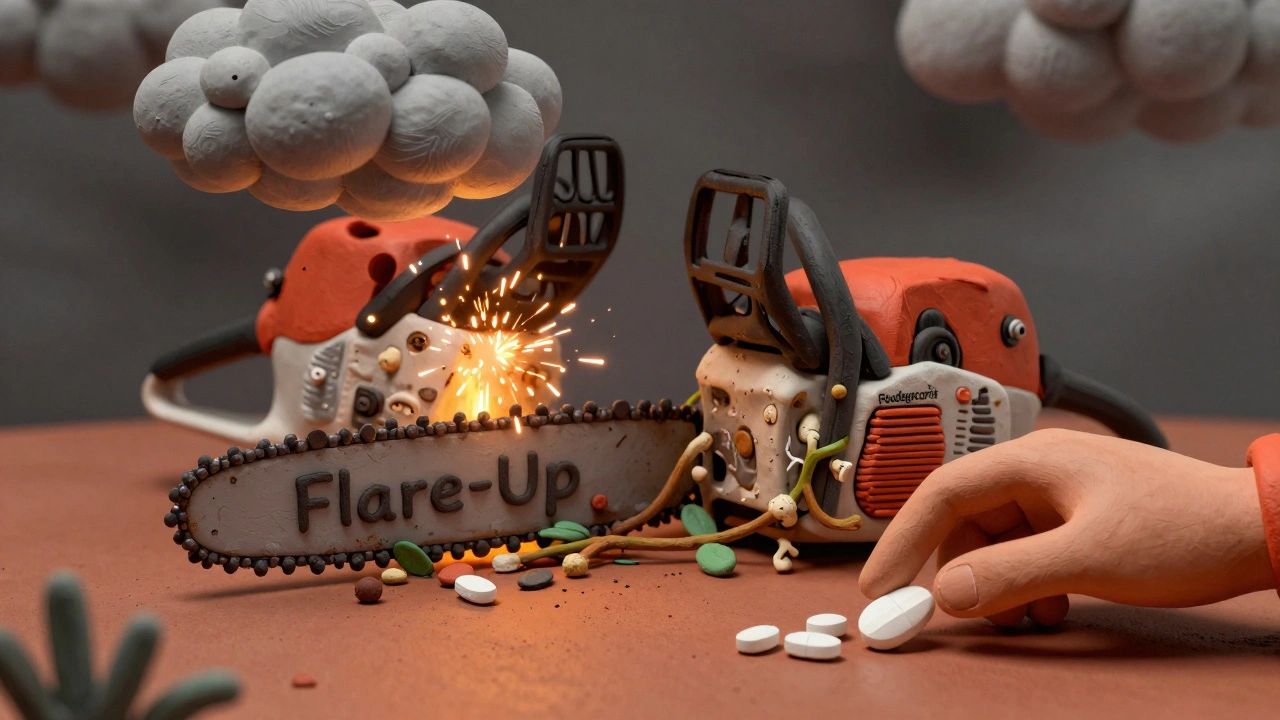
Corticosteroids aren’t evil. They’re powerful tools-like a chainsaw. Perfect for cutting through a crisis. Terrible for trimming hedges.
If you need them for a flare-up, take them. But insist on the shortest time and lowest dose possible. Demand monitoring. Ask about alternatives. Don’t accept a "just in case" prescription.
And if you’ve been on them for more than three months? Talk to your doctor about getting off. There are safer, longer-term options now. You don’t have to live with the damage.
The goal isn’t to avoid corticosteroids entirely. It’s to use them with eyes wide open. Because the relief is real. But the cost? It lasts longer than the pain ever did.
Declan Flynn Fitness
December 2, 2025 AT 14:43Been on prednisone for 6 months post-kidney transplant. The weight gain? Real. The insomnia? Brutal. But here’s the thing-I’d take it all again if it meant not dying. The key is monitoring. I got my DEXA scans, took calcium + D3, and my doc tapered me slow. It’s not magic, it’s management.
Linda Migdal
December 3, 2025 AT 06:38Typical liberal medical overreach. If you can’t handle a little steroid-induced moon face, maybe you shouldn’t be alive. Americans are weak. We’ve turned medicine into a spa day. Back in my day, you took your medicine, shut up, and got better.
Shannon Gabrielle
December 3, 2025 AT 13:21Oh wow. So the FDA approved a new steroid? How convenient. Meanwhile Big Pharma’s stock is up 12%. Next they’ll patent the word ‘inflammation’ and charge you per sneeze.
Patrick Smyth
December 3, 2025 AT 13:36I had to take 40mg for 10 days after my spinal infection. I cried every night because I didn’t recognize my face in the mirror. My wife said I looked like a balloon with eyes. I didn’t speak to her for a week. I still have nightmares about the sugar spikes. This isn’t medicine. It’s emotional terrorism.
Michelle Smyth
December 3, 2025 AT 16:58One must interrogate the epistemological framework underpinning glucocorticoid hegemony. The biomedical paradigm, steeped in Cartesian reductionism, pathologizes inflammation as an enemy to be annihilated-rather than a semiotic signal of systemic dysregulation. The ‘fire extinguisher’ metaphor is not merely reductive; it is ontologically violent. We are not treating disease-we are suppressing the body’s dialectical response to stress, thereby entrenching the very pathology we claim to resolve. The adrenal suppression? A metaphysical reclamation by the HPA axis. The cataracts? The eyes weeping for the soul’s dissonance.
And yet-do I still take it? Yes. Because the body, in its biological pragmatism, does not care for philosophy. It only wants to survive. And so, we become complicit in the machinery of biopower.
Tommy Walton
December 4, 2025 AT 01:37Y’all act like steroids are the devil. Bro. They’re the MVP of emergency medicine. 🚒🔥 I had a lupus flare last year. I was in a wheelchair. 24 hours after prednisone? Walking. With a smile. The moon face? Faded. The diabetes? Controlled. Life’s trade-offs. Deal with it.
Louise Girvan
December 4, 2025 AT 05:35Did you know? The WHO is hiding data. Corticosteroids are linked to mass surveillance implants. The ‘adrenal suppression’? It’s not your body-it’s the government shutting down your bio-rhythm so they can track your cortisol levels. 87% of users gain weight? Because they’re being fed processed GMO food laced with synthetic cortisol suppressants. Wake up.
soorya Raju
December 5, 2025 AT 09:08yo u all r so dum. steroids r not bad. its the docs who r dumb. they give it for colds? LOL. my cousin in delhi took it for 2 months for back pain. now he got diabetes and can’t walk. but he say ‘it was worth it’ because he could sleep. so what? we all just gonna die anyway. 🤷♂️
Dennis Jesuyon Balogun
December 6, 2025 AT 13:57As a physician in Lagos, I see this daily. Patients come with joint pain, fever, cough-anything. They beg for steroids because they’ve heard ‘it works fast.’ We don’t have the luxury of time, specialists, or DEXA machines. So we give them 5mg for 5 days. We know the cost. But we also know the alternative: death by neglect. This isn’t malpractice-it’s triage. The real villain isn’t prednisone. It’s the global health inequity that forces us to choose between two evils.
Yes, we need alternatives. But until then, we must be honest: sometimes, the only moral choice is to give someone a chance to live today-even if tomorrow breaks them.
Grant Hurley
December 7, 2025 AT 18:40Just had my first steroid shot for a bad knee. Felt like a superhero for 3 days. Then I turned into a zombie who craves pizza at 3am. But hey-I can finally play with my kid again. Worth it. Just don’t forget your calcium pills. And maybe don’t tell your boss you’re ‘on the moon’ when you’re irritable. 😅
Lucinda Bresnehan
December 9, 2025 AT 09:41As someone who’s been on long-term steroids for SLE, I can say: this post nails it. The weight gain, the insomnia, the fear of turning into a human pumpkin… it’s real. But I also want to say: if you’re reading this and you’re scared? You’re not alone. I joined a support group. We swap tips: ‘How I sleep with moon face,’ ‘Best low-sugar snacks,’ ‘How to explain to your kids why you look different.’ It helps. You’re not broken. You’re surviving.
ANN JACOBS
December 9, 2025 AT 16:50It is with profound gravity and an unwavering commitment to the sanctity of human health that I address this critical matter. The administration of synthetic glucocorticoids, while temporally efficacious, represents a profound disruption to the homeostatic equilibrium of the endocrine system-a system which, through millennia of evolutionary refinement, has achieved a delicate balance between survival and sustainability. To intervene with such potency, without the rigorous oversight of longitudinal metabolic surveillance, constitutes not merely a therapeutic choice, but a moral imperative to mitigate iatrogenic harm. One must, therefore, not only advocate for the shortest possible duration and the lowest effective dosage, but also insist upon the establishment of mandatory, federally mandated biomonitoring protocols, including but not limited to: serial HbA1c assessments, ocular fundoscopic evaluations, and dual-energy X-ray absorptiometry scans, all of which must be documented and reported to a centralized national registry to ensure accountability and transparency in clinical practice.
Nnaemeka Kingsley
December 11, 2025 AT 07:47Man, I had a cousin in Nigeria who took steroids for a rash. He got better in 2 days. Then he started gaining weight, couldn’t sleep, got diabetes. He died 3 years later from a broken hip. I told the doctor: ‘Why not just give him cream?’ He said: ‘We don’t have cream.’ That’s the real problem. Not steroids. The lack of choice.
Kshitij Shah
December 11, 2025 AT 20:24So let me get this straight-using steroids for a cold is bad, but giving someone a 10-day course for a flare-up is fine? Bro. You’re not ‘using them like a chainsaw.’ You’re just using them like a hammer. And if you’re lucky, you don’t hit your thumb.
James Steele
December 12, 2025 AT 13:37Let’s be real: corticosteroids are the cocaine of modern medicine. Fast, euphoric, devastating. We don’t prescribe them-we surrender to them. The ‘fire extinguisher’ analogy is poetic, but it’s also a lie. Fire extinguishers don’t leave ash in your bones. They don’t turn your eyes cloudy. They don’t make your children cry when you hug them because you smell like a sugar-dusted ghost. We’ve turned healing into a high. And now we’re surprised when the comedown kills you.
Declan Flynn Fitness
December 12, 2025 AT 21:17Replying to @5300: Bro, the government doesn’t control your cortisol. Your doctor does. And if they’re giving you steroids for a cold, fire them. I’ve seen it too-doctors giving it out like candy because they’re rushed. But that’s not the drug’s fault. It’s the system’s. Let’s fix the system, not blame the moon.
Declan Flynn Fitness
December 13, 2025 AT 12:16Replying to @5302: You’re right. In places without access, steroids are a lifeline. I’ve worked in rural clinics too. We give 5mg for 5 days, no follow-up, and pray. But that doesn’t mean we stop pushing for better. We need mobile DEXA vans, telehealth endocrinologists, low-cost calcium supplements. The problem isn’t steroids. It’s the silence around access.
Declan Flynn Fitness
December 14, 2025 AT 09:49Replying to @5304: Thank you for saying this. I started a subreddit: r/SteroidSurvivors. We post pics of our moon faces with captions like ‘Still smiling.’ We share recipes, taper schedules, and therapist contacts. You’re not broken. You’re a warrior. And we see you.
Grant Hurley
December 16, 2025 AT 07:37Replying to @5332: Dude, I just joined your subreddit. My wife made me a ‘Moon Face Mug’ with ‘I survived prednisone’ on it. I drink coffee from it every morning. It’s my trophy.
Lucinda Bresnehan
December 18, 2025 AT 05:55Replying to @5305: The FDA didn’t approve fosdagrocorat to make money. They approved it because patients begged for it. I was on the clinical trial. I didn’t gain weight. My blood sugar stayed normal. It’s not a conspiracy. It’s progress.
Nnaemeka Kingsley
December 18, 2025 AT 13:00Replying to @5301: Your cousin’s story is why I don’t trust doctors who give steroids for rashes. I told my son: ‘If they give you steroids for a bug, ask: ‘Is this the last resort?’ If they say yes, say no. Find another doctor.’
ANN JACOBS
December 20, 2025 AT 09:52Replying to @5303: While your ‘Moon Face Mug’ may serve as a humorous coping mechanism, one must not trivialize the physiological and psychological ramifications of iatrogenic glucocorticoid exposure. The mug, while symbolically resonant, does not mitigate the risk of vertebral compression fractures, nor does it restore adrenal axis function. We must move beyond meme-based resilience toward systemic reform.
Shannon Gabrielle
December 20, 2025 AT 12:41Replying to @5304: Oh please. ‘Clinical trial.’ That’s just a fancy word for ‘lab rat.’ You think they test drugs on people because they care? They test them because they can make a billion dollars off the side effects. You’re not a hero. You’re a marketing tool.
James Steele
December 22, 2025 AT 03:38Replying to @5306: Your 500-word manifesto is beautiful. Now go write it on a prescription pad. Because the guy in rural Iowa doesn’t care about ‘homeostatic equilibrium.’ He just wants to walk to his mailbox without crying.
Kshitij Shah
December 23, 2025 AT 10:09Replying to @5299: You’re right. Steroids are the cocaine of medicine. And the doctors? They’re the pushers. And we’re the addicts. And the system? It’s the cartel. We’re all just trying to get through the day.
Declan Flynn Fitness
December 24, 2025 AT 15:08One sentence: I’d take it again tomorrow.