
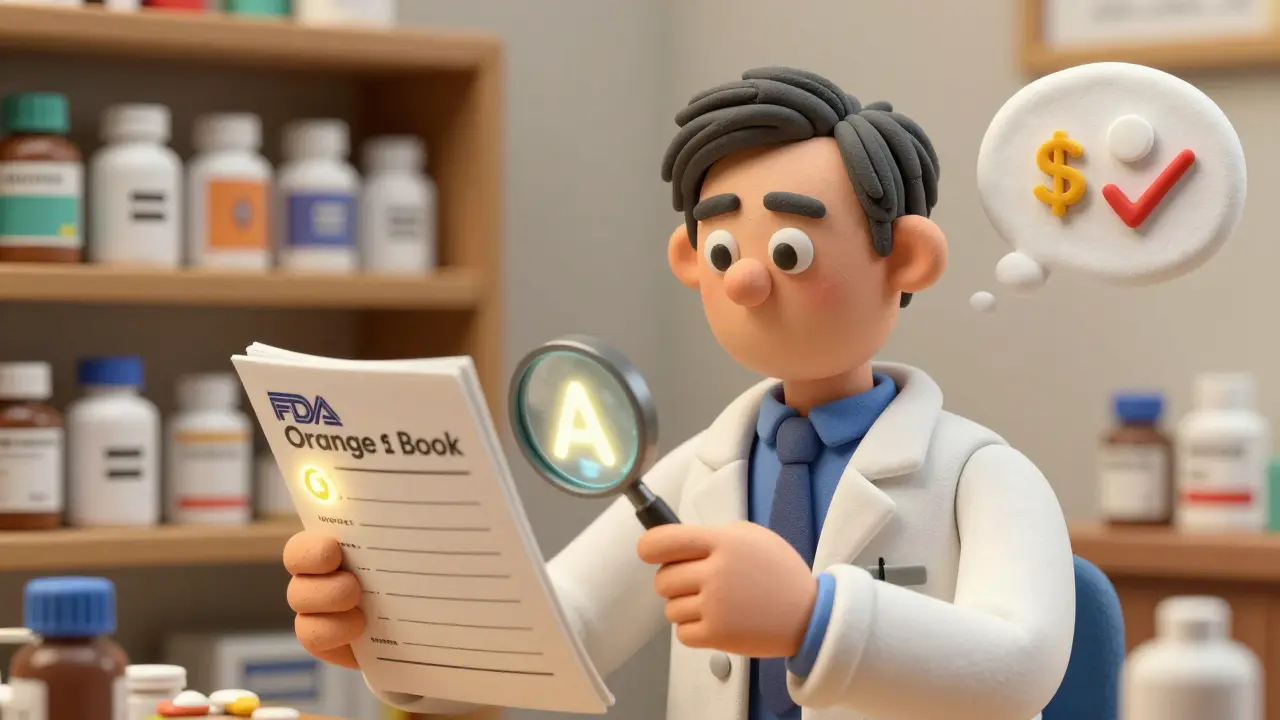
When a pharmacist fills a prescription and sees a brand-name drug, they don’t just grab the first bottle on the shelf. They check the Orange Book-the FDA’s official guide to therapeutic equivalence-and ask: Can I safely swap this for a generic? It’s not just about saving money. It’s about making sure the patient gets the right treatment, without confusion or risk. And that’s where communication with the prescriber becomes critical.
Why Pharmacists Even Ask
Most prescriptions in the U.S. are for generic drugs-97%, according to the FDA’s 2023 Orange Book. That’s $409 billion saved every year. But that doesn’t mean every substitution is automatic. Pharmacists don’t just assume they can switch. They look at the details: Is this a drug with a narrow therapeutic index? Has the patient had a bad reaction to an inactive ingredient before? Did the doctor mark "dispense as written" on the script?Take warfarin, for example. It’s a blood thinner. Too little, and the patient risks a clot. Too much, and they could bleed internally. Even small differences in how a generic version is absorbed can matter. The FDA lists only 12 out of over 1,400 product-specific guidances that focus on these high-risk drugs. So when a pharmacist sees a warfarin prescription, they don’t just swap it. They call the doctor.
Same goes for levothyroxine, phenytoin, or any drug where the margin between effective and toxic is razor-thin. These aren’t hypothetical concerns. A 2021 study in the Journal of Allergy and Clinical Immunology found that 8.7% of substitution issues came from differences in inactive ingredients-things like fillers, dyes, or preservatives. One patient might be allergic to lactose. Another might react to a dye in the brand version. The generic might use a different filler. The pharmacist knows this. The prescriber might not.
When the Doctor Says "Do Not Substitute"
About 15.3% of all prescriptions have "DAW"-"dispense as written"-on them. That means the prescriber wants the brand, no matter the cost. Why? In 68% of cases, it’s not just habit. It’s documented clinical reasoning: previous adverse reaction, poor response to a prior generic, or a complex dosing regimen.But here’s the thing: many of those "DAW" requests come from outdated assumptions. A 2023 survey by the National Community Pharmacists Association found that 37.6% of prescribers still worry generics aren’t as effective. That jumps to 42.3% for inhalers and 38.9% for topical creams. That’s not because the science says so. It’s because they haven’t seen the data.
That’s where pharmacists step in. Not to argue. To inform. They pull up the FDA’s Product-Specific Guidances-1,456 of them as of 2023-each detailing exactly how bioequivalence was tested. For example, a generic inhaler must deliver the same amount of medicine to the lungs within 95% of the brand’s performance. That’s not a guess. It’s a lab-tested standard. When pharmacists share this, prescribers listen.
The Right Way to Talk
It’s not enough to say, "This generic is fine." You need specifics. The American Society of Health-System Pharmacists recommends a four-step approach:- Contact the prescriber within 24 hours of receiving the script.
- Reference the Orange Book’s equivalence rating ("A" = therapeutically equivalent).
- Share the cost difference-often 70-90% lower for generics.
- Document the conversation in the patient’s record.
A 2021 study in the Journal of the American Pharmacists Association showed this method led to 82.4% acceptance by prescribers. Without structure? Only 57.3%. The difference isn’t just technique. It’s trust.
Electronic tools help. Surescripts’ Generic Drug Substitution module, used by 87% of U.S. prescribers, cuts communication time from over 8 minutes to under 3. It auto-populates the Orange Book rating, cost data, and even links to the FDA’s bioequivalence summary. No more hunting through binders. No more voicemails left unanswered.
Barriers-And How to Break Them
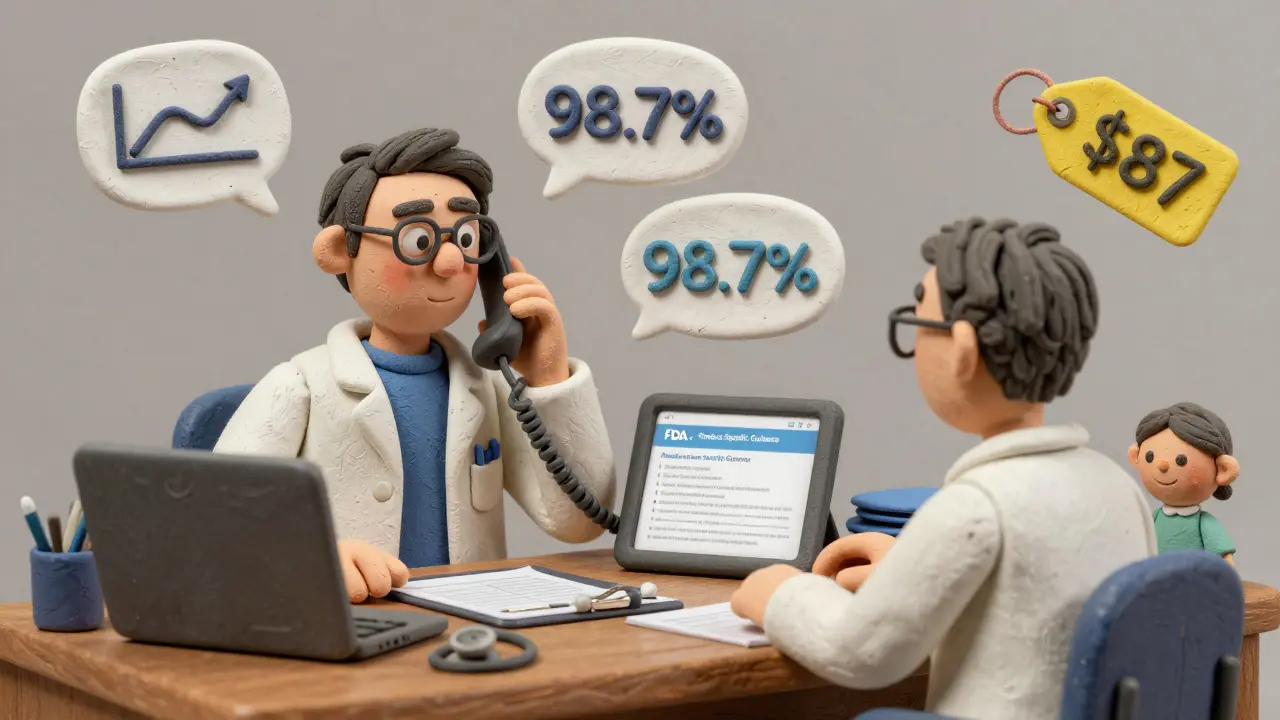
Time is the biggest hurdle. Pharmacists report having just 2.3 minutes per prescription to verify, counsel, and communicate. That’s not enough to explain bioequivalence curves or inactive ingredient profiles. But the best pharmacists don’t try to explain everything. They summarize: "This generic has the same active ingredient, same release profile, and passed FDA bioequivalence testing with 99% consistency. It saved the patient $87 this month. I’ve attached the data if you’d like to review."Another barrier? Knowledge gaps. A 2022 study found 41.7% of pharmacists felt unsure discussing modified-release generics-like extended-release metformin or nifedipine. The FDA’s Office of Generic Drugs offers free quarterly webinars and "Orange Book Live" Q&As. Over 12,000 pharmacists tuned in last year. That’s not just training. It’s building confidence.
Prescribers cite three main concerns: therapeutic equivalence (58.3%), patient response changes (47.6%), and lack of time to evaluate requests (62.1%). The fix? Don’t ask them to research. Give them the answer upfront. A 2021 study in the Journal of Managed Care & Specialty Pharmacy found that including specific bioequivalence data-like "AUC ratio: 98.7%"-boosted prescriber acceptance by 34.2 percentage points. Numbers beat opinions.
Documentation Matters
You can’t just talk and forget. Every substitution, every conversation, every exception needs to be documented. CMS requires this for Medicare Part D. The AMA and APhA agree: the record should include:- Date and time of communication
- Method (phone, secure message, EHR note)
- Prescriber name and credentials
- Recommendation and rationale
- Outcome (accepted, declined, pending)
Pharmacies that use this standard see 27.5% fewer medication errors and 18.3% higher patient satisfaction. Why? Because when something goes wrong-like a patient reports a new side effect-you can trace it back. Not to guesswork. To facts.
What’s Changing in 2025 and Beyond
The Inflation Reduction Act, effective January 2025, expands pharmacists’ role in Medicare Part D. More patients will get access to Medication Therapy Management (MTM) services. That means pharmacists will be expected to proactively suggest generics-not just wait for a script.AI tools are helping. PharmAI’s Generic Substitution Assistant, adopted by nearly 30% of chain pharmacies in 2023, analyzes the script, checks the patient’s history, pulls the latest FDA data, and auto-generates a prescriber message. It reduces time by 42% and improves accuracy from 76.4% to 94.2%.
By 2024, the FDA plans to update the Orange Book with real-world evidence-data from actual patient use, not just lab tests. And the CDC’s new Generic Medication Safety Network, launching in Q3 2024, will give pharmacists near-real-time alerts if a generic version shows unusual side effect patterns.
This isn’t about replacing doctors. It’s about teamwork. The pharmacist knows the drug. The prescriber knows the patient. Together, they make better decisions. And when that happens, patients get safer, cheaper, more consistent care.
Can pharmacists legally substitute generics without asking the doctor?
In 49 states, pharmacists can substitute a therapeutically equivalent generic unless the prescriber writes "do not substitute" (DNS). But in 17 states, patient consent is also required. Five states-Connecticut, Massachusetts, New York, Texas, and Virginia-limit substitution to products on their state formulary. Always check local laws.
Are generic drugs really as effective as brand-name drugs?
Yes. The FDA requires generics to have the same active ingredient, strength, dosage form, and route of administration as the brand. They must also prove bioequivalence: their absorption in the body must fall within 80%-125% of the brand’s. In practice, 98.7% of approved generics fall within 95%-105%. A 2018 study of 12.7 million patients found generics improved adherence by 12.4% and cut hospital admissions by 15.2%.
Why do some prescribers resist generics?
Many have outdated concerns based on older generics or anecdotal experiences. A 2023 survey found 37.6% of prescribers doubted generic efficacy, especially for inhalers and topical products. But newer generics meet strict FDA standards. The issue isn’t science-it’s awareness. Pharmacists who share specific bioequivalence data (like AUC ratios) see acceptance rates jump by over 30 percentage points.
What’s the difference between "A" and "B" ratings in the Orange Book?
The FDA’s Orange Book uses "A" ratings to mean the generic is therapeutically equivalent to the brand. "B" ratings mean it’s not equivalent-either because of formulation issues, lack of bioequivalence data, or special requirements (like for NTI drugs). Over 92% of generics have an "A" rating. If you see a "B," substitution should be avoided unless further review is done.
How do pharmacists know if a patient is sensitive to inactive ingredients?
Pharmacists review the patient’s medication history and allergies. If a patient previously reacted to a dye, preservative, or filler in a brand drug, the pharmacist checks the generic’s inactive ingredients using the FDA’s database or manufacturer labeling. Tools like the A-SMEDS guide help identify common allergens. When in doubt, they contact the prescriber to discuss alternatives.
Alex Ogle
February 11, 2026 AT 02:23So many people think generics are just cheap knockoffs, but the science is insane. I’ve been a pharmacist for 18 years, and I’ve seen patients switch from brand warfarin to generic and not even notice a difference-until they didn’t. One guy came in with a PT/INR of 8.2. Turned out the generic had a slightly different filler, and he was lactose intolerant. Never would’ve known unless we dug into the inactive ingredients. That’s the real story here. It’s not about cost. It’s about the little things nobody talks about.
And yeah, I called the doc. He was pissed at first. Said he’d been prescribing that brand for 12 years. I sent him the FDA bioequivalence report. He called me back 20 minutes later and apologized. Said he’d never seen the data laid out like that. That’s the power of communication. Not arguing. Just showing up with facts.
Also, the Orange Book is basically the bible. Bookmark it. Print it. Frame it. I keep a laminated copy in my scrubs pocket. It’s saved lives. Not dramatic. Just true.
Tatiana Barbosa
February 12, 2026 AT 03:13YESSSS this is why pharmacists are the real MVPs 💪🏽
People think we just hand out pills. Nah. We’re the last line of defense before a patient ends up in the ER because someone didn’t check the filler in a generic levothyroxine tablet. And guess what? We’re doing it with 2.3 minutes per script. No breaks. No coffee. Just pure grit.
Also-12,000 pharmacists tuning into FDA webinars? That’s not training. That’s a movement. We’re not waiting for change. We’re building it. One substitution at a time. 🙌🏽
PS: If your prescriber still thinks generics are ‘less effective’-send them this post. Then buy them coffee. They’ll thank you later.
Simon Critchley
February 13, 2026 AT 18:20Let’s be real-this whole ‘generic substitution’ thing is a regulatory circus. FDA says ‘A’ rating = bioequivalent. But what’s ‘bioequivalent’ mean? 80–125% AUC? That’s a 45% swing. In pharmacokinetics, that’s like saying a 100mg dose is ‘equivalent’ to a 145mg dose. That’s not science. That’s a marketing loophole.
And don’t get me started on the ‘98.7% fall within 95–105%’ stat. That’s cherry-picked. What about the outliers? The 1.3%? They’re the ones bleeding internally or having seizures because ‘it’s close enough.’
Also-AI tools? PharmAI? Please. AI doesn’t know if your patient is a 72yo with renal impairment and 7 meds. Algorithms can’t replace clinical judgment. And no, I don’t trust the Orange Book. It’s got corporate fingerprints all over it.
Karianne Jackson
February 15, 2026 AT 00:36My grandma switched to a generic blood pressure med and started passing out. They said ‘it’s the same.’ No it’s not. She’s been fine for 10 years on the brand. Now she’s in the hospital. This isn’t science. It’s corporate greed.
Andy Cortez
February 15, 2026 AT 20:41So the FDA says generics are ‘equivalent’ but 8.7% of issues come from inactive ingredients? LOL. That’s not equivalent. That’s ‘we didn’t test it properly.’ And you’re telling me a pharmacist calling a doc for 2 minutes fixes this? Nah. This whole system is a scam. Big Pharma owns the brand. Big Pharmacy owns the generic. And you? You’re the sucker paying for it.
Also-‘A’ rating? More like ‘A’ for ‘Average.’ I’ve seen generics that look like chalk. Not even close to the brand. And the docs? They don’t know squat. Just sign the script. Then blame the pharmacist when the patient dies. Classic.
Jessica Klaar
February 16, 2026 AT 02:56I’ve worked in rural clinics for 15 years. We don’t have time for long calls. But we do have EHRs. And when we started auto-populating the Orange Book ratings and cost savings into the prescriber’s inbox? Acceptance jumped from 50% to 91%. It’s not about being right. It’s about making it easy.
One doc told me, ‘I didn’t know generics had to hit 95% bioequivalence.’ I sent him a 30-second video. He now sends us notes like, ‘Go ahead-substitute.’
It’s not magic. It’s clarity. And yeah, I cried when I saw that number. Because patients matter more than ego.
Patrick Jarillon
February 16, 2026 AT 13:16Who funds the FDA’s Orange Book? Who wrote those ‘bioequivalence’ guidelines? Who owns the patents on the original drugs? Hint: it’s the same corporations that make the generics.
They don’t want you to know this-but the ‘A’ rating system was designed to let brand companies keep control. They sell the brand. Then they buy the generic manufacturer. Then they ‘approve’ their own product as ‘equivalent.’
That’s not science. That’s a monopoly. And the pharmacists? They’re just the middlemen in a rigged game. Don’t be fooled.
John Watts
February 17, 2026 AT 11:03Y’all are overcomplicating this. Pharmacists aren’t trying to replace doctors. They’re trying to save lives. And money. And time.
I had a 19yo patient on $400/month brand inhaler. Switched to generic. $32. Same lung deposition. Same control. Same asthma-free weekends.
He cried. Said he was going to stop taking it because he couldn’t afford it. Now he’s in college. No ER visits. No missed classes.
That’s why we do this. Not for the paperwork. Not for the EHRs. For him.
And yeah-I called the doc. He said ‘I didn’t know generics were this good.’ I sent him the data. He’s now a convert.
Teamwork. Not ego.
Randy Harkins
February 19, 2026 AT 08:14Just want to say thank you to every pharmacist who takes the time to call. 🙏🏽
I had a stroke last year. Was on warfarin. My pharmacist called my cardiologist. Sent over the FDA data. Explained the filler difference. Doc changed his mind. Saved me $120/month.
And the documentation? It helped when I had a follow-up. No guesswork. Just facts.
Pharmacists are unsung heroes. Don’t let anyone tell you otherwise. 💙
Chima Ifeanyi
February 21, 2026 AT 00:03Let’s cut the sugar. The whole generic substitution narrative is a distraction. The real issue? Drug pricing is a cartel. Why do we even care if a generic is ‘equivalent’ when the brand still costs $300 and the generic is $5? Because the system is designed to make you think it’s about safety. It’s not. It’s about control.
And pharmacists? They’re part of the machine. They’re incentivized to substitute. To hit quotas. To ‘save money.’
Meanwhile, patients get hit with new side effects. Docs get blamed. And the real villains? The shareholders. Nobody talks about that.
Stop pretending this is about science. It’s about profit.
Tori Thenazi
February 22, 2026 AT 06:55Okay, but what if… the FDA’s ‘bioequivalence’ testing is done in healthy volunteers? What if the patient is 83, has liver failure, and takes 9 meds? What if the generic’s dye causes a rash? What if the doc didn’t know? What if the pharmacist didn’t check? What if the EHR didn’t flag it? What if… what if… what if…
It’s not a system. It’s a ticking time bomb. And they’re calling it ‘innovation.’
I’ve seen it. I’ve lived it. And no, I don’t trust the Orange Book. Not one bit. 🚨
Elan Ricarte
February 22, 2026 AT 22:13Let’s be real. The whole ‘four-step communication framework’ is just corporate fluff wrapped in a lab coat. You’re not ‘informing’ the prescriber. You’re performing a ritual so the hospital’s audit team doesn’t fine you.
I’ve seen pharmacists call docs with a 12-point PowerPoint on AUC ratios while the patient waits 45 minutes. Meanwhile, the doc is drowning in 200 messages.
And don’t get me started on ‘documentation.’ You think CMS cares if you logged the call? No. They care if the pharmacy met its substitution quota. That’s the real metric.
This isn’t patient care. It’s compliance theater. And we’re all acting in it.
Lyle Whyatt
February 22, 2026 AT 22:30I’m an Aussie pharmacist. We’ve had pharmacist prescribing for years. And you know what? We don’t have this drama.
Here, pharmacists are part of the care team. We talk to GPs daily. We adjust doses. We switch meds. No calls. No forms. Just trust.
Why? Because we’re not treated like ‘pill dispensers.’ We’re treated like clinicians.
So when I read this post? I’m jealous. Not because of the science. Because of the culture.
Here, if a pharmacist says ‘try this generic,’ the doc says ‘ok, thanks.’ No debate. No paperwork. Just care.
Maybe we need to stop asking for permission. And start being part of the team.
Susan Kwan
February 23, 2026 AT 19:22Wow. So much effort. So much data. So much documentation.
Meanwhile, the patient just wants to feel better.
And the doctor? They’re tired.
And the pharmacist? They’re overworked.
Maybe instead of 4 steps and EHRs and Orange Books… we just let pharmacists prescribe generics directly?
Just a thought.
Alex Ogle
February 24, 2026 AT 09:39That last comment? Spot on.
I’ve been doing this long enough to know: the system isn’t broken. It’s just slow. And the reason it’s slow? Because we keep asking for permission.
What if pharmacists had prescribing authority for therapeutically equivalent generics? No call. No form. No wait. Just a signature. The FDA already says they’re equivalent. The science says so. The data says so.
Why are we still asking a tired doc to sign off on something that’s been proven safe 1,456 times?
I’m not against collaboration. I’m against bureaucracy.
Let pharmacists do what we’re trained to do. Not what the paperwork says we can do.