
Living with an autoimmune disease isn’t just about taking medication. It’s about staying one step ahead of your body’s own immune system - the very thing meant to protect you - turning against your tissues. That’s where autoimmune disease monitoring comes in. It’s not a one-time checkup. It’s a continuous, personalized system using lab tests, imaging, and regular doctor visits to catch flares early, track how well treatment is working, and stop damage before it becomes permanent.
What Lab Tests Actually Tell You
Lab work is the backbone of monitoring. But not all tests are created equal. Many patients think a positive ANA test means their disease is active. That’s a myth. The antinuclear antibody (ANA) test is a screening tool, not a tracker. About 20% of healthy people have a positive ANA. What matters is what comes after.
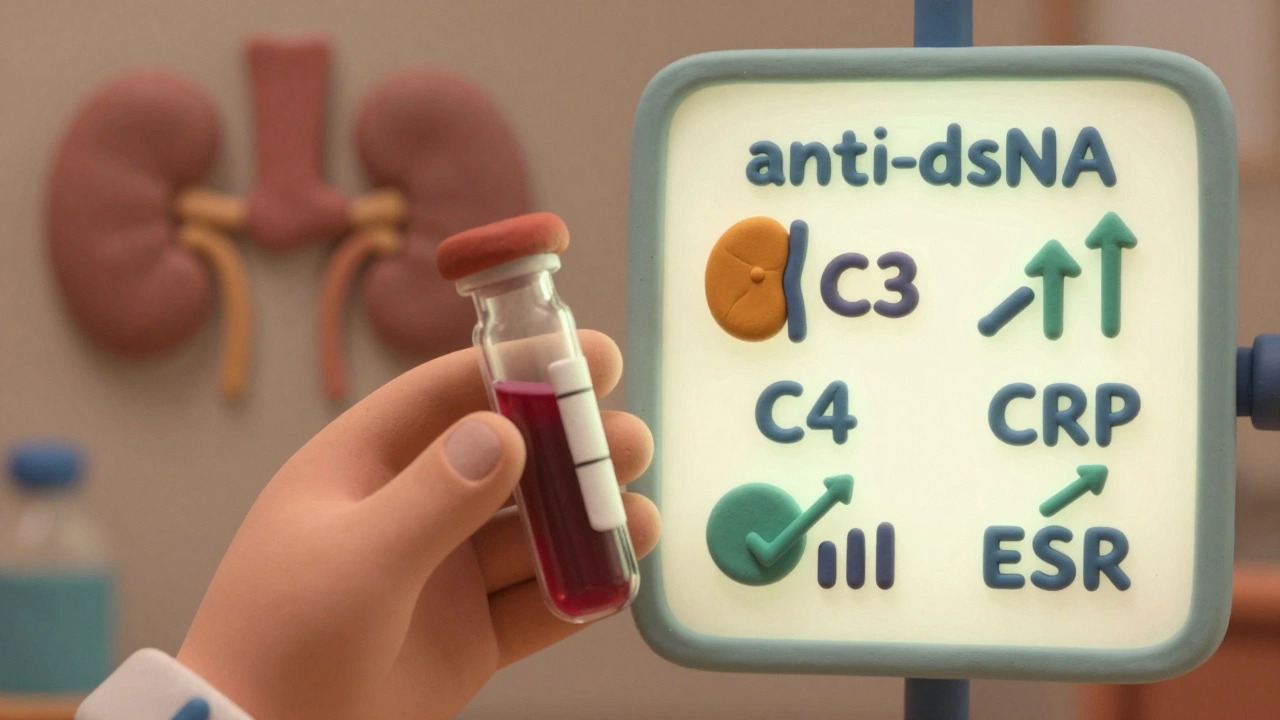
When ANA is positive, reflex testing kicks in. This means running more specific antibody panels. For lupus, anti-dsDNA is the gold standard for monitoring. It’s positive in 60-70% of cases and spikes when kidney involvement (lupus nephritis) flares. If your anti-dsDNA goes up, your doctor knows to look closer at your kidneys - even if you feel fine.
Complement levels (C3 and C4) are just as important. These proteins drop during active lupus because your immune system is using them up. A falling C3 or C4 level often signals a flare before symptoms show. That’s why your doctor checks them every visit, not just ANA.
Inflammatory markers like CRP and ESR give you a bigger picture. CRP above 3.0 mg/L means active inflammation. ESR over 20 mm/hr in women or 15 mm/hr in men suggests ongoing immune activity. These aren’t perfect - they can rise with infections or even stress - but when they trend up over time, it’s a red flag.
For rheumatoid arthritis, the anti-CCP antibody is more specific than rheumatoid factor. It doesn’t change much over time, so it’s used for diagnosis, not monitoring. But CRP and ESR? Those you track monthly. For Sjögren’s syndrome, SS-A and SS-B antibodies help confirm the diagnosis, but they don’t change with disease activity. So don’t waste money on repeat testing unless your doctor suspects a new complication.
Imaging: Seeing What Labs Can’t
Lab tests tell you something’s wrong inside. Imaging shows you where and how bad it is. That’s why they work together.
MRI is the most powerful tool for early detection. It can spot inflammation in joints, the brain, or even the kidneys before you feel pain. Newer contrast agents are safer than old gadolinium ones, reducing risks of long-term tissue buildup. For someone with lupus, an MRI of the brain might catch tiny lesions before headaches or memory issues appear.
Ultrasound is changing how we monitor arthritis. With microbubble contrast, it measures blood flow in swollen joints. In rheumatoid arthritis, it’s 85% accurate at detecting active inflammation - better than X-rays, which only show bone damage after it’s happened. You can see the swelling, the fluid, even the tiny blood vessels growing in response to inflammation. It’s quick, painless, and doesn’t use radiation.
PET scans are the future. By tagging immune cells with radioactive tracers, doctors can see where T-cells are gathering - even in places like the lungs or pancreas. This isn’t routine yet, but in research centers, it’s helping predict which patients will develop severe organ damage.
CT scans give detailed pictures of lungs or blood vessels, useful for vasculitis or lung involvement in scleroderma. SPECT scans track specific molecules at inflammation sites, useful for rare conditions like autoimmune encephalitis.
Bottom line: Imaging doesn’t replace labs. It completes them. If your CRP is high but your ultrasound shows no joint swelling, your flare might be elsewhere - maybe in your gut or skin. Without imaging, you’d miss it.
How Often Should You See Your Doctor?
There’s no one-size-fits-all schedule. It depends on your disease, how severe it is, and how stable you are.
At diagnosis, visits are every 4-6 weeks. You’re adjusting meds, watching for side effects, and trying to get inflammation under control. Once you’re stable - meaning no flares, normal labs, and feeling well - visits stretch to every 3-4 months. Most guidelines, including the American College of Rheumatology, recommend at least two full assessments a year: labs, physical exam, and a discussion about how you’re really doing.
For high-risk patients - those with kidney, lung, or brain involvement - quarterly visits are non-negotiable. Even if you feel fine, your organs might be quietly getting damaged. For mild disease, like early Sjögren’s without organ damage, every 6-12 months may be enough.
Doctors use scoring systems to guide decisions. DAS28 for rheumatoid arthritis, SLEDAI for lupus. These scores combine joint counts, lab results, and patient reports into one number. If your DAS28 drops from 5.2 to 2.8, your treatment is working. If it climbs back up, your doctor needs to act.
And here’s the truth most patients don’t hear: your symptoms matter more than your labs. Dr. Betty Hahn from UNC says 63% of flares show up in how you feel - fatigue, joint stiffness, rashes - before labs change. That’s why your doctor asks, “How are you sleeping?” and “Are you having trouble buttoning your shirts?” These aren’t small talk. They’re data.

What Doesn’t Work - And Why
Not every test needs repeating. Serial ANA testing is a waste of money. Once it’s positive, it stays positive, even in remission. You’re not going to get a negative ANA if you’re in remission. It doesn’t reflect activity.
Same with rheumatoid factor. It’s useful for diagnosis, but levels don’t predict flares. Repeating it monthly gives false hope or panic.
Also, don’t assume normal labs = no disease. Autoimmune conditions don’t always show up in blood. Some patients have severe joint damage but normal CRP. Others have high ESR from a cold, not a flare. That’s why imaging and clinical exams are just as important.
What’s New in Monitoring
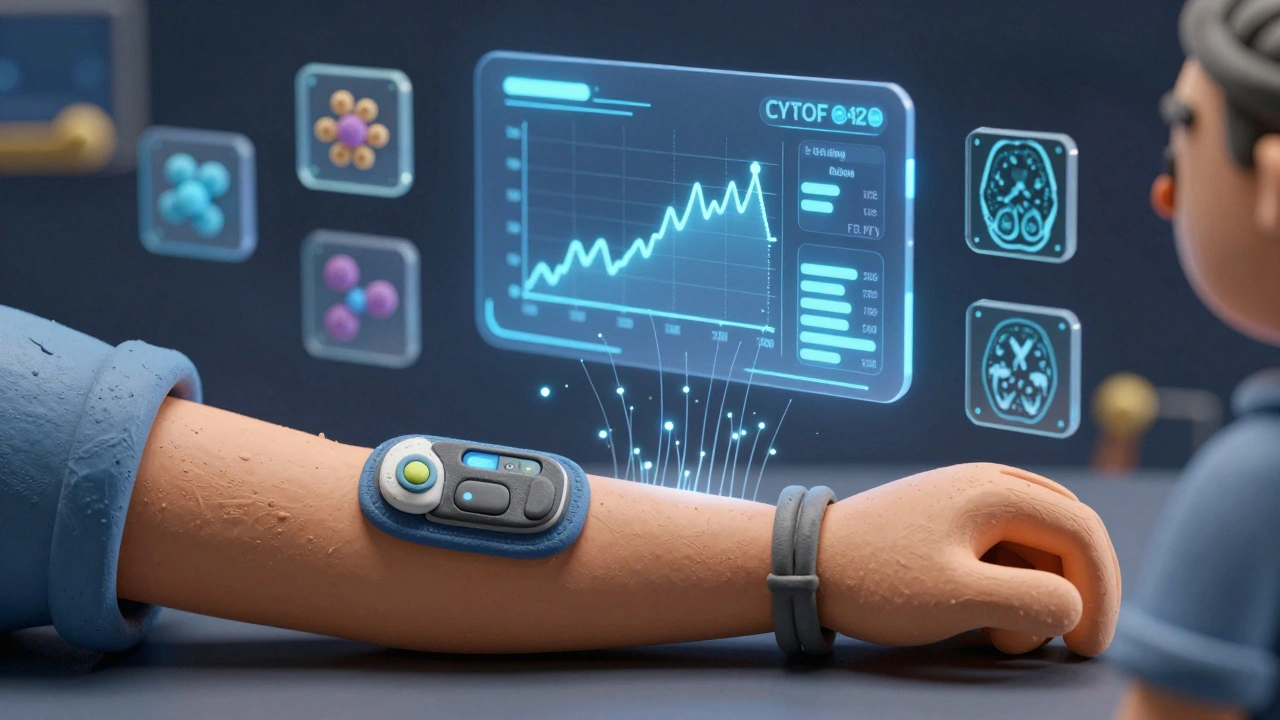
Technology is changing everything. CyTOF - mass cytometry - lets doctors see 50 different immune cell types at once. Traditional flow cytometry could only handle 15. This means we can now spot abnormal immune patterns years before a diagnosis. It’s still mostly in research labs, but it’s coming to clinics.
Wearables are next. New patches and sensors analyze interstitial fluid for CRP and other markers. Early studies show 89% accuracy compared to blood tests. Imagine a patch you wear for a week that tells your doctor if inflammation is rising - without a needle.
AI is helping too. Platforms like AutoimmuneTrack, approved by the FDA in 2023, combine your lab results, wearable data, symptom logs, and even sleep patterns. It predicts flares 14 days in advance with 76% accuracy. In a trial of over 2,000 patients, emergency visits dropped by 29%.
These tools aren’t magic. They’re force multipliers. They give your doctor a clearer, real-time picture. But they don’t replace the human connection. You still need to tell your doctor how you’re feeling.
Barriers and Real-Life Challenges
Not everyone gets the care they need. Insurance often denies MRI or PET scans unless you’ve failed three other treatments. Medicaid patients are half as likely to get recommended monitoring as those with private insurance. In Portland, one patient told me she waited 11 weeks for an ultrasound because her rheumatologist’s waitlist was full.
Test variability is another problem. Labs use different methods for ANA. One lab’s “positive” might be another’s “weak positive.” That’s why it’s best to stick with the same lab for tracking. Consistency matters more than the number.
Cost is real. A single CyTOF test can run $1,200. PET scans cost upwards of $3,000. Not every clinic offers them. But for high-risk patients, the cost of missing a flare - hospitalization, organ failure - is far higher.
Your Role in Monitoring
You’re not a passive patient. You’re the most important part of the team. Keep a symptom journal. Note fatigue levels, joint pain, rashes, fevers, and even mood changes. Bring it to every visit.
Ask: “Is this test helping us track my disease or just checking a box?”
Ask: “What’s the next step if this result goes up?”
Ask: “Can we use ultrasound instead of MRI this time?”
And if your insurance denies a test your doctor ordered - appeal. Many denials are overturned with a simple letter from your rheumatologist. You have rights. Use them.
Autoimmune disease monitoring isn’t about being paranoid. It’s about being prepared. It’s about catching the fire before it burns down the house. With the right tools, the right team, and your active participation, you can live well - even with a condition that attacks your own body.
David Palmer
December 10, 2025 AT 13:54So you're telling me I gotta pay for all these fancy scans just because my ANA's positive? Lol. I've been told that for years and I'm still standing. My dog's got more lab work than I do.
Michaux Hyatt
December 11, 2025 AT 20:13Really glad you broke this down so clearly! A lot of people think a positive ANA means they're doomed, but you're right - it's just the first step. I've seen patients panic over it for years until someone explained that it's like a smoke alarm going off - doesn't mean there's a fire, just means you should check the kitchen. Keep track of your CRP and C3/C4 trends, not just one number. And yes - ultrasound is a game changer. My rheum doc uses it every visit now. No needles, no radiation, and I can see the swelling myself on the screen. Game changer.
Jack Appleby
December 11, 2025 AT 23:16While your general framework is serviceable, it remains fundamentally superficial. You mention CyTOF and AI-driven platforms as if they're accessible to the average patient - a gross misrepresentation of clinical reality. CyTOF is not merely "coming to clinics"; it is a $1.2M instrument requiring PhD-level operators and is confined to five U.S. academic centers. Moreover, "AutoimmuneTrack" - a product of corporate biotech theater - has a 76% predictive accuracy in a single, non-blinded cohort of 2,000, which is statistically underpowered for clinical deployment. The FDA clearance you cite is 510(k), not PMA - meaning it was cleared via equivalence, not clinical validation. You're conflating marketing with medicine. And let’s not forget: ESR is a crude, age-dependent, nonspecific acute-phase reactant - yet you treat it like a biomarker of precision. This is why patients are misled. The real frontier isn't wearables; it's single-cell epigenomic profiling of T-reg dysfunction - which you didn't mention. At all.
Aileen Ferris
December 12, 2025 AT 04:42wait so crp goes up when u stressed?? so like... maybe my doc is just mad at me for being late? lol. also why do they keep testing my ss-a? i got it in 2018. its not gonna change. its like having a tattoo. its just there. forever. like my ex.
Nikki Smellie
December 12, 2025 AT 06:01Have you considered that these "monitoring protocols" are actually designed by Big Pharma to keep you dependent on expensive tests and drugs? The FDA approves these AI tools because they're funded by pharmaceutical conglomerates. The real reason they don't want you to know about natural anti-inflammatories - like turmeric, vitamin D, and fasting - is because they can't patent them. Your doctor is trained to ignore the root causes and push more scans, more blood draws, more pills. The system is rigged. I’ve seen patients go into remission by switching to a paleo-keto diet and grounding themselves daily. Why isn't that in the guidelines? Because the AMA gets kickbacks from lab corporations. I'm not paranoid - I'm informed.
Raj Rsvpraj
December 13, 2025 AT 14:52Rebecca Dong
December 15, 2025 AT 10:06Okay but what if the AI predicts a flare… and it’s WRONG? Like what if I get hospitalized because it said I was fine? And then I die? And my family sues? And then the company says "it’s just a tool"? And the doctor says "I trusted the algorithm"? And then the insurance says "we don’t cover algorithm errors"? And then I’m dead and my cat is in a shelter?? I’m not risking it. I’m doing ALL the tests. Every. Single. One. Even the ones they don’t recommend. I’m not dying because someone’s algorithm had a bad day. I’ve got 17 binders. I’ve got spreadsheets. I’ve got my symptom journal in 5 colors. I’m not letting technology decide if I live or die. I’m taking control. Even if it costs me my savings. Even if I have to sell my car. I’m not letting this disease win. Not today. Not ever.
Michelle Edwards
December 16, 2025 AT 02:11Just wanted to say thank you for writing this. I’ve been living with Sjögren’s for 8 years and this is the first time I’ve read something that didn’t make me feel like a walking lab report. I started keeping a symptom journal last year - just little notes like "felt foggy after lunch" or "couldn’t button my shirt this morning" - and when I brought it to my last visit, my doctor actually paused and said, "I didn’t know you were having this." It changed everything. You’re right - your body talks. You just have to listen. And you’re not being paranoid. You’re being brave. Keep going. You’ve got this.