

Medication Hair Loss Timeline Calculator
Track Your Hair Loss Timeline
Enter when you started taking your medication to see expected hair loss and regrowth timeline.
Your Expected Hair Loss Timeline
This timeline shows when you might experience hair loss and regrowth based on medication-induced hair loss patterns.
When you start a new medication, you expect it to help - not hurt. But for some people, the side effect isn't nausea or dizziness. It's hair loss. If you've noticed more hair in your brush, shower drain, or on your pillow, it might not be stress or aging. It could be your medicine.
Drug-induced hair loss, also called drug-induced alopecia a reversible or sometimes permanent form of hair thinning caused by pharmaceuticals, is more common than most people realize. It doesn't look like bald patches. Instead, your hair feels thinner all over, especially when you pull it into a ponytail or run your fingers through it. This isn't just cosmetic - it affects confidence, mood, and daily life. About 4.7 million Americans experience this each year, according to the National Institutes of Health.
How Medications Make You Lose Hair
Not all hair loss from meds works the same way. There are two main mechanisms: telogen effluvium a disruption that pushes hair follicles into a resting phase too early and anagen effluvium a sudden stop in active hair growth.
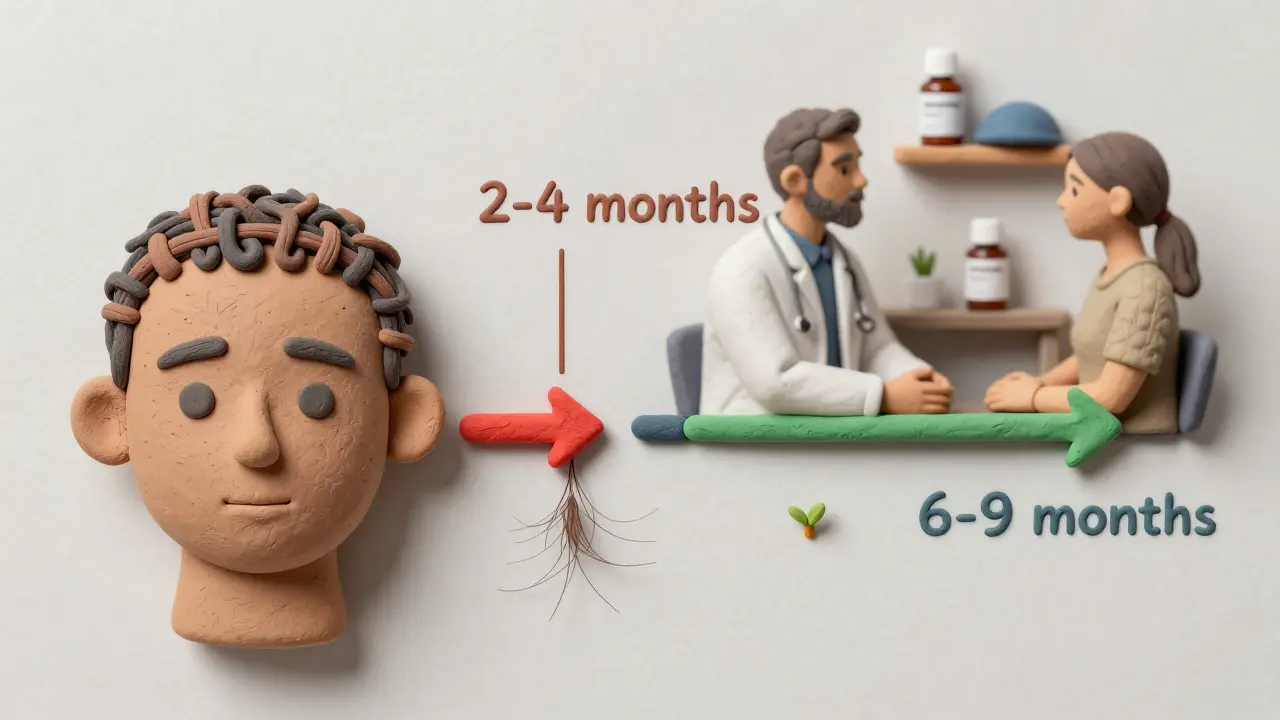
Telogen effluvium is the most common. It happens when a drug throws your hair cycle out of sync. Normally, 90% of your hair is growing. The rest is resting before falling out. Medications like antidepressants, blood pressure pills, or birth control can trick your follicles into resting too soon. You won’t notice the loss right away. It takes 2 to 4 months for those resting hairs to shed. That’s why people often think their hair loss started after a stressful event - when really, it was the medication they started three months ago.
Anagen effluvium is rarer and more dramatic. It’s mostly linked to chemotherapy a class of cancer drugs that attack rapidly dividing cells, including hair follicles. Within 7 to 14 days of starting chemo, hair can fall out in clumps. This isn’t just shedding - it’s a full stop to growth. About 65% of people on standard chemo regimens lose most of their hair. But unlike telogen effluvium, this type often grows back faster once treatment ends.
Which Medications Cause Hair Loss?
It’s not just chemo. Many everyday prescriptions can trigger hair thinning. Here are the top offenders based on clinical data:
- Methotrexate - Used for rheumatoid arthritis and psoriasis. Affects 1-3% of users. The Arthritis Foundation says taking folic acid (1mg daily) cuts hair loss severity by 25%.
- Leflunomide - Another arthritis drug. Up to 10% of users report hair thinning.
- Oral retinoids - Like isotretinoin (Accutane) for acne. Around 18% of users lose hair, sometimes permanently if used long-term.
- Antidepressants - SSRIs like sertraline and fluoxetine. Affects 5-7% of users. Reddit’s r/HairLoss community reports 68% of users see regrowth after stopping.
- Beta-blockers and ACE inhibitors - Blood pressure meds. Less common, but still listed as possible side effects.
- Birth control pills and hormone therapies - Especially those high in progestin. Can trigger shedding in women sensitive to hormonal shifts.
Here’s what matters: timing. If you started a new med within the last 7 months and noticed hair thinning, that’s your prime suspect. Dermatologists call this the "7-month rule." It’s not a guarantee, but it’s a strong clue.
What You Can Do - Real, Proven Steps
First, don’t panic. Most cases are reversible. But you need to act smart.
1. Don’t stop your meds without talking to your doctor. Stopping a drug cold turkey can be dangerous. If your hair loss is linked to something like blood pressure or depression meds, the risks of stopping may be worse than the hair loss. Your doctor might switch you to a different drug in the same class - like changing from sertraline to bupropion - which has lower hair loss risk.
2. Give it time. The American Academy of Dermatology says wait at least 3 months after stopping the drug before trying anything else. Eighty-five percent of telogen effluvium cases fix themselves in that window. Rushing into treatments too early wastes time and money.
3. Try minoxidil (Rogaine). This is the most studied topical treatment. For women, use the 2% solution. For men, 5% works better. Apply 1mL twice daily, every day. Don’t skip. Results take 4-6 months. And yes - you’ll shed more at first. That’s normal. 89% of users go through this "initial shedding" phase between weeks 2 and 8. It means the follicles are waking up. If you stick with it, 40-50% see noticeable improvement in density after 6 months.
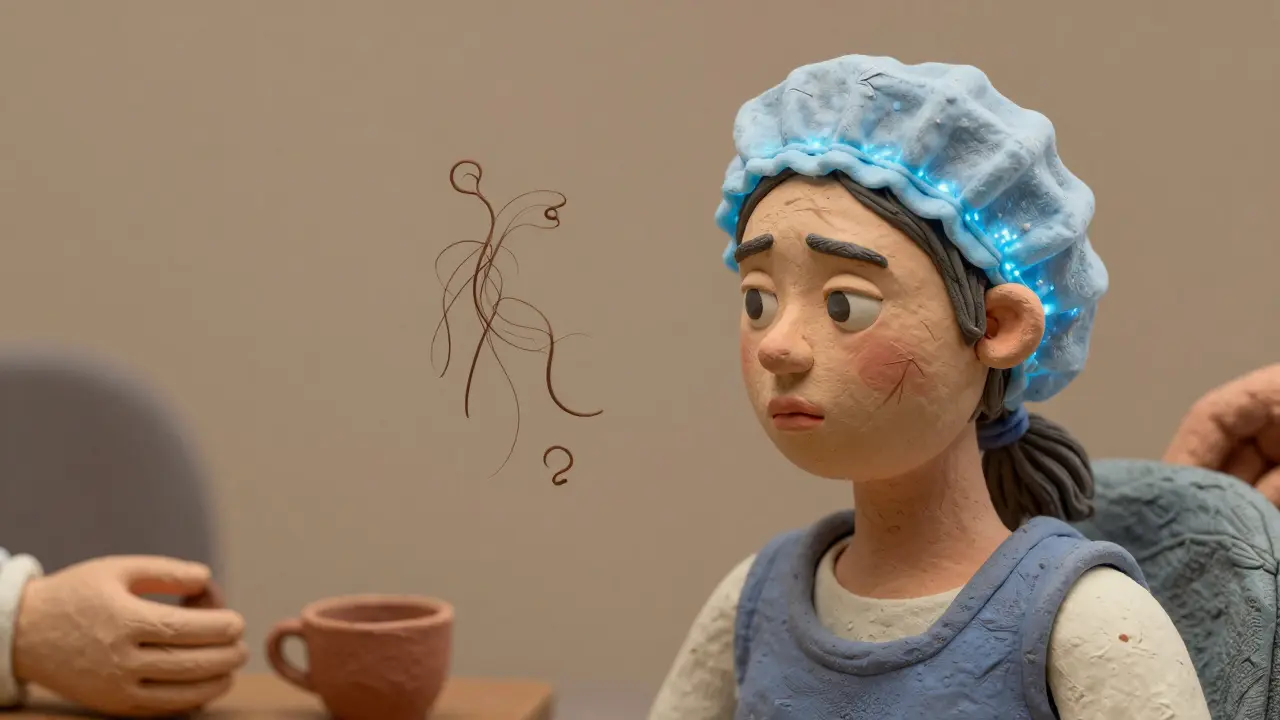
4. Consider low-level laser therapy (LLLT). Devices like the iRestore Elite 780 a Class II FDA-approved laser cap for hair regrowth or Capillus82 a wearable laser helmet with clinical data supporting 65% density improvement are backed by science. Use them 20-30 minutes daily. Studies show results after 26 weeks. They’re not magic, but they work better than most supplements.
5. Check your nutrition. Hair needs fuel. Many people with drug-induced hair loss are low in key nutrients - even if they eat well. Ask your doctor for a blood test. Focus on:
- Biotin - 5,000 mcg daily
- Zinc - 15 mg daily
- Iron - Only if your ferritin is under 70 ng/mL. Too much iron can hurt you.
Don’t waste money on fancy hair vitamins unless they have these in the right doses. Most over-the-counter blends are just sugar and filler.
Special Cases: Chemotherapy and Scalp Cooling
If you’re on chemo, you’re not alone. About two-thirds of patients lose their hair. But there’s a tool that helps: scalp cooling a system that reduces blood flow to the scalp during chemo to protect hair follicles.
The DigniCap Cooling System an FDA-approved device used during chemotherapy infusions to reduce hair loss has been shown to preserve hair in 50-65% of breast cancer patients on taxane-based chemo. You wear a tight cap that cools your scalp to 3°C before, during, and after treatment. It’s uncomfortable - people rate the pain at 7.2 out of 10 - but many say it’s worth it. The downside? It’s not covered by all insurance, and it’s not available everywhere.
And yes - there’s a tiny risk (0.8%) that cancer cells could hide in the scalp and grow back. But for most, the trade-off is clear: keep your hair, even if it’s just a little.
What Doesn’t Work
There’s a lot of noise out there. Here’s what science says doesn’t help:
- Biological supplements like Nutrafol - They’re popular. Amazon reviews say 4.1 stars. But the ingredients - marine collagen, ashwagandha, curcumin - have no proven effect on drug-induced hair loss. Some users report improvement, but it’s likely placebo or natural regrowth timing.
- Scalp massages alone - They feel good. They don’t regrow hair.
- Essential oils - Rosemary, peppermint, lavender - no solid evidence they reverse medication-related loss.
Don’t get fooled by marketing. Stick to what’s been tested.
When to See a Dermatologist
If you’ve tried the basics for 6 months and see no improvement, it’s time to see a specialist. They can:
- Do a pull test to confirm telogen effluvium
- Check for other causes like thyroid issues or iron deficiency
- Prescribe stronger options like finasteride an oral medication that blocks DHT, effective in 60-65% of cases or dutasteride a more potent version of finasteride with 70-75% efficacy but higher risk of side effects
- Discuss emerging treatments like exosome therapy an experimental treatment showing 30% hair density increase in early trials
Don’t wait until you’re losing 100 hairs a day. Early intervention saves time and stress.
What to Expect - Realistic Timelines
Regrowth isn’t overnight. Here’s what to expect:
- 2-4 months after starting the med - Hair starts shedding (telogen effluvium)
- 3-6 months after stopping the med - Shedding slows
- 6-9 months - New hair begins to appear (fine, light, fuzzy at first)
- 9-12 months - Full regrowth for most
- Chemo patients - Hair often starts growing back in 3-6 weeks after treatment ends, but texture may change (curlier, thinner, grayer)
Be patient. Hair grows about half an inch a month. If you’re losing 50-100 hairs a day and it’s been 8 months since you stopped the med - you’re probably on track.
Emotional Impact - It’s Real
One in five people with medication-induced hair loss says it damaged their self-esteem. Nearly half report avoiding social events. It’s not vanity - it’s identity. Your hair is part of how you see yourself. Losing it can feel like losing control.
That’s why support matters. Joining a group like Reddit’s r/HairLoss (247,000 members) helps. Talking to others who’ve been there reduces isolation. And remember: this isn’t permanent for most. Your hair will come back.
Jinesh Jain
March 13, 2026 AT 13:49douglas martinez
March 15, 2026 AT 11:05Shruti Chaturvedi
March 16, 2026 AT 14:19Katherine Rodriguez
March 17, 2026 AT 22:50Sally Lloyd
March 18, 2026 AT 03:55Emma Deasy
March 19, 2026 AT 10:06tamilan Nadar
March 21, 2026 AT 01:33Adam M
March 21, 2026 AT 13:13