

When eye pressure won’t drop with drops or laser treatment, surgery becomes the next step. For many people with glaucoma, that means choosing between a well-established procedure like trabeculectomy and newer options like MIGS. It’s not about which is better-it’s about which is right for your eyes, your lifestyle, and your long-term vision goals.
What Glaucoma Surgery Actually Does
Glaucoma isn’t just about high pressure. It’s about what that pressure does to your optic nerve over time. Left unchecked, it slowly steals your peripheral vision, often without symptoms until it’s too late. Surgery doesn’t cure glaucoma. It doesn’t restore lost sight. But it can stop it from getting worse-by lowering the pressure inside your eye, known as intraocular pressure (IOP). The goal? Get IOP down to a level your optic nerve can handle. For some, that’s 18 mmHg. For others with advanced damage, it’s 12 mmHg or lower. Medications help, but they’re not always enough. Laser treatments like SLT work well for early cases, but when they wear off or aren’t strong enough, surgery steps in.Trabeculectomy: The Gold Standard That Still Works
First developed in the 1960s by British surgeon John Cairns, trabeculectomy is the original surgical fix for glaucoma. It’s still the most effective at lowering pressure-especially for people who need very low targets. Here’s how it works: A small flap is cut in the white part of your eye (the sclera), and a tiny piece of the drainage tissue (trabecular meshwork) is removed. This creates a new path for fluid to escape, forming a small blister-like pocket under the eyelid called a bleb. Fluid collects there and slowly soaks away, lowering pressure. The numbers speak for themselves. According to Mass Eye and Ear’s 2023 data, trabeculectomy reduces IOP by 40-60% in about 85-90% of patients at one year. That often means pressure drops to 5-15 mmHg. For someone with severe glaucoma, that’s life-changing. But it comes with trade-offs. Recovery takes 4-6 weeks. You’ll need frequent check-ups for 3-6 months. There’s a 10-15% chance of bleb leaks, where the fluid escapes too much. A 5-15% risk of serious complications like infection (endophthalmitis) or dangerously low pressure (hypotony). And about 10-20% of blebs fail within five years. It’s a powerful tool-but it’s not gentle. Surgeons need to do 50 to 100 of these before they’re truly comfortable. That’s why it’s usually reserved for advanced cases or when other treatments have failed.MIGS: The Rise of Minimally Invasive Glaucoma Surgery
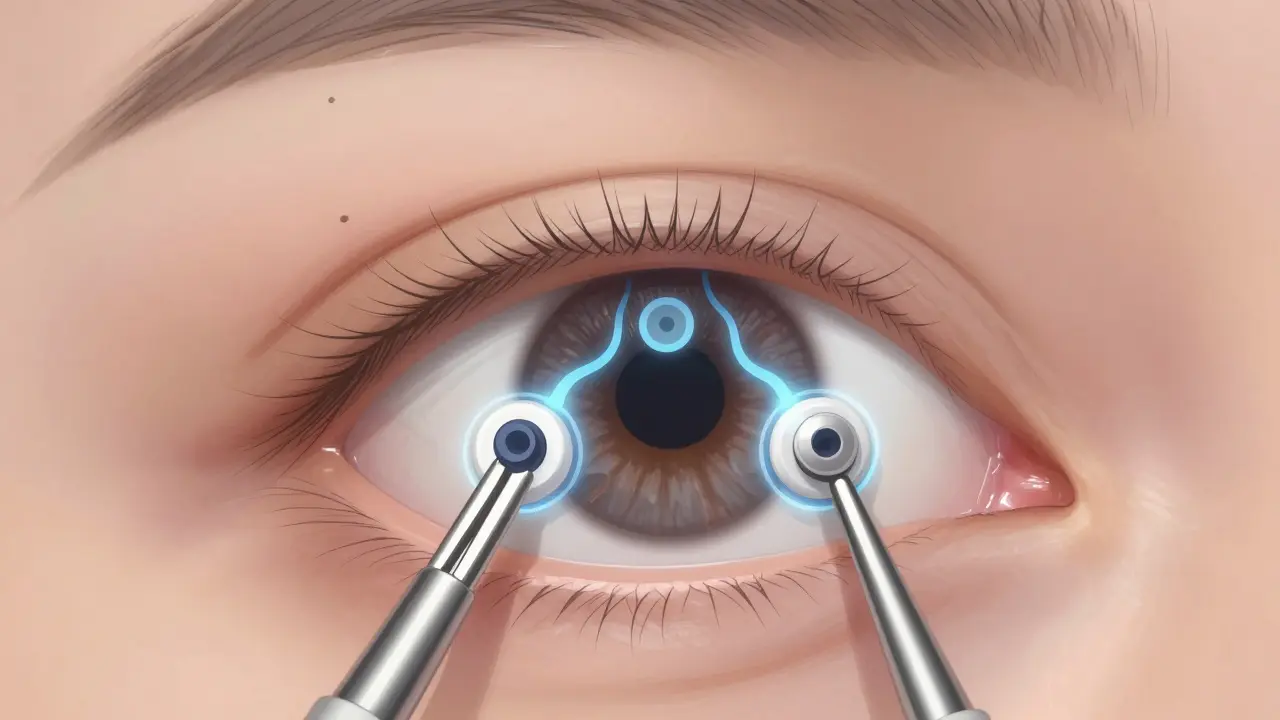
Around 2012, everything changed. The FDA approved the iStent, the first MIGS device. Since then, a whole new category has exploded. Today, MIGS makes up 65% of all standalone glaucoma surgeries in the U.S., according to Glaucoma Today’s January-February 2025 report. MIGS stands for Minimally Invasive Glaucoma Surgery. That means tiny incisions-less than 1.5mm-no cutting of the sclera, and almost no disruption to the eye’s natural structure. Most MIGS procedures are done at the same time as cataract surgery, which makes them even more appealing. There are several types:- iStent inject: Two tiny stents (1mm long) placed in the drainage channel. Reduces IOP by 25-30%.
- Hydrus Microstent: A small scaffold that stretches the drainage canal. Works well for moderate glaucoma.
- Xen Gel Stent: A 6mm soft tube that drains fluid to the surface. Often used when other MIGS isn’t enough.
- GATT (Gonioscopy-Assisted Transluminal Trabeculotomy): A thread is threaded through the drainage system to open it up. Achieves 30-35% IOP reduction.
How They Compare: Pressure, Risk, and Recovery
| Procedure | Average IOP Reduction | Target IOP Range | Complication Rate | Recovery Time | Typical Use Case |
|---|---|---|---|---|---|
| Trabeculectomy | 40-60% | 5-15 mmHg | 5-15% | 4-6 weeks | Advanced glaucoma, young patients, failed MIGS |
| MIGS (e.g., iStent, Xen) | 20-30% | 15-18 mmHg | 1-3% | 1-2 weeks | Mild to moderate glaucoma, combined with cataract surgery |
| SLT (Laser) | 20-30% | 15-20 mmHg | <1% | 1-2 days | First-line treatment for open-angle glaucoma |
Who Gets Which Surgery?
There’s no one-size-fits-all. The decision depends on three things: how bad your glaucoma is, how low your target pressure needs to be, and your overall health.- If you have early glaucoma and your pressure is only slightly high, SLT is your best first move. If that doesn’t last, a MIGS device like iStent inject can be added during cataract surgery.
- If you have moderate glaucoma and you’re already on multiple drops, MIGS is a smart choice. It reduces medication burden and lowers pressure safely.
- If you have advanced glaucoma or your pressure is still high after MIGS, trabeculectomy or a tube shunt is likely needed. These give you the deepest pressure drop.
- If you’re young and have decades ahead, your surgeon might lean toward trabeculectomy. MIGS devices may not last long enough.
- If you’re older and have cataracts, combining MIGS with cataract surgery is often the smartest move.

What’s Changing in 2026?
The field is moving fast. Direct Selective Laser Trabeculoplasty (DSLT) is now being tested-no contact needed, full 360° treatment in seconds. It’s a bit more irritating post-op, but it’s promising. Suprachoroidal shunts are another new direction. Instead of draining fluid to the surface, they send it to a space behind the eye. Early results show good pressure control with fewer complications than trabeculectomy. And the trend? Earlier intervention. No longer waiting until drops fail. Surgeons are now using MIGS and SLT at the first sign of progression. The goal isn’t just to avoid blindness-it’s to avoid lifelong medication dependence.What You Should Ask Your Surgeon
Don’t just say yes to the first option. Ask:- What’s my target pressure, and how does this surgery get me there?
- What’s the chance this will need to be repeated in 5 years?
- How many of these have you done? What’s your complication rate?
- Will I still need eye drops after surgery? How many?
- What happens if this doesn’t work? Can I still have a trabeculectomy later?
Final Thoughts
Glaucoma surgery isn’t about picking the most advanced or the most popular option. It’s about matching the tool to the job. Trabeculectomy still saves vision in advanced cases. MIGS is changing lives by making surgery safer and more accessible. And SLT? It’s now the go-to starting point for most. The future of glaucoma care isn’t one surgery-it’s a personalized pathway. Laser first. MIGS next. Trabeculectomy if needed. The goal is simple: protect your vision, with the least disruption to your life.Is MIGS surgery safer than trabeculectomy?
Yes, MIGS is significantly safer. Trabeculectomy has a 5-15% risk of serious complications like infection, bleeding, or dangerously low eye pressure. MIGS procedures, with their tiny incisions and no bleb formation, have complication rates under 3%. Recovery is faster, and there’s almost no risk of long-term bleb-related issues.
Can MIGS replace trabeculectomy completely?
Not yet. MIGS lowers pressure by 20-30%, which is great for mild to moderate glaucoma. But for advanced cases, where pressure needs to drop below 15 mmHg, trabeculectomy or tube shunts are still the most reliable options. MIGS is expanding into more cases, but it hasn’t replaced the gold standard for severe disease.
How long do MIGS devices last?
Long-term data is still being collected. Most studies track outcomes for 2-5 years, showing sustained pressure control. But we don’t yet know if they last 10, 15, or 20 years. For younger patients, this uncertainty is a factor when choosing between MIGS and trabeculectomy.
Is SLT better than eye drops for glaucoma?
According to the LiGHT trial, SLT is just as effective as eye drops at controlling pressure over three years-and better at preserving quality of life. It’s now the recommended first-line treatment for open-angle glaucoma in most guidelines. Plus, it’s one-time, no daily drops, and can be repeated if needed.
What’s the cost difference between MIGS and trabeculectomy?
Trabeculectomy averages around $4,200 per eye. MIGS devices like the Xen stent cost about $6,300, mostly because of the device itself. But since MIGS is often done with cataract surgery, the total cost can be lower overall. Insurance usually covers both, but out-of-pocket costs vary by provider and plan.
Ashlyn Ellison
February 8, 2026 AT 00:05Just had my first MIGS last month. Recovery was insane-back to work in 3 days, no drops for weeks. I was scared it wouldn’t work, but my pressure’s at 14 now. No bleb, no drama. Honestly? If you’re not at the edge of vision loss, why risk the trabeculectomy nightmare?
Jonah Mann
February 9, 2026 AT 10:49man i had trabeculectomy 3 yrs ago and its been a rollercoaster. bleb leakd twice, had to go back for sutures, and now i still do 3 drops a day. but my pressure is at 11 so i cant complain. migs sounds nice but i think its for people who dont wanna deal with real surgery. also i think they spell it 'trabeculectomy' wrong like 80% of the time on here lol
THANGAVEL PARASAKTHI
February 10, 2026 AT 02:15As someone from India where access to advanced glaucoma care is still uneven, I’ve seen both worlds. Trabeculectomy is still the backbone here because MIGS devices are expensive and often not covered. But I’ve started seeing younger patients opt for MIGS with cataract surgery-it’s changing the game. The real win? Reducing lifelong drop dependency. That’s huge for quality of life. Just wish more clinics had the training.
Frank Baumann
February 11, 2026 AT 14:09LET ME TELL YOU ABOUT MY SURGERY EXPERIENCE BECAUSE NO ONE ELSE GETS IT. I WAS A 32-YEAR-OLD WITH ADVANCED GLAUCOMA, AND THEY TOLD ME MIGS WASN’T ENOUGH. I THOUGHT, ‘FINE, I’LL TAKE THE TRABECULECTOMY.’ WELL, THAT BLEB? IT WAS A LIVING THING. I COULD SEE IT PULSING UNDER MY EYELID. I HAD TO SLEEP WITH AN EYE SHIELD FOR MONTHS. I WASN’T ALLOWED TO BEND OVER. I HAD TO RINSE MY EYE WITH SALINE THREE TIMES A DAY. AND THEN-AFTER ALL THAT-I STILL NEEDED TWO DROPS. I’M NOT SAYING MIGS IS PERFECT, BUT IF YOU’RE NOT AT THE BRINK OF BLINDNESS, WHY PUT YOURSELF THROUGH THAT NIGHTMARE? I’M STILL HAVING NIGHTMARES ABOUT THAT BLEB.
Chelsea Deflyss
February 11, 2026 AT 19:58so u guys are all actin like migs is some miracle cure but i had a friend who got one and it failed in 14 months and now she’s back to drops + laser. and she’s only 40. why do people think these tiny stents are gonna last forever? and dont even get me started on the cost. its a scam. trabeculectomy is still the real deal. u just gotta be tough.
Tricia O'Sullivan
February 12, 2026 AT 01:49Thank you for this comprehensive and meticulously detailed post. It is exceedingly rare to encounter such clarity on a topic that is often shrouded in clinical jargon. The data presented, particularly regarding the LiGHT trial and the comparative complication rates, offers a genuinely balanced perspective. I find it profoundly reassuring that the field is moving toward personalized pathways rather than one-size-fits-all interventions. This is precisely the kind of patient-centered evolution that will define the next decade of ophthalmology.
Scott Conner
February 13, 2026 AT 17:08wait so if slt is first line now, why do so many docs still push drops? i got slt 2 years ago and it worked great, pressure stayed down. but my doc still had me on a drop. i asked why and he said ‘just in case.’ like… what? i’ve been fine for 2 years. is this just habit? or is there a legit reason i’m missing?
Alex Ogle
February 15, 2026 AT 01:15I’ve been following this for years. Trabeculectomy used to be the only real option-until MIGS came along and quietly changed everything. I remember when the iStent first came out. People were skeptical. ‘It’s too small. It won’t do anything.’ But now? I’ve seen patients go from 6 drops a day to zero. And the recovery? You’re back to yoga, driving, even swimming. I’m not saying it’s perfect. Long-term data? Still emerging. But the trend is undeniable. We’re not just treating pressure anymore-we’re treating quality of life. And that shift? That’s the real breakthrough.
Brandon Osborne
February 15, 2026 AT 03:30YOU PEOPLE ARE ALL DELUDED. MIGS IS A CORPORATE SCAM DESIGNED TO MAKE SURGEONS RICH WHILE YOU STAY ON DROPS FOREVER. TRABECULECTOMY IS THE ONLY REAL SOLUTION. I’VE SEEN 12-YEAR-OLDS WITH GLAUCOMA BECAUSE THEIR PARENTS CHOSE ‘SAFER’ OPTIONS. YOUR ‘MINIMALLY INVASIVE’ STENTS ARE JUST PLASTIC TOYS THAT FALL OUT. AND DON’T EVEN GET ME STARTED ON SLT-IT’S A TEMPORARY FIX FOR PEOPLE WHO DON’T WANT TO FACE THE TRUTH. YOUR VISION ISN’T ‘PROTECTED’-IT’S BEING STOLEN SLOWLY BECAUSE YOU’RE TOO AFRAID TO DO THE ONE THING THAT ACTUALLY WORKS. I’M A SURGEON. I’VE DONE 200 TRABECULECTOMIES. I KNOW WHAT REAL TREATMENT LOOKS LIKE. STOP LETTING CORPORATIONS DECIDE WHAT’S BEST FOR YOUR EYES.