
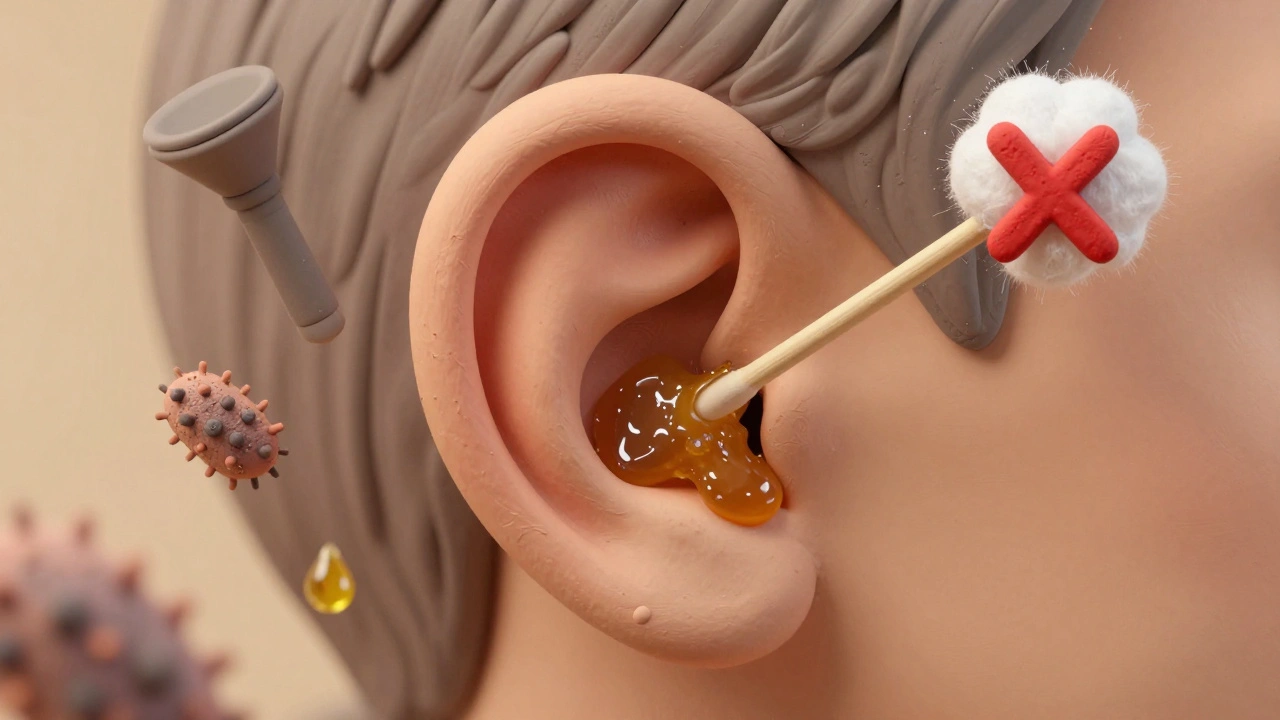
Most people think earwax is dirty. It’s not. It’s your ear’s natural defense system-trapping dust, bacteria, and debris before it reaches your eardrum. But when it builds up and hardens, it becomes a problem. That’s called earwax impaction. It’s not rare. About 6 in every 100 adults have it. For people over 65, that number jumps to 1 in 8. And if you wear hearing aids? Your risk is nearly 4 in 10.
What Does Earwax Impaction Feel Like?
It doesn’t always hurt. But when it does, you’ll know. You might notice your hearing feels muffled, like you’re underwater. Or you hear a ringing-tinnitus-that wasn’t there before. Some people get a dull ache inside the ear. Others feel pressure, like something’s pushing from the inside. It’s not just the ear, either. You might get a cough. Yes, a cough. That’s because the nerve running through your ear connects to your throat. When wax presses on it, your body reacts like it’s irritated.Itching? That’s common too. And if you’ve got drainage or a strange smell? That’s a red flag. It could mean infection has set in. Most people don’t notice symptoms right away. They build up slowly-over a week or two. By the time you realize something’s wrong, the wax has already packed tight against your eardrum.
Why Does This Happen?
Your ears are designed to clean themselves. Jaw movement-talking, chewing-helps push old wax out naturally. But we interfere. We stick cotton swabs in. We think we’re helping. We’re not.Studies show that 60 to 70% of earwax blockages are caused by cotton swabs. You’re not cleaning out wax-you’re shoving it deeper. It’s like trying to clean a drain by pushing the clog further down. Hearing aids make it worse. They block the natural exit path for wax. Every time you put one in, you’re packing wax further in. Same with earplugs, headphones, or even excessive ear hair. Older adults are more at risk because wax gets drier and stickier with age. And if your ear canal is narrow or oddly shaped? You’re more likely to get impacted wax, no matter what you do.
What NOT to Do
Don’t use ear candles. They don’t work. They’re not even safe. The FDA has been warning about them since 2010. They can burn your ear, melt wax into your canal, or even puncture your eardrum. Between 2018 and 2022, over 12,500 ear injuries in the U.S. were linked to unsafe home removal methods. About 3,000 of those were perforated eardrums.Don’t use suction devices sold online. Most are cheap, poorly designed, and can suck too hard. You might think you’re removing wax. You’re more likely to bruise the canal or tear the eardrum. And don’t try to dig it out with a bobby pin, paperclip, or anything else smaller than your elbow. That’s not advice-it’s a warning from people who’ve seen the damage.
What Actually Works
If you’ve got symptoms, the safest path is professional help. But there are steps you can take at home first.Start with oil. Olive oil or almond oil (if you’re not allergic) is gentle and effective. Lie on your side. Put 2 to 3 drops into the ear. Stay like that for 5 to 10 minutes. Do this 3 or 4 times a day for 3 to 5 days. The oil softens the wax. It won’t dissolve it, but it loosens it enough that your body can push it out naturally.
After a few days, gently wipe the outer ear with a damp cloth. Don’t stick anything inside. Just clean what’s visible. If your hearing improves? Great. You’re done. If not? It’s time to see a professional.
Professional Removal: The Three Best Methods
There are three proven ways doctors remove impacted wax. Each has its place.1. Ear irrigation-This is the most common. Warm water or saline is gently flushed into the ear canal using a controlled device. It’s 85% effective. But it’s not for everyone. If you’ve ever had a perforated eardrum, ear surgery, or an active infection? Skip this. The water can get trapped and cause problems.
2. Manual removal-An ENT specialist uses tiny tools-curettes or forceps-to gently scoop or pull out the wax. This is 92% effective in one visit. It’s precise. No water involved. Great for people with narrow canals or a history of ear problems. It takes about 15 minutes per ear.
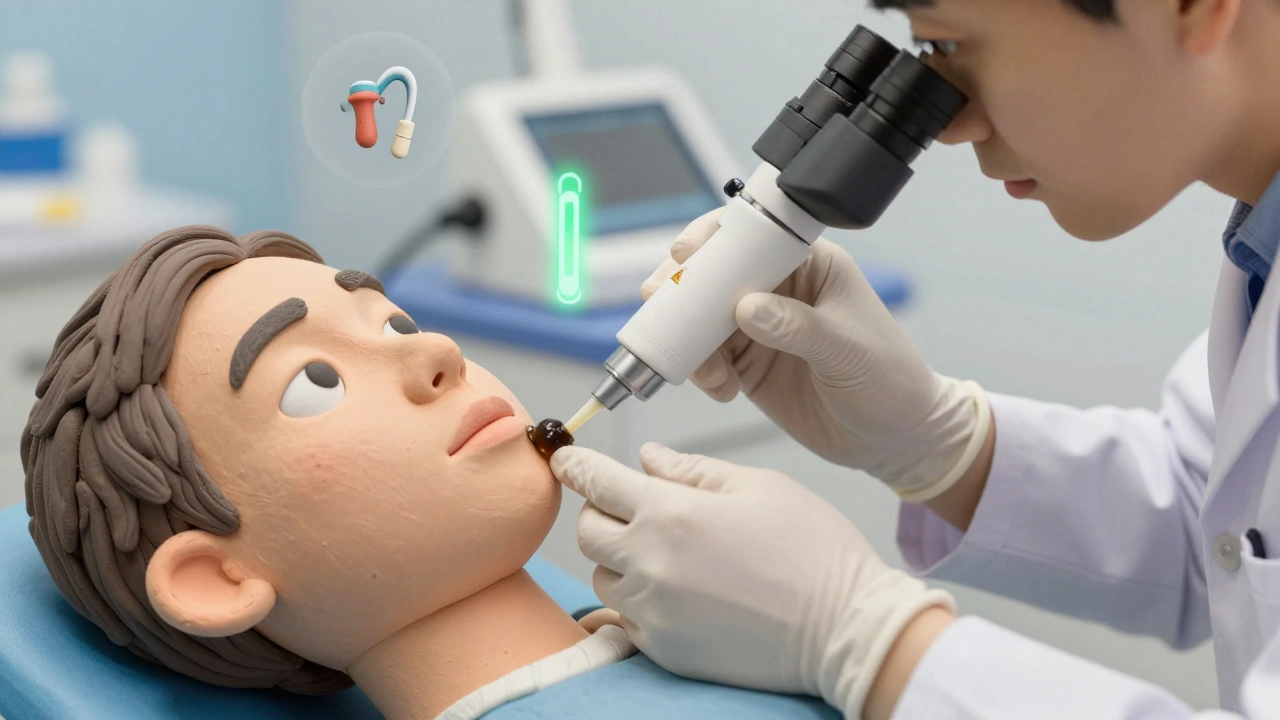
3. Microsuction-This is the gold standard. A small vacuum device removes wax under direct vision using a microscope. It’s dry, quiet, and quick. Success rate? 96%. Complications? Rare. Most patients say their hearing improves instantly. Satisfaction rates on review sites hit 92%. It’s the method most specialists prefer for complex cases.
One thing all three methods have in common: they’re done in a clinic. No home tools. No guessing. No risk of pushing wax deeper.
When to See a Doctor
You don’t need to rush in if you have no symptoms. About 30 to 40% of people have visible wax during checkups-but no problems. That’s not impaction. That’s normal.But if you’ve got any of these: hearing loss, pain, dizziness, ringing, or drainage-see someone. Don’t wait. Delaying can lead to infection or permanent hearing damage. And if you’ve had ear surgery, a perforated eardrum, or a condition like diabetes? Don’t try anything at home. Go straight to a professional.
What About New Tech?
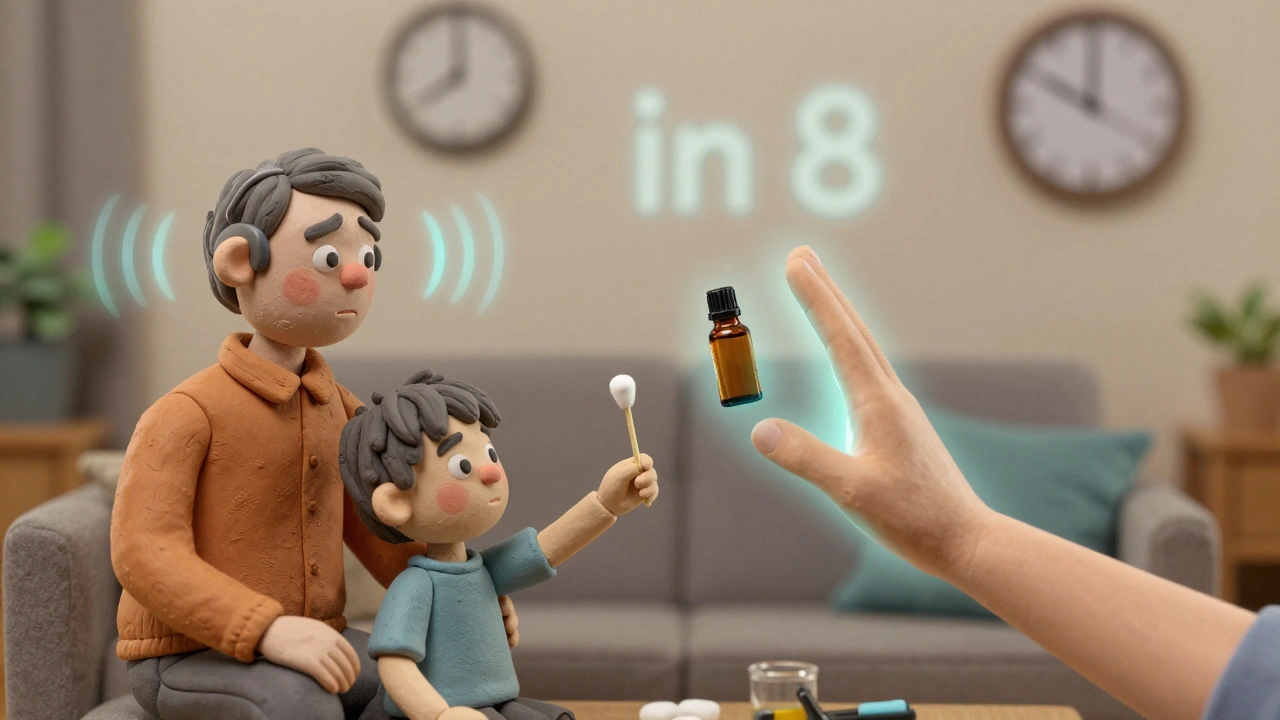
There’s a new device called the Eareto OtoSonic. It’s an ultrasonic softener cleared by the FDA in 2023. It’s prescription-only. In trials, it worked in 78% of cases. It’s not a magic fix, but it’s a step toward safer home options. Still, it doesn’t replace professional care for severe blockages.Telehealth is also changing things. A 2023 study showed doctors can accurately diagnose earwax impaction over video calls 89% of the time. That means you might not need to go in for a simple check-up. You can get advice, then decide if you need an in-person visit.
What’s Really Going On
The real problem isn’t earwax. It’s misinformation. Social media is full of videos showing people pulling out huge chunks of wax with scoops and hooks. Those videos have over 1.2 billion views. They make it look easy. They’re dangerous.Doctors agree: 90% of earwax impaction cases happen because people tried to clean their ears. Your ears don’t need cleaning. They clean themselves. Wax is not dirt. It’s protection.
And if you’re wondering about cost? In the U.S., over 12 million visits each year are for earwax. That’s $116 million in direct costs. In the UK, NHS clinics handle thousands of cases annually. Most are resolved in one visit. No prescriptions. No surgery. Just expert care.
Final Advice
Let your ears do their job. Don’t stick things in them. If you wear hearing aids, clean them regularly and check your ears every few months. If you feel fullness, muffled hearing, or ringing-don’t guess. Don’t YouTube it. See a doctor or audiologist. They’ll check with an otoscope in seconds. If there’s wax, they’ll remove it safely. In most cases, your hearing comes back right away.Earwax isn’t the enemy. Ignorance is. The best thing you can do for your ears is nothing at all-unless something’s wrong. Then, let a professional handle it.
Can earwax impaction cause permanent hearing loss?
No, not if treated. Impacted earwax causes temporary hearing loss by blocking sound from reaching the eardrum. Once the wax is removed, hearing typically returns to normal. But if left untreated for months, the pressure can lead to infection or damage to the eardrum, which may cause lasting issues. That’s why prompt care matters.
Is it safe to use hydrogen peroxide for earwax?
It can help soften wax, but it’s not the best choice. Hydrogen peroxide solutions are about 52% effective, but 15% of users report burning, itching, or irritation. It can also dry out the skin in your ear canal, making it more prone to infection. Olive oil or commercial cerumenolytics like carbamide peroxide are gentler and more reliable.
How often should I get my ears checked for wax buildup?
If you don’t have symptoms or risk factors (like hearing aids or diabetes), you don’t need regular checks. Your ears clean themselves. But if you wear hearing aids, use earplugs daily, or are over 65, get your ears checked once a year. If you notice symptoms-muffled hearing, fullness, ringing-don’t wait. See someone right away.
Can children get earwax impaction?
Yes, especially if they use cotton swabs or have narrow ear canals. Kids are more likely to develop impaction because their canals are smaller and wax is often stickier. Never insert anything into a child’s ear. If they’re showing signs of hearing trouble or ear pain, see a pediatrician or ENT. Professional removal is safe and quick for children.
Why does my ear feel clogged after swimming?
Water doesn’t cause wax impaction, but it can soften existing wax and make it swell. That’s why you feel blocked after swimming. The moisture traps the wax against the eardrum. Dry your ears gently after swimming-tilt your head and tug the earlobe to help water drain. If the feeling lasts more than a day or two, see a professional. It’s not water-it’s impacted wax reacting to moisture.
Are over-the-counter earwax removal kits safe?
They’re safer than cotton swabs or suction devices, but still carry risks. Kits with carbamide peroxide (like Debrox or Murine) are FDA-approved and work well for mild cases. But if you have ear pain, drainage, or a history of ear surgery, don’t use them. Always follow the instructions exactly. If symptoms don’t improve in 4 days, stop and see a doctor.
Can earwax impaction cause dizziness?
Yes. The inner ear controls balance. When wax presses on the eardrum or the canal wall, it can interfere with signals sent to your brain. This can cause mild dizziness or unsteadiness, especially when moving your head. Once the wax is removed, balance usually returns within hours. If dizziness lasts longer, it could signal another issue-like an inner ear infection-and needs further evaluation.
If you’ve ever felt like your ears are full and you can’t hear clearly, you’re not alone. And you don’t have to live with it. The fix is simple-when done right. Skip the swabs. Skip the videos. Let your ears work the way they were meant to. And if they need help? A professional can fix it in minutes.
Gene Linetsky
December 2, 2025 AT 19:10So let me get this straight-our ears are self-cleaning but we’re all just too dumb to stop sticking Q-tips in there? Of course. That’s why we invented capitalism-to monetize our own ignorance. Also, ear candles? People still buy those? I swear if I saw one in the wild I’d burn it myself just to save humanity from itself.
Archie singh
December 3, 2025 AT 16:5196% success rate with microsuction? That’s statistically significant. And yet 78% of Americans still believe YouTube tutorials are medical authority. This isn’t a public health issue-it’s a cognitive failure on a societal scale. We’ve outsourced critical thinking to algorithms and now our ear canals are paying the price.
Ignacio Pacheco
December 4, 2025 AT 20:28So… you’re telling me the reason I hear better after swimming is because water swells the wax? Not because I’m suddenly a dolphin? Because that’s what my inner child wants to believe.
Jim Schultz
December 4, 2025 AT 22:51Let’s be real: the ENT industry is a $116M scam. Who benefits? The companies selling carbamide peroxide. The manufacturers of hearing aids. The doctors who charge $300 for a 10-minute procedure. Meanwhile, you’re told to ‘let your ears clean themselves’-but only after you’ve paid for three visits and a $40 bottle of oil you could’ve bought at Trader Joe’s.
Kidar Saleh
December 5, 2025 AT 04:30In the UK, we call this ‘the quiet epidemic.’ People suffer for months because they’re too embarrassed to admit they’ve been digging in their ears since they were eight. The NHS does wonders-but we need more public education. Not more products. Not more fear. Just clarity. And maybe a poster in every pharmacy that says: ‘Your ear is not a garden. Stop weeding it.’
Chloe Madison
December 6, 2025 AT 23:20I’m a nurse. I’ve seen people cry because they thought they were going deaf-and it was just wax. One woman came in after 18 months of ignoring muffled hearing. She said, ‘I thought I was getting old.’ I removed the wax. She cried again-but this time because she heard her grandson say ‘I love you’ for the first time in a year. You don’t need a PhD to understand this: sometimes the simplest fix is the most life-changing.
Katherine Gianelli
December 7, 2025 AT 05:06Earwax isn't dirt it's like your body's little bouncer keeping the club of your inner ear safe from the wild crowd of dust and germs and who knows what else floating around. And yet we come in with our cotton swab bouncers and throw the real bouncer out and let the chaos in. We're the problem. Not the wax. Not the ear. Us.
parth pandya
December 7, 2025 AT 09:39i read this and i was like wow this is so true i used to use q tips every day now i just use a towel after shower and my ears feel so much better no more ringing
Albert Essel
December 8, 2025 AT 12:52There’s something poetic about how something so natural-earwax-is so deeply misunderstood. We fear what we don’t understand. We pathologize biology. We turn protection into pathology. Maybe the real impaction isn’t in the ear canal-it’s in our collective imagination.
Gavin Boyne
December 8, 2025 AT 19:17Let me guess-the next viral trend is ‘earwax yoga’ where you hum into a copper tube while chanting mantras to ‘release blockages.’ 1.2 billion views guaranteed. Someone’s already making a TikTok filter that turns your ear canal into a lava lamp. We’re not just ignorant. We’re performative about it.
Rashi Taliyan
December 10, 2025 AT 04:41I’m from India and we have this old practice of using warm mustard oil drops-my grandmother swore by it. I never thought about it until now, but maybe it’s not superstition. Maybe it’s just ancient wisdom that predates corporate ear care. I’ll never use a Q-tip again.
Kara Bysterbusch
December 11, 2025 AT 20:47The fact that we’ve normalized self-inflicted auditory damage as ‘personal hygiene’ is a cultural tragedy. We scrub our skin, brush our teeth, floss, exfoliate, moisturize, detox, juice, and yet we violently shove cotton into the one organ that doesn’t ask for help. It’s not just ignorance-it’s a ritual of control over something that refuses to be controlled. And we keep losing.
Rashmin Patel
December 13, 2025 AT 14:13OMG I JUST REALIZED WHY MY EARPLUGS ALWAYS GET SO STUCK IN MY EARS!! I THOUGHT IT WAS BECAUSE I HAD WAX BUT NOW I GET IT THEY’RE PUSHING IT IN LIKE A TINY WAX SQUIRT GUN 😭 I’M GONNA STOP USING THEM WHEN I SLEEP AND JUST GET NOISE CANCELLING HEADPHONES INSTEAD 💕 I’M SO GLAD I READ THIS THANK YOU SO MUCH
sagar bhute
December 15, 2025 AT 07:0792% success rate? That’s just marketing. You know how many people get infections after irrigation? You think they report it? No. They just disappear into the medical black hole. And microsuction? That’s a luxury procedure for rich people who can afford to pay $500 to have someone with a vacuum stare into their ear for 15 minutes. Meanwhile, the rest of us are still using Q-tips because we can’t afford to be ‘properly’ cleaned.
Cindy Lopez
December 15, 2025 AT 21:12Wow. This was long. I didn’t read it all. But I’m sure it’s right.